Clinical Knowledge › Internal medicine › Nephrology › Acute kidney injury
Abdominal compartment syndrome
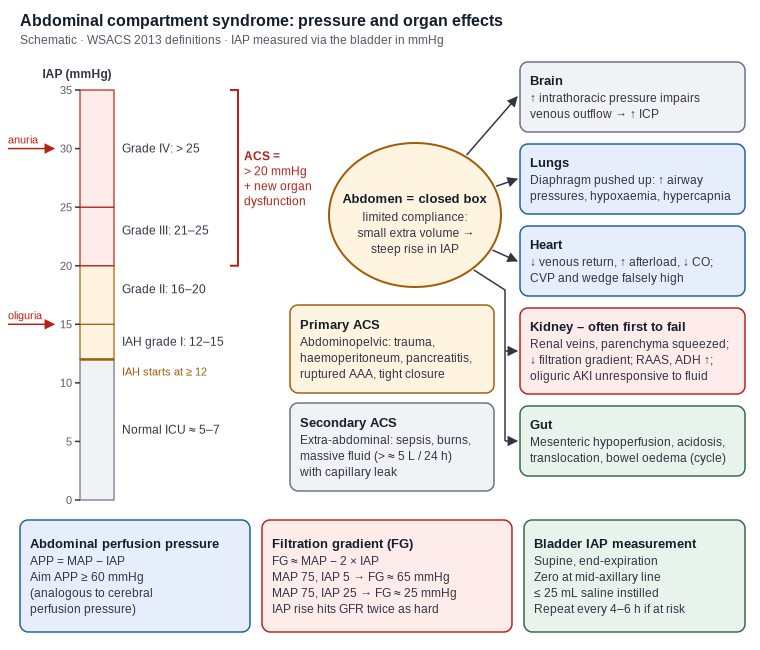
Abdominal compartment syndrome (ACS) is new organ dysfunction caused by a sustained rise in intra-abdominal pressure (IAP) above 20 mmHg. Intra-abdominal hypertension (IAH) means a sustained IAP of 12 mmHg or more and is graded I to IV. It develops in critically ill patients after trauma, emergency laparotomy, ruptured aortic aneurysm, severe acute pancreatitis, burns, sepsis and, above all, large-volume fluid resuscitation with capillary leak. The kidney is often the first organ to fail: raised pressure compresses the renal veins and parenchyma, lowers the filtration gradient and causes oliguric acute kidney injury that does not respond to more fluid; cardiac output, ventilation and gut perfusion also suffer. Diagnosis relies on measuring IAP through the bladder, because examination is unreliable. The 2013 World Society of the Abdominal Compartment Syndrome (WSACS) guideline advises protocolised monitoring, medical measures to empty the gut, drain fluid, relax the abdominal wall and avoid a positive fluid balance, and decompressive laparotomy for overt ACS.
Patient case, mechanism, investigations, management, flashcards and exam-style questions.Open the lesson →
Key facts
- IAH = sustained IAP of 12 mmHg or more; ACS = sustained IAP above 20 mmHg with new organ dysfunction (WSACS 2013)
- IAH grades: I 12–15, II 16–20, III 21–25, IV above 25 mmHg; normal IAP in critically ill adults is about 5–7 mmHg
- Abdominal perfusion pressure (APP) = MAP − IAP; aim for APP of 60 mmHg or more
- Filtration gradient ≈ MAP − 2 × IAP, so a rise in IAP lowers GFR twice as much as an equal fall in MAP
- Oliguric AKI is often the first sign; oliguria at about 15 mmHg, anuria above about 30 mmHg
- Measure IAP through the bladder: supine, end-expiration, zeroed at the mid-axillary line, no more than 25 mL saline instilled
- Primary ACS arises from abdominopelvic disease or injury; secondary ACS from extra-abdominal causes such as massive resuscitation, burns and sepsis
- Overt ACS needs decompressive laparotomy; medical measures (decompression, drainage, sedation, fluid removal) treat IAH
Differential diagnosis
| Condition | Clues | Key test |
|---|---|---|
| Prerenal AKI from hypovolaemia | Low CVP, collapsing IVC, responds to a fluid challenge; IAP normal | Bladder pressure, dynamic fluid responsiveness tests |
| Acute tubular necrosis from sepsis or shock | AKI persists despite normal IAP; muddy brown casts | Urine microscopy, IAP measurement |
| Cardiorenal syndrome | Raised venous pressure from heart failure; IAP normal or mildly raised | Echocardiography, NT-proBNP |
| Obstructive uropathy | Blocked catheter or bilateral hydronephrosis; anuria | Flush catheter, bladder and kidney ultrasound |
| Tension pneumothorax or auto-PEEP | High airway pressures and hypotension from the chest | Chest examination, chest X-ray or lung ultrasound |
| Abdominal sepsis or bowel ischaemia without IAH | Peritonism and raised lactate with normal IAP | CT abdomen, lactate |
Exam pearls
Guideline
World Society of the Abdominal Compartment Syndrome (WSACS) 2013 Consensus Definitions and Clinical Practice Guidelines
References
- Kirkpatrick AW, Roberts DJ, De Waele J, et al.. Intra-abdominal hypertension and the abdominal compartment syndrome: updated consensus definitions and clinical practice guidelines from the World Society of the Abdominal Compartment Syndrome. Intensive Care Med 2013.
- Malbrain ML, Cheatham ML, Kirkpatrick A, et al.. Results from the International Conference of Experts on Intra-abdominal Hypertension and Abdominal Compartment Syndrome. I. Definitions. Intensive Care Med 2006.
- De Laet IE, Malbrain MLNG, De Waele JJ. A clinician's guide to management of intra-abdominal hypertension and abdominal compartment syndrome in critically ill patients. Crit Care 2020.
- Mohmand H, Goldfarb S. Renal dysfunction associated with intra-abdominal hypertension and the abdominal compartment syndrome. J Am Soc Nephrol 2011.
- Reintam Blaser A, Regli A, De Keulenaer B, et al.. Incidence, risk factors, and outcomes of intra-abdominal hypertension in critically ill patients: a prospective multicenter study (IROI Study). Crit Care Med 2019.
- Kidney Disease: Improving Global Outcomes (KDIGO) Acute Kidney Injury Work Group. KDIGO Clinical Practice Guideline for Acute Kidney Injury. Kidney Int Suppl 2012.
Related topics
By Dr Khalid Seidi (B.Sc., M.D.) · MedEd World Clinical Knowledge library. Original teaching content checked against current guidelines (November 2026); confirm the latest local guidance before clinical use. Not a substitute for clinical judgement.