Clinical Knowledge › Internal medicine › Pulmonology › Respiratory failure and critical care
Acute respiratory failure (type 1 and type 2)
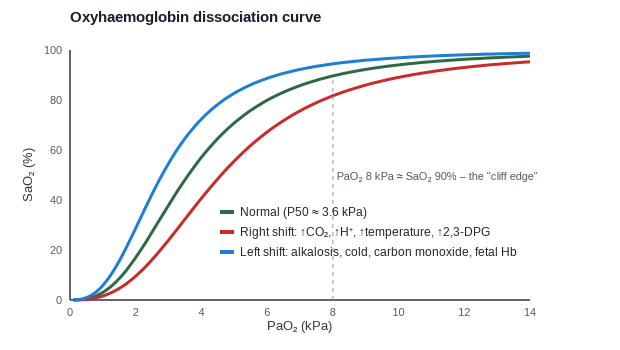
Acute respiratory failure is failure of the lungs or the respiratory pump to maintain adequate gas exchange, defined on arterial blood gas as a PaO2 below 8 kPa (60 mmHg) breathing air. Type 1 (hypoxaemic) failure has a normal or low PaCO2 and results from ventilation–perfusion mismatch, shunt or diffusion limitation, as in pneumonia, pulmonary oedema, pulmonary embolism and ARDS. Type 2 (hypercapnic) failure has a PaCO2 above 6.0 kPa (45 mmHg) and reflects inadequate alveolar ventilation from COPD, obesity hypoventilation, neuromuscular disease, chest wall deformity or sedative drugs; the pH and bicarbonate show whether it is acute, chronic or acute-on-chronic. Assessment combines an ABCDE approach, the alveolar–arterial gradient and a search for the cause. Oxygen is prescribed to a target saturation, usually 94–98%, or 88–92% for patients at risk of hypercapnia. Support escalates through high-flow nasal oxygen, CPAP or non-invasive ventilation to intubation, while the underlying cause is treated.
Patient case, mechanism, investigations, management, flashcards and exam-style questions.Open the lesson →
Key facts
- Respiratory failure: PaO2 below 8 kPa (60 mmHg) on air; type 2 adds PaCO2 above 6.0 kPa (45 mmHg)
- Five causes of hypoxaemia: V/Q mismatch, shunt, diffusion limitation, hypoventilation and low inspired oxygen
- Normal A–a gradient with high PaCO2 means pure hypoventilation (drugs, neuromuscular disease); a raised gradient means lung disease
- Shunt responds poorly to increasing FiO2; V/Q mismatch improves readily with supplemental oxygen
- Target SpO2 94–98% for most acutely ill patients and 88–92% for those at risk of hypercapnic failure (COPD, obesity hypoventilation, neuromuscular disease)
- Raised bicarbonate with near-normal pH suggests chronic type 2 failure; low pH with high PaCO2 means acute or acute-on-chronic failure
- NIV is indicated in acute hypercapnic failure with pH below 7.35 and PaCO2 above 6.5 kPa despite optimal medical therapy
- High-flow nasal oxygen is preferred over conventional oxygen for acute hypoxaemic respiratory failure and delays need for intubation in many patients
Differential diagnosis
| Condition | Clues | Key test |
|---|---|---|
| Pneumonia | Fever, focal crackles, consolidation; type 1 failure | Chest X-ray, CRP, cultures |
| Acute exacerbation of COPD | Known COPD, wheeze, purulent sputum; type 2 failure | ABG, chest X-ray to exclude pneumothorax or consolidation |
| Acute cardiogenic pulmonary oedema | Orthopnoea, raised JVP, bilateral crackles | Chest X-ray, BNP, echocardiography |
| Pulmonary embolism | Sudden dyspnoea, pleuritic pain, clear chest on X-ray | CT pulmonary angiography |
| Opioid or sedative toxicity | Pinpoint pupils, low respiratory rate, normal A–a gradient | Drug history; trial of naloxone |
| Neuromuscular weakness (Guillain–Barré, myasthenia) | Weak cough, paradoxical abdominal movement, normal lungs | Bedside vital capacity, neurological examination |
| ARDS | Bilateral opacities within a week of a known insult, severe shunt | ABG with PaO2/FiO2, chest imaging, echocardiography |
| Methaemoglobinaemia or carbon monoxide poisoning | Normal PaO2 but low oxygen content or misleading SpO2 | Co-oximetry |
Exam pearls
Guideline
BTS guideline for oxygen use in adults (2017), BTS/ICS acute hypercapnic respiratory failure guideline (2016), ERS/ATS NIV guideline (2017), ERS high-flow nasal cannula guideline (2022) and ESICM ARDS guideline (2023)
References
- O'Driscoll BR, Howard LS, Earis J, Mak V; BTS Emergency Oxygen Guideline Group.. BTS guideline for oxygen use in adults in healthcare and emergency settings. Thorax 2017.
- Davidson AC, Banham S, Elliott M, et al.. BTS/ICS guideline for the ventilatory management of acute hypercapnic respiratory failure in adults. Thorax 2016.
- Rochwerg B, Brochard L, Elliott MW, et al.. Official ERS/ATS clinical practice guidelines: noninvasive ventilation for acute respiratory failure. Eur Respir J 2017.
- Oczkowski S, Ergan B, Bos L, et al.. ERS clinical practice guidelines: high-flow nasal cannula in acute respiratory failure. Eur Respir J 2022.
- Siemieniuk RAC, Chu DK, Kim LH, et al.. Oxygen therapy for acutely ill medical patients: a clinical practice guideline. BMJ 2018.
- Chu DK, Kim LH, Young PJ, et al.. Mortality and morbidity in acutely ill adults treated with liberal versus conservative oxygen therapy (IOTA): a systematic review and meta-analysis. Lancet 2018.
Related topics
By Dr Khalid Seidi (B.Sc., M.D.) · MedEd World Clinical Knowledge library. Original teaching content checked against current guidelines (November 2026); confirm the latest local guidance before clinical use. Not a substitute for clinical judgement.