Clinical Knowledge › Internal medicine › Nephrology › Tubulointerstitial and inherited kidney diseases
Analgesic nephropathy
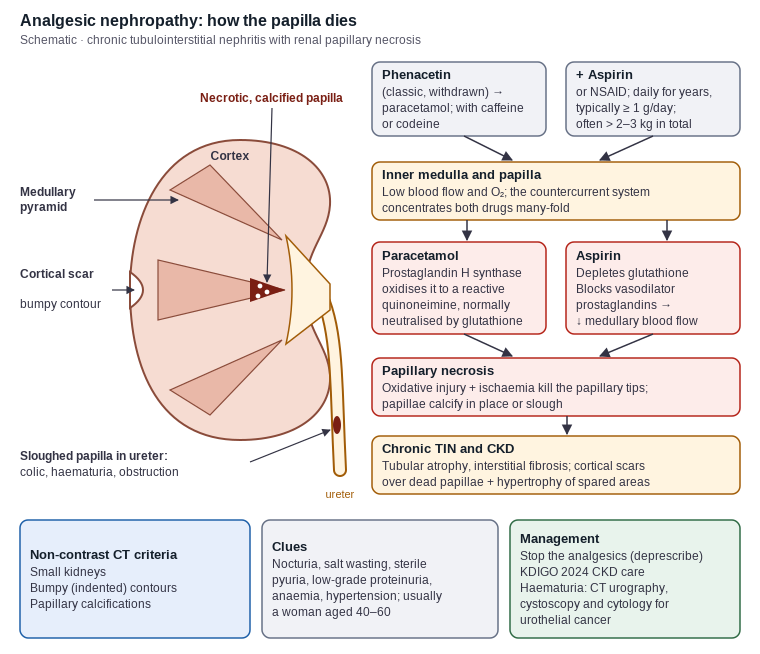
Analgesic nephropathy is a chronic tubulointerstitial nephritis with renal papillary necrosis caused by years of heavy daily use of combination analgesics, classically phenacetin with aspirin, often with caffeine or codeine that encouraged dependence. Phenacetin's metabolite paracetamol is concentrated in the renal medulla, where its reactive metabolite overwhelms glutathione defences, while aspirin depletes glutathione and lowers medullary blood flow by blocking prostaglandins; the papillae become ischaemic and necrotic, followed by cortical scarring. It fell sharply after phenacetin was withdrawn but persists where over-the-counter combinations are freely sold. Typical patients are middle-aged women with chronic headache or back pain who present with slowly progressive CKD, sterile pyuria, nocturia, anaemia, hypertension or flank pain and haematuria from sloughed papillae. Non-contrast CT showing small kidneys with bumpy contours and papillary calcifications supports the diagnosis. Management is stopping analgesic misuse, CKD care under KDIGO 2024 and lifelong vigilance for urothelial cancer.
Patient case, mechanism, investigations, management, flashcards and exam-style questions.Open the lesson →
Key facts
- Analgesic nephropathy = chronic TIN with papillary necrosis from long-term daily use of combination analgesics (classically phenacetin plus aspirin with caffeine or codeine)
- Risk relates to cumulative dose: typically at least 1 g a day for years, often more than 2–3 kg in total
- Mechanism: medullary concentration of paracetamol metabolites, glutathione depletion by aspirin and prostaglandin-dependent medullary ischaemia
- Typical patient: woman aged 40–60 with chronic headache or back pain, dyspepsia or peptic ulcer, anaemia and dependency on analgesics
- Features: slowly rising creatinine, sterile pyuria, nocturia, salt wasting, low-grade proteinuria, hypertension, colic and haematuria from sloughed papillae
- Non-contrast CT criteria: small kidneys, bumpy (indented) contours and papillary calcifications
- Complications: urothelial carcinoma of the renal pelvis, ureter and bladder, obstruction by necrotic papillae, UTI, premature atherosclerosis
- Management: stop the analgesics (function often stabilises), KDIGO 2024 CKD care, investigate any haematuria for urothelial cancer
Differential diagnosis
| Condition | Clues | Key test |
|---|---|---|
| Diabetic papillary necrosis | Long-standing diabetes, often with UTI | HbA1c, history; CT papillary changes |
| Sickle cell nephropathy | Sickle cell disease or trait, haematuria, concentrating defect | Haemoglobin electrophoresis |
| Obstructive uropathy and chronic pyelonephritis | Recurrent UTIs, scarring over calyces, hydronephrosis | Ultrasound, CT urogram |
| Renal tuberculosis | Sterile pyuria, calyceal irregularity and calcification, constitutional symptoms | Early morning urine for mycobacteria |
| Aristolochic acid nephropathy | Herbal remedy use, rapid fibrosis, urothelial cancer | Herbal history; biopsy |
| Lithium or other chronic TIN | Drug history, nephrogenic DI, microcysts | Drug levels, MRI |
| Urothelial carcinoma presenting with haematuria | Painless visible haematuria in a smoker | CT urography, cystoscopy, cytology |
Exam pearls
Guideline
No disease-specific guideline: KDIGO 2024 CKD guideline (analgesic and NSAID safety), National Kidney Foundation recommendations on analgesics and the kidney (1996), and EAU Guidelines on Upper Urinary Tract Urothelial Carcinoma (2025)
References
- Kidney Disease: Improving Global Outcomes (KDIGO) CKD Work Group. KDIGO 2024 Clinical Practice Guideline for the Evaluation and Management of Chronic Kidney Disease. Kidney Int 2024.
- Henrich WL, Agodoa LE, Barrett B, et al.. Analgesics and the kidney: summary and recommendations to the Scientific Advisory Board of the National Kidney Foundation from an Ad Hoc Committee of the National Kidney Foundation. Am J Kidney Dis 1996.
- De Broe ME, Elseviers MM.. Analgesic nephropathy. N Engl J Med 1998.
- Elseviers MM, De Schepper A, Corthouts R, et al.. High diagnostic performance of CT scan for analgesic nephropathy in patients with incipient to severe renal failure. Kidney Int 1995.
- De Broe ME, Elseviers MM.. Over-the-counter analgesic use. J Am Soc Nephrol 2009.
- European Association of Urology (EAU). EAU Guidelines on Upper Urinary Tract Urothelial Carcinoma. EAU Guidelines Office, Arnhem 2025.
Related topics
By Dr Khalid Seidi (B.Sc., M.D.) · MedEd World Clinical Knowledge library. Original teaching content checked against current guidelines (November 2026); confirm the latest local guidance before clinical use. Not a substitute for clinical judgement.