Clinical Knowledge › Dermatology › Viral, fungal and parasitic skin infections
Cutaneous larva migrans
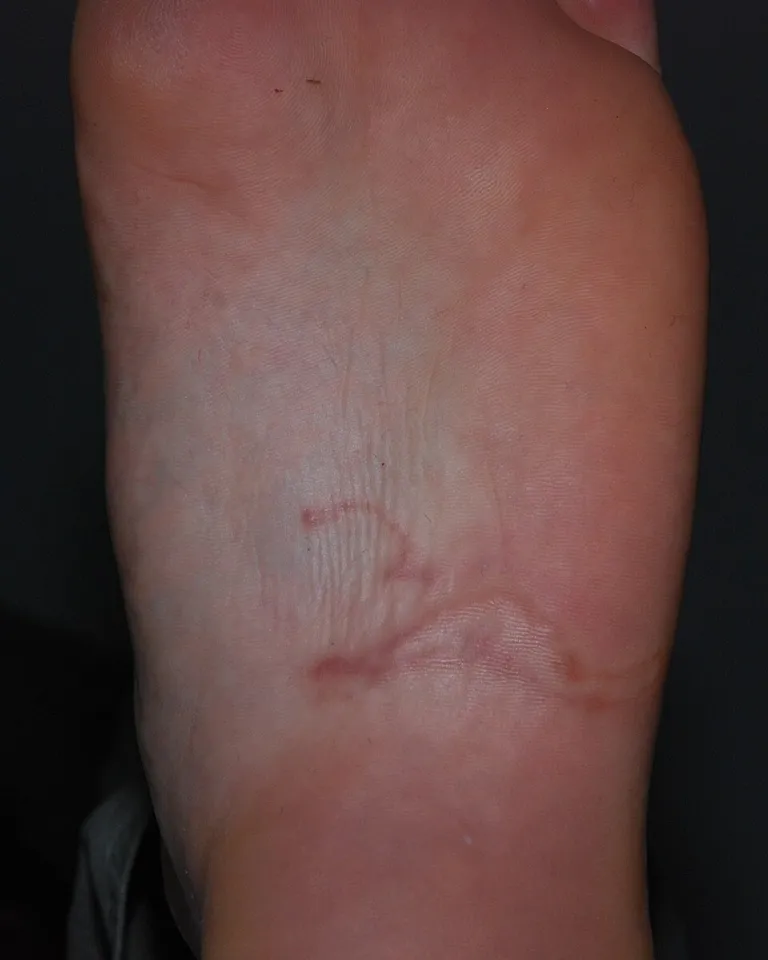
Hookworm-related cutaneous larva migrans ('creeping eruption') is the commonest skin disease in travellers returning from tropical beaches. It is caused by third-stage larvae of animal hookworms, mainly Ancylostoma braziliense and A. caninum from dogs and cats, which penetrate human skin after contact with sand or soil contaminated by animal faeces. Humans are dead-end hosts: the larvae lack the enzymes to cross the epidermal basement membrane, so they wander in the epidermis, advancing millimetres to about 2 cm a day. The result is an intensely itchy, raised, erythematous, serpiginous track, usually on the feet, buttocks or hands, appearing days to weeks after exposure. Diagnosis is clinical, based on the track and exposure history; biopsy is unhelpful because the larva lies ahead of the visible track. Although self-limiting over weeks to months, the itch, sleep loss and risk of impetigo justify treatment with a single dose of oral ivermectin (200 micrograms/kg) or albendazole 400 mg daily for 3 days. Footwear prevents it.
Patient case, mechanism, investigations, management, flashcards and exam-style questions.Open the lesson →
Key facts
- Cause: larvae of animal hookworms (Ancylostoma braziliense, A. caninum, Uncinaria stenocephala) from dog and cat faeces
- Exposure: walking barefoot or lying on beaches and moist sandy soil in tropical and subtropical regions
- Humans are dead-end hosts; larvae stay in the epidermis and die within weeks to months
- Lesion: intensely pruritic, raised, erythematous serpiginous track 2-3 mm wide, advancing up to about 1-2 cm per day
- Sites: feet (most common), buttocks, thighs, hands; often several tracks
- Diagnosis is clinical; eosinophilia and raised IgE are uncommon; biopsy rarely finds the larva
- Treatment: ivermectin 200 micrograms/kg single dose or albendazole 400 mg daily for 3 days (teaching doses)
- Prevention: shoes on beaches, lie on a mat or sunbed, avoid areas where dogs and cats defecate
Differential diagnosis
| Condition | Clues | Key test |
|---|---|---|
| Larva currens (Strongyloides stercoralis) | Very fast track (5-10 cm per hour), urticarial, perianal, buttocks and trunk; recurrent | Strongyloides serology, stool larvae; eosinophilia |
| Scabies | Short burrows in finger webs and wrists, nocturnal itch, family affected | Dermoscopy (delta-wing sign) or skin scraping for mites |
| Gnathostomiasis | Deep, migratory, painful swellings after raw fish; eosinophilia | Gnathostoma serology |
| Tinea corporis | Annular scaly plaque with active edge, not linear | KOH microscopy |
| Allergic or phytophotodermatitis | Linear streaks matching contact with plants and sun; no movement | History; patch testing for contact allergy |
| Jellyfish sting | Linear urticarial or whip-like marks immediately after sea swimming | History; no progression |
| Myiasis | Furuncle-like nodule with central pore and movement | Visualise larva; occlusion and extraction |
Exam pearls
Guideline
No dedicated international guideline: CDC Yellow Book (2024 edition), expert reviews by Caumes (2000) and Hochedez and Caumes (2007), and Heukelbach and Feldmeier (2008)
References
- Heukelbach J, Feldmeier H. Epidemiological and clinical characteristics of hookworm-related cutaneous larva migrans. Lancet Infect Dis 2008.
- Caumes E. Treatment of cutaneous larva migrans. Clin Infect Dis 2000.
- Centers for Disease Control and Prevention. CDC Yellow Book: Health Information for International Travel (cutaneous larva migrans section). Oxford University Press / CDC 2024.
- Hochedez P, Caumes E. Hookworm-related cutaneous larva migrans. J Travel Med 2007.
- Veraldi S, Persico MC, Francia C, Schianchi R. Chronic hookworm-related cutaneous larva migrans. Int J Infect Dis 2013.
- Papadakis MA, Rabow MW, McQuaid KR, eds.. CURRENT Medical Diagnosis & Treatment 2026 (65th ed). McGraw Hill 2026.
Related topics
By Dr Khalid Seidi (B.Sc., M.D.) · MedEd World Clinical Knowledge library. Original teaching content checked against current guidelines (November 2026); confirm the latest local guidance before clinical use. Not a substitute for clinical judgement.