Clinical Knowledge › Internal medicine › Endocrinology › Complications of diabetes
Diabetic foot
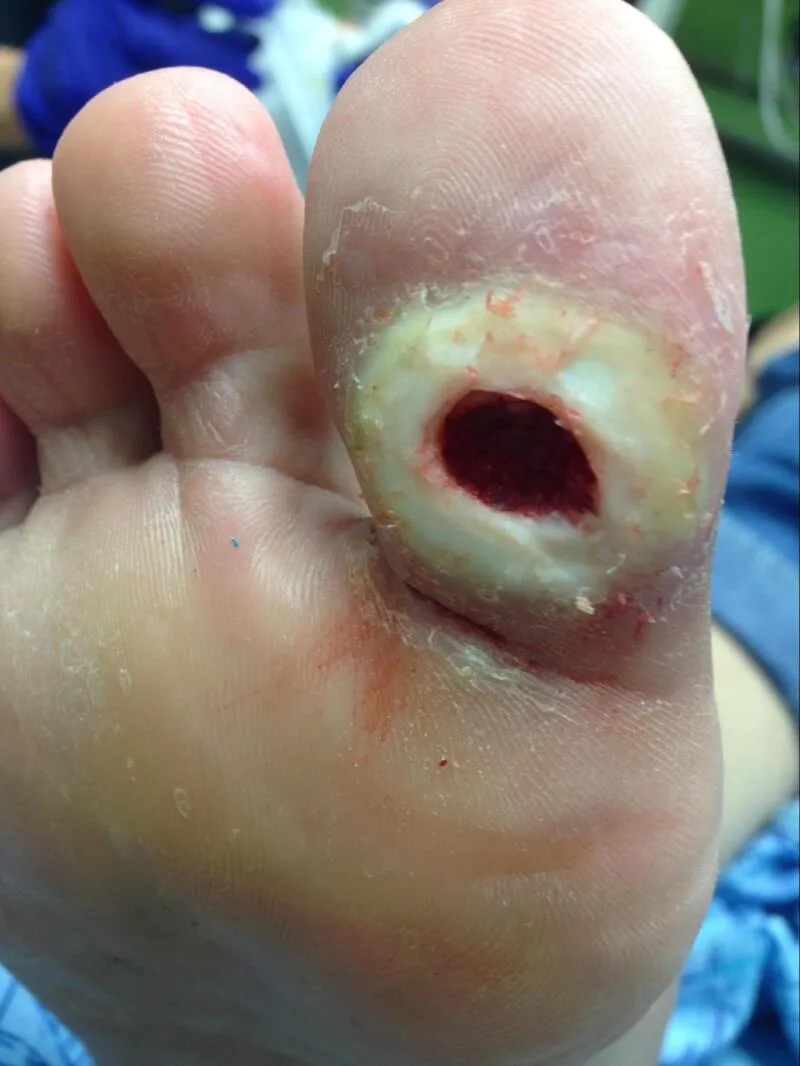
Diabetic foot disease covers ulceration, infection, Charcot neuro-osteoarthropathy and gangrene of the foot in people with diabetes, usually arising from peripheral neuropathy, peripheral arterial disease or both. About one in three people with diabetes will develop a foot ulcer during their lifetime, and diabetes-related foot disease causes most non-traumatic lower limb amputations. Loss of protective sensation, deformity and repetitive pressure lead to painless ulcers; ischaemia delays healing and infection can spread rapidly to bone. Prevention rests on annual foot screening, risk stratification, education and protective footwear. An active foot problem needs rapid referral to a multidisciplinary foot team. Management follows a checklist: offload pressure (non-removable knee-high device), assess perfusion and revascularise when needed, treat infection by severity with debridement and targeted antibiotics, look for osteomyelitis, and control glucose. A hot, swollen foot with intact skin in a neuropathic patient is acute Charcot foot until proven otherwise.
Patient case, mechanism, investigations, management, flashcards and exam-style questions.Open the lesson →
Key facts
- Neuropathy (loss of protective sensation), peripheral arterial disease and deformity are the three main causes; trauma triggers most ulcers
- Examine both feet at least yearly; IWGDF risk categories 0–3 set screening every 12 months down to every 1–3 months
- Non-removable knee-high offloading (total contact cast or non-removable walker) is first-line for neuropathic plantar forefoot and midfoot ulcers
- ABI may be falsely normal or high (above 1.3) from calcified arteries; use toe pressures, toe–brachial index and Doppler waveforms
- Urgent vascular imaging and revascularisation if toe pressure below 30 mmHg or TcPO2 below 25 mmHg, or an ulcer fails to heal in 4–6 weeks
- Diagnose infection clinically (IWGDF/IDSA grades); do not give antibiotics for clinically uninfected ulcers
- Positive probe-to-bone test plus X-ray suggests osteomyelitis; MRI is the most useful imaging; bone biopsy is the reference standard
- Acute Charcot foot: warm, red, swollen foot, often painless, temperature difference over 2 °C; immobilise in a total contact cast immediately
Differential diagnosis
| Condition | Clues | Key test |
|---|---|---|
| Venous leg ulcer | Gaiter area above the medial malleolus, varicose veins, lipodermatosclerosis | Venous duplex; ABI before compression |
| Pure arterial (ischaemic) ulcer | Painful ulcer on toes or heel, rest pain, absent pulses | ABI, toe pressures, angiography |
| Cellulitis | Spreading erythema without ulcer or bone changes | Clinical; elevate foot (Charcot redness settles, cellulitis persists) |
| Gout | Acute painful red first MTP joint | Joint aspiration for urate crystals |
| Deep vein thrombosis | Swollen calf and ankle | Compression ultrasound |
| Pressure ulcer of the heel | Immobile patient, heel contact with bed | Clinical; perfusion assessment |
| Squamous cell carcinoma or melanoma | Non-healing, atypical ulcer with rolled or pigmented edge | Biopsy |
Exam pearls
Guideline
IWGDF 2023 Guidelines on the prevention and management of diabetes-related foot disease (including IWGDF/IDSA 2023 infection guideline), ADA Standards of Care in Diabetes—2026 (Section 12) and NICE NG19 Diabetic foot problems
References
- Schaper NC, van Netten JJ, Apelqvist J, et al.. Practical guidelines on the prevention and management of diabetes-related foot disease (IWGDF 2023 update). Diabetes Metab Res Rev 2024.
- Senneville É, Albalawi Z, van Asten SA, et al.. IWGDF/IDSA guidelines on the diagnosis and treatment of diabetes-related foot infections (IWGDF/IDSA 2023). Clin Infect Dis 2023.
- American Diabetes Association Professional Practice Committee. Standards of Care in Diabetes—2026 (Section 12: Retinopathy, Neuropathy, and Foot Care). Diabetes Care 2026.
- National Institute for Health and Care Excellence. Diabetic foot problems: prevention and management (NG19). NICE 2015.
- Armstrong DG, Boulton AJM, Bus SA. Diabetic foot ulcers and their recurrence. N Engl J Med 2017.
- Pop-Busui R, Boulton AJM, Feldman EL, et al.. Diabetic neuropathy: a position statement by the American Diabetes Association. Diabetes Care 2017.
Related topics
By Dr Khalid Seidi (B.Sc., M.D.) · MedEd World Clinical Knowledge library. Original teaching content checked against current guidelines (November 2026); confirm the latest local guidance before clinical use. Not a substitute for clinical judgement.