Clinical Knowledge › Internal medicine › Endocrinology › Basics of endocrinology
Hypothalamic–pituitary axis
The hypothalamus integrates neural, metabolic and hormonal signals and controls the pituitary in two ways. Parvocellular neurones release CRH, TRH, GnRH, GHRH, somatostatin and dopamine into the hypophyseal portal veins, which carry them to the anterior pituitary (adenohypophysis, derived from Rathke pouch). Magnocellular neurones of the supraoptic and paraventricular nuclei send axons down the stalk to release ADH and oxytocin from the posterior pituitary (neurohypophysis). The gland sits in the sella turcica beneath the optic chiasm, between the cavernous sinuses and above the sphenoid sinus, so a sellar mass causes bitemporal field loss, ophthalmoplegia, headache and hypopituitarism. Lesions of the stalk interrupt dopamine (raising prolactin) and ADH (causing diabetes insipidus). Compression typically affects GH and gonadotrophins first and ACTH last. Assessment combines a basal pituitary profile, visual fields and pituitary MRI, with glucocorticoid replaced first when ACTH is deficient.
Patient case, mechanism, investigations, management, flashcards and exam-style questions.Open the lesson →
Key facts
- Anterior pituitary: Rathke pouch (oral ectoderm); posterior pituitary: downgrowth of the diencephalon (neuroectoderm)
- Hypophyseal portal veins carry releasing hormones from the median eminence to the anterior lobe; the lobe has little direct arterial supply
- Supraoptic and paraventricular nuclei make ADH and oxytocin; arcuate nucleus makes dopamine, GHRH and kisspeptin
- Optic chiasm lies above the sella: upward growth causes bitemporal hemianopia, often starting in the superior temporal quadrants
- Cavernous sinus contains the internal carotid artery and cranial nerve VI in its body, with III, IV, V1 and V2 in its lateral wall
- Typical order of loss with compression: GH → LH/FSH → TSH → ACTH; prolactin often rises from stalk compression
- Stalk-effect prolactin is usually modest (often below about 2000 mU/L); macroprolactinomas usually exceed 5000 mU/L
- Diabetes insipidus with a sellar mass suggests a non-adenoma lesion (craniopharyngioma, hypophysitis, granulomatous disease, germinoma, metastasis)
Differential diagnosis
| Condition | Clues | Key test |
|---|---|---|
| Non-functioning pituitary adenoma (PitNET) | Macroadenoma with field loss and hypopituitarism; mild prolactin rise | Pituitary MRI, pituitary profile, visual fields |
| Prolactinoma | Prolactin proportional to tumour size; galactorrhoea, amenorrhoea, low libido | Prolactin (with dilution for large tumours) |
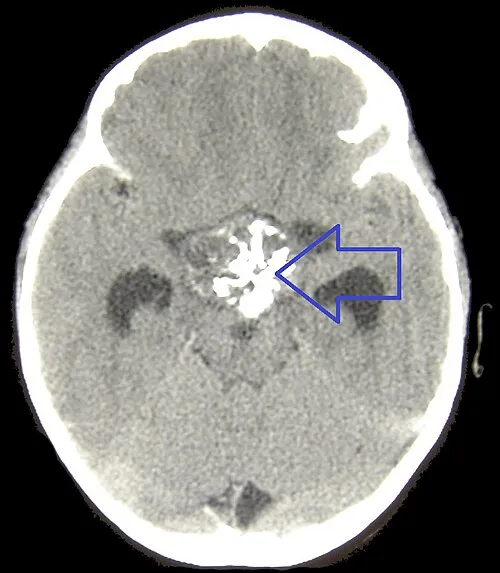
| Craniopharyngioma | Children or older adults; suprasellar cystic calcified mass; DI, growth failure | MRI and CT (calcification) |
| Hypophysitis | Pregnancy or postpartum, immune checkpoint inhibitors; early ACTH loss, thickened stalk | MRI; history of ipilimumab |
| Pituitary apoplexy | Sudden severe headache, ophthalmoplegia, visual loss, collapse | Urgent MRI or CT; cortisol |
| Sheehan syndrome | Postpartum haemorrhage followed by failure of lactation and amenorrhoea | Pituitary profile; MRI (empty or small sella) |
| Infiltrative or metastatic disease | Diabetes insipidus, thickened stalk; sarcoidosis, Langerhans cell histiocytosis, breast or lung cancer | MRI, chest imaging, ACE, biopsy |
| Lactotroph hyperplasia of pregnancy | Symmetrical gland enlargement in pregnancy | Pregnancy test; resolves postpartum |
Exam pearls
Guideline
Endocrine Society hypopituitarism hormone replacement guideline (2016), Endocrine Society pituitary incidentaloma guideline (2011), Pituitary Society international consensus on prolactinomas (2023) and Pituitary Society consensus on Cushing disease (2021)
References
- Fleseriu M, Hashim IA, Karavitaki N, et al.. Hormonal replacement in hypopituitarism in adults: an Endocrine Society clinical practice guideline. J Clin Endocrinol Metab 2016.
- Freda PU, Beckers AM, Katznelson L, et al.. Pituitary incidentaloma: an Endocrine Society clinical practice guideline. J Clin Endocrinol Metab 2011.
- Petersenn S, Fleseriu M, Casanueva FF, et al.. Diagnosis and management of prolactin-secreting pituitary adenomas: a Pituitary Society international consensus statement. Nat Rev Endocrinol 2023.
- Fleseriu M, Auchus R, Bancos I, et al.. Consensus on diagnosis and management of Cushing's disease: a guideline update. Lancet Diabetes Endocrinol 2021.
- Melmed S.. Pituitary-tumor endocrinopathies. N Engl J Med 2020.
- Higham CE, Johannsson G, Shalet SM.. Hypopituitarism. Lancet 2016.
Related topics
By Dr Khalid Seidi (B.Sc., M.D.) · MedEd World Clinical Knowledge library. Original teaching content checked against current guidelines (November 2026); confirm the latest local guidance before clinical use. Not a substitute for clinical judgement.