Clinical Knowledge › Internal medicine › Nephrology › Sodium and water disorders
Hypovolaemia and dehydration
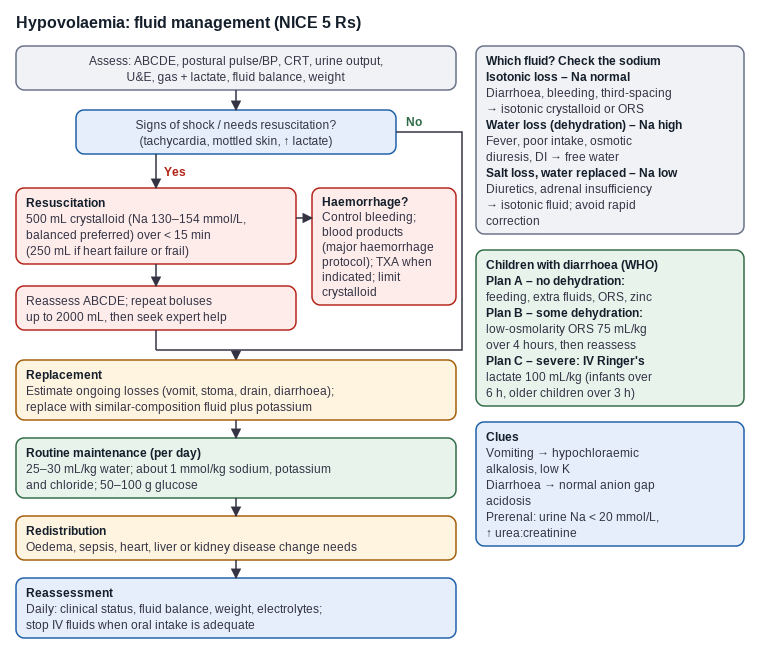
Hypovolaemia (volume depletion) is a loss of extracellular fluid – sodium with water – that reduces circulating volume; dehydration in the strict sense is loss of water alone, which raises plasma sodium and osmolality. In practice the terms overlap, and both are common causes of emergency attendance, falls, acute kidney injury and death, especially in children with diarrhoea and in older adults. Causes are gastrointestinal losses, bleeding, kidney losses (diuretics, osmotic diuresis, salt-wasting), skin losses (burns, heat) and third-spacing (pancreatitis, bowel obstruction, sepsis). Bedside signs are insensitive: a postural pulse rise of 30/min or severe postural dizziness is the most useful in adults; capillary refill and skin turgor are more useful in children. Urea, creatinine, sodium, bicarbonate, lactate and urine sodium help. Treatment matches the loss: oral rehydration solution for mild to moderate dehydration, balanced crystalloid boluses (for example 500 mL with reassessment) for hypovolaemia, and blood for haemorrhage, followed by replacement and maintenance fluids.
Patient case, mechanism, investigations, management, flashcards and exam-style questions.Open the lesson →
Key facts
- Volume depletion = loss of sodium and water (ECF); dehydration = loss of water (raises sodium); both may coexist
- Most useful adult sign: postural pulse rise ≥ 30/min or severe postural dizziness preventing standing (specificity about 98%)
- Dry axilla supports hypovolaemia; moist mucous membranes and a tongue without furrows argue against it
- Urea:creatinine ratio rises, urine sodium < 20 mmol/L and urine osmolality > 500 mOsm/kg in prerenal states
- NICE NG29 resuscitation: 500 mL crystalloid (sodium 130–154 mmol/L) over < 15 minutes, reassess, repeat up to 2000 mL then seek expert help
- Balanced crystalloids (Hartmann's, Plasma-Lyte) reduced major adverse kidney events vs 0.9% saline in SMART; PLUS found no mortality difference
- Children: WHO low-osmolarity ORS (Na 75 mmol/L); plan B 75 mL/kg over 4 hours; severe dehydration plan C 100 mL/kg IV Ringer's lactate
- Routine adult maintenance (NICE): 25–30 mL/kg/day water, about 1 mmol/kg/day sodium, potassium and chloride, 50–100 g/day glucose
Differential diagnosis
| Condition | Clues | Key test |
|---|---|---|
| Gastrointestinal losses | Vomiting, diarrhoea, stomas, fistulae | Urine Na < 20; alkalosis (vomiting) or normal anion gap acidosis (diarrhoea) |
| Haemorrhage | Trauma, GI bleed, ruptured ectopic, aortic aneurysm | Haemoglobin (late fall), lactate, imaging |
| Diuretic or osmotic diuresis | Diuretic use, hyperglycaemia | Urine Na high (diuretic), glucose high |
| Adrenal insufficiency | Hypotension, hyponatraemia, hyperkalaemia, pigmentation | Cortisol and ACTH |
| Third-space losses | Pancreatitis, bowel obstruction, burns, sepsis | Clinical context, imaging |
| Heat-related illness | Exertion in hot climate, older adults in heatwaves | Raised sodium, CK |
| Distributive shock (sepsis, anaphylaxis) | Warm peripheries, fever or rash | Blood cultures, lactate, response to vasopressors |
| Cardiogenic shock (mimic) | Raised JVP, crackles, chest pain | ECG, troponin, echocardiography |
Exam pearls
Guideline
NICE NG29 Intravenous fluid therapy in adults in hospital (2013, updated 2017), Surviving Sepsis Campaign (2026) and WHO diarrhoea treatment manual (2005)
References
- National Institute for Health and Care Excellence (NICE). Intravenous fluid therapy in adults in hospital (NG29/CG174). NICE guideline 2017.
- McGee S, Abernethy WB, Simel DL.. The rational clinical examination. Is this patient hypovolemic?. JAMA 1999.
- Prescott HC, et al.. Surviving Sepsis Campaign: international guidelines for management of sepsis and septic shock 2026. Crit Care Med 2026.
- Semler MW, Self WH, Wanderer JP, et al.. Balanced crystalloids versus saline in critically ill adults. N Engl J Med 2018.
- Finfer S, Micallef S, Hammond N, et al.. Balanced multielectrolyte solution versus saline in critically ill adults. N Engl J Med 2022.
- World Health Organization. The treatment of diarrhoea: a manual for physicians and other senior health workers, 4th revision. WHO, Geneva 2005.
Related topics
By Dr Khalid Seidi (B.Sc., M.D.) · MedEd World Clinical Knowledge library. Original teaching content checked against current guidelines (November 2026); confirm the latest local guidance before clinical use. Not a substitute for clinical judgement.