Clinical Knowledge › Surgery › Small bowel, colorectal and anal surgery
Large bowel obstruction
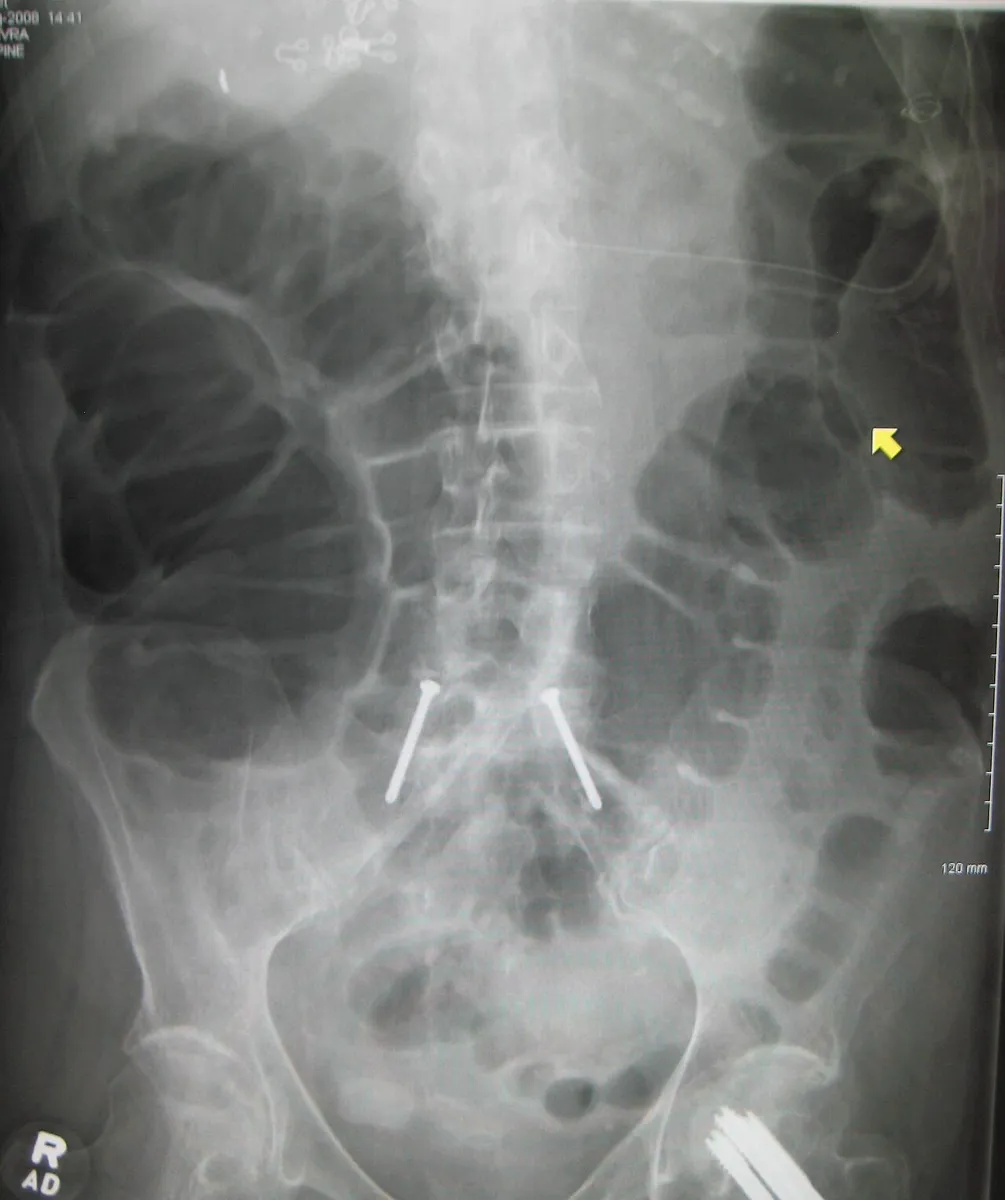
Large bowel obstruction (LBO) is a surgical emergency in which the passage of colonic contents is blocked, most often by colorectal cancer (about 60% in high-income countries), then volvulus, diverticular stricture, hernia and extrinsic compression; pseudo-obstruction mimics it. Patients develop gradual abdominal distension, colicky pain and absolute constipation, with vomiting late. If the ileocaecal valve is competent, the colon becomes a closed loop and the caecum, as the widest segment, is at greatest risk of ischaemia and perforation, especially when its diameter exceeds about 12 cm. Contrast CT of the abdomen and pelvis confirms the level, cause and complications and stages a tumour. Management starts with resuscitation, nasogastric decompression if vomiting, correction of electrolytes and early senior surgical review. Peritonitis, perforation or caecal ischaemia need emergency laparotomy. For left-sided obstructing cancer the options are resection with primary anastomosis (± defunctioning stoma), Hartmann's procedure, a decompressing stoma, or a self-expanding metal stent as a bridge to elective surgery or for palliation; right-sided obstruction is usually treated by right hemicolectomy.
Patient case, mechanism, investigations, management, flashcards and exam-style questions.Open the lesson →
Key facts
- Colorectal cancer causes about 60% of large bowel obstruction in high-income settings; sigmoid volvulus is a leading cause in the 'volvulus belt' (Africa, Middle East, South America, parts of Asia)
- A competent ileocaecal valve creates a closed-loop obstruction; the caecum is the commonest site of perforation (law of Laplace)
- Caecal diameter above about 12 cm, or tenderness over the caecum, signals impending perforation
- Contrast CT abdomen and pelvis is the investigation of choice; it distinguishes mechanical obstruction from pseudo-obstruction
- Peritonitis, free gas, CT signs of ischaemia or a closed loop at risk mandate emergency surgery
- Left-sided obstructing cancer: stent as bridge to surgery reduces stoma rates without worsening oncological outcome (CReST, ESCO)
- Hartmann's procedure suits unstable or high-risk patients; many Hartmann's stomas are never reversed
- Colonic stents are the preferred palliation for incurable malignant obstruction; main risks are perforation, migration and re-obstruction
Differential diagnosis
| Condition | Clues | Key test |
|---|---|---|
| Obstructing colorectal cancer | Older patient, weight loss, change in bowel habit, iron deficiency | CT: 'apple core' shouldered stricture with proximal dilatation |
| Sigmoid volvulus | Elderly, constipated, institutionalised or volvulus belt; massive distension | AXR coffee-bean sign; CT whirl sign |
| Caecal volvulus | Younger adult, prior surgery, left upper quadrant gas-filled loop | CT whirl sign, displaced caecum |
| Diverticular stricture | Previous diverticulitis, slow onset | CT shows long segment with diverticula; colonoscopy to exclude cancer |
| Acute colonic pseudo-obstruction (Ogilvie) | Inpatient after surgery or illness, electrolyte disturbance, opioids | CT: dilated colon without transition point |
| Faecal impaction | Older, immobile, opioids; overflow diarrhoea | Rectal examination and CT |
| Small bowel obstruction | Early vomiting, central colic, previous surgery or hernia | CT transition point in small bowel; collapsed colon |
| Toxic megacolon | Known colitis or C. difficile, systemically unwell, bloody diarrhoea | AXR transverse colon over 6 cm with mucosal islands |
Exam pearls
Guideline
WSES guidelines on colon and rectal cancer emergencies: obstruction and perforation (2017, published 2018), ESGE colonic stenting guideline update (2020), ASCRS colonic volvulus and pseudo-obstruction guideline (2021), WSES sigmoid volvulus guideline (2023) and NICE NG151 colorectal cancer (2020, updated)
References
- Pisano M, Zorcolo L, Merli C, et al.. 2017 WSES guidelines on colon and rectal cancer emergencies: obstruction and perforation. World J Emerg Surg 2018.
- van Hooft JE, Veld JV, Arnold D, et al.. Self-expandable metal stents for obstructing colonic and extracolonic cancer: European Society of Gastrointestinal Endoscopy (ESGE) Guideline – Update 2020. Endoscopy 2020.
- Alavi K, Poylin V, Davids JS, et al.. The American Society of Colon and Rectal Surgeons clinical practice guidelines for the management of colonic volvulus and acute colonic pseudo-obstruction. Dis Colon Rectum 2021.
- CReST Collaborative Group. Colorectal Endoscopic Stenting Trial (CReST) for obstructing left-sided colorectal cancer: randomized clinical trial. Br J Surg 2022.
- Arezzo A, Balague C, Targarona E, et al.. Colonic stenting as a bridge to surgery versus emergency surgery for malignant colonic obstruction: results of a multicentre randomised controlled trial (ESCO trial). Surg Endosc 2017.
- National Institute for Health and Care Excellence. Colorectal cancer (NG151). NICE 2020.
Related topics
By Dr Khalid Seidi (B.Sc., M.D.) · MedEd World Clinical Knowledge library. Original teaching content checked against current guidelines (November 2026); confirm the latest local guidance before clinical use. Not a substitute for clinical judgement.