Clinical Knowledge › Radiology › Interventional radiology
Mechanical thrombectomy for stroke
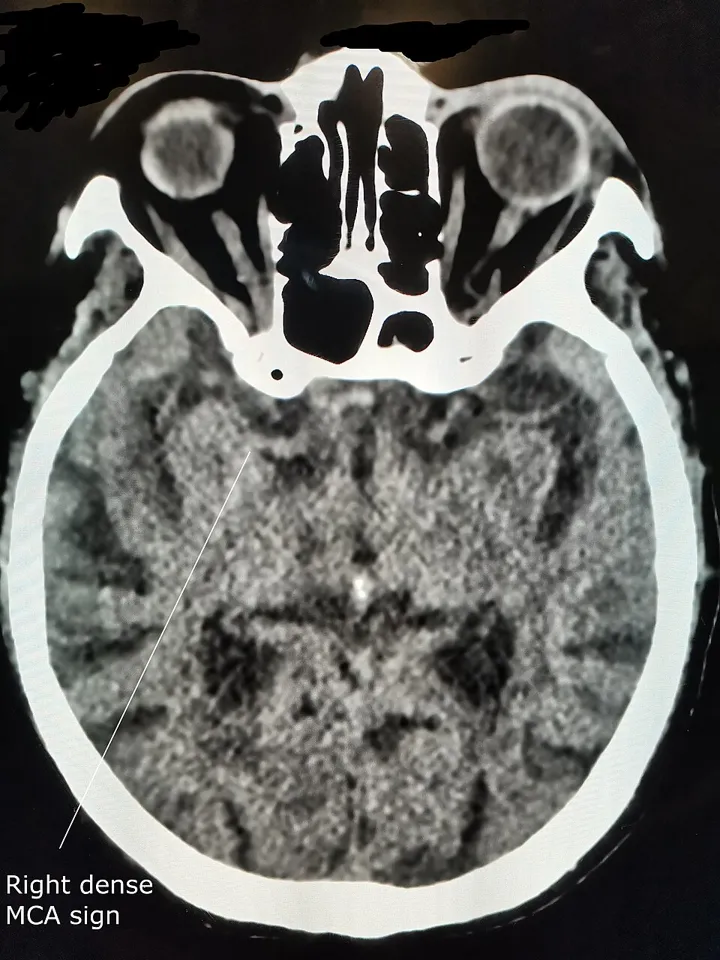
Mechanical thrombectomy (endovascular thrombectomy, EVT) removes an occluding clot from a large intracranial artery using a stent retriever and/or aspiration catheter passed from the femoral or radial artery under fluoroscopy. In anterior circulation large vessel occlusion (internal carotid or proximal middle cerebral artery) it roughly doubles the chance of functional independence. Imaging selects patients: non-contrast CT excludes haemorrhage and scores early ischaemia (ASPECTS), CT angiography from arch to vertex finds the occlusion, and CT perfusion or MRI identifies salvageable tissue in later windows. The 2026 AHA/ASA guideline supports EVT within 6 hours, up to 24 hours with favourable imaging, in selected patients with large ischaemic cores, and for basilar artery occlusion within 24 hours with NIHSS 10 or more; medium and distal vessel occlusion trials (2025) were negative. Eligible patients still receive IV thrombolysis (alteplase or tenecteplase) without delaying transfer. Key risks are symptomatic intracranial haemorrhage and vessel injury.
Patient case, mechanism, investigations, management, flashcards and exam-style questions.Open the lesson →
Key facts
- EVT targets large vessel occlusion (LVO): intracranial ICA, M1 and dominant proximal M2 of the MCA, and the basilar artery
- HERMES (5 trials, 2015): EVT within 6 hours in anterior LVO reduced disability, number needed to treat about 2.6 for one-point mRS improvement
- DAWN and DEFUSE 3 (2018) extended EVT to 6–24 hours using clinical-core mismatch or perfusion mismatch
- Large core trials (SELECT2, ANGEL-ASPECT, others, 2023): benefit also with ASPECTS 3–5 within 24 hours, at the cost of more haemorrhage
- Basilar occlusion: 2026 AHA/ASA strongly recommends EVT within 24 hours with NIHSS 10 or more; ESO/ESMINT 2024 also supports EVT
- ESCAPE-MeVO and DISTAL (2025): no benefit of EVT for medium or distal vessel occlusions
- Give IV thrombolysis (alteplase 0.9 mg/kg or tenecteplase 0.25 mg/kg, maximum 25 mg) to eligible patients within 4.5 hours without delaying EVT
- Successful reperfusion is eTICI 2b–3; symptomatic intracranial haemorrhage occurs in roughly 4–6%; intensive systolic lowering below 140 mmHg after successful EVT may harm
Differential diagnosis
| Condition | Clues | Key test |
|---|---|---|
| Intracerebral haemorrhage | Hyperdense parenchymal blood on non-contrast CT | Non-contrast CT |
| Stroke mimic: seizure with Todd paresis | Witnessed seizure, no LVO on CTA | CTA, EEG |
| Stroke mimic: hypoglycaemia | Low capillary glucose, rapid reversal | Bedside glucose |
| Migraine with aura | Spreading positive symptoms, young, recurrent | Normal CTA and perfusion |
| Functional neurological disorder | Inconsistent signs, Hoover sign | Normal imaging |
| Carotid or vertebral dissection | Neck pain, Horner syndrome, tapered occlusion | CTA or MRA of neck |
| Medium or distal vessel occlusion | Lower NIHSS, M2–M4, ACA or PCA occlusion | CTA; medical therapy usually |
Exam pearls
Guideline
AHA/ASA 2026 Guideline for the Early Management of Patients With Acute Ischemic Stroke, with ESO–ESMINT guidelines on mechanical thrombectomy (2019) and basilar artery occlusion (2024)
References
- Prabhakaran S, Gonzalez NR, Zachrison KS, et al.. 2026 Guideline for the Early Management of Patients With Acute Ischemic Stroke: a guideline from the American Heart Association/American Stroke Association. Stroke 2026.
- Turc G, Bhogal P, Fischer U, et al.. European Stroke Organisation (ESO) – European Society for Minimally Invasive Neurological Therapy (ESMINT) guidelines on mechanical thrombectomy in acute ischaemic stroke. J Neurointerv Surg 2019.
- Strbian D, Tsivgoulis G, Ospel J, et al.. European Stroke Organisation and European Society for Minimally Invasive Neurological Therapy guideline on acute management of basilar artery occlusion. Eur Stroke J 2024.
- Goyal M, Menon BK, van Zwam WH, et al.. Endovascular thrombectomy after large-vessel ischaemic stroke: a meta-analysis of individual patient data from five randomised trials. Lancet 2016.
- Sarraj A, Hassan AE, Abraham MG, et al.. Trial of endovascular thrombectomy for large ischemic strokes. N Engl J Med 2023.
- Huo X, Ma G, Tong X, et al.. Trial of endovascular therapy for acute ischemic stroke with large infarct. N Engl J Med 2023.
Related topics
By Dr Khalid Seidi (B.Sc., M.D.) · MedEd World Clinical Knowledge library. Original teaching content checked against current guidelines (November 2026); confirm the latest local guidance before clinical use. Not a substitute for clinical judgement.