Clinical Knowledge › Dermatology › Premalignant and malignant skin lesions
Merkel cell carcinoma
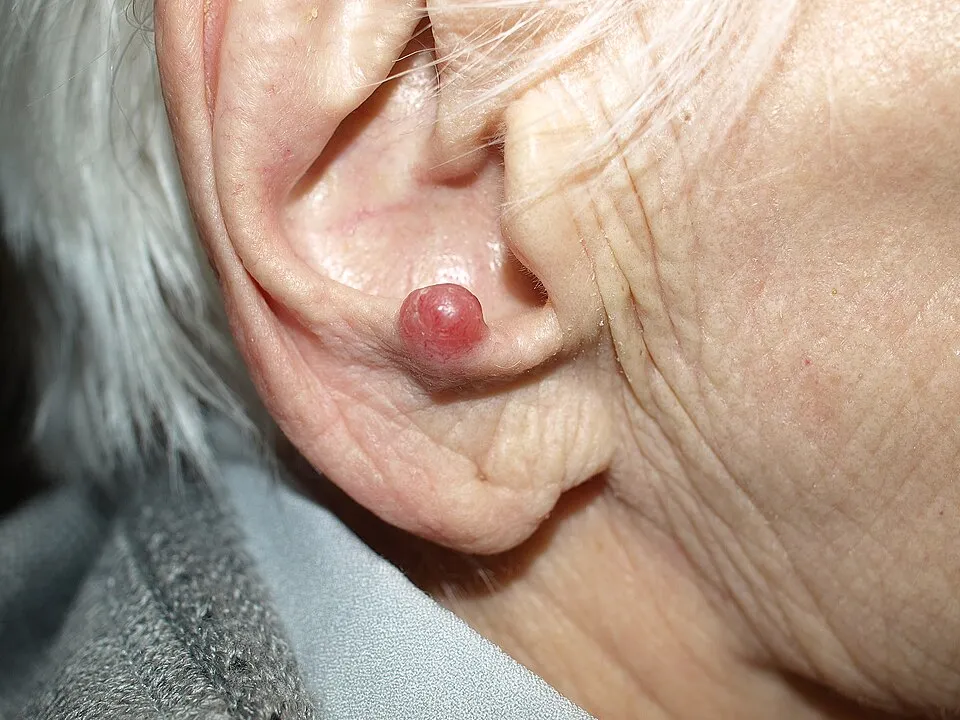
Merkel cell carcinoma (MCC) is a rare, aggressive primary neuroendocrine carcinoma of the skin. It mainly affects older, fair-skinned people and the immunosuppressed (organ transplant, chronic lymphocytic leukaemia, HIV), and presents as a painless, rapidly growing, firm, shiny red-violet nodule on sun-exposed skin of the head, neck or limbs, without a keratin crater. The 'AEIOU' features (Asymptomatic, Expanding rapidly, Immunosuppression, Older than 50, UV-exposed site) help raise suspicion. Two pathways exist: Merkel cell polyomavirus integration (most cases in Europe and North America) and UV-driven mutation (most in Australia). Histology shows small round blue cells with CK20 perinuclear dot positivity and TTF-1 negativity, which separates MCC from metastatic small-cell lung cancer. About a quarter of patients have nodal disease at diagnosis. Management in a specialist MDT includes PET-CT, sentinel lymph node biopsy, wide excision with adjuvant radiotherapy, and anti-PD-1/PD-L1 immunotherapy (avelumab, pembrolizumab, retifanlimab) for advanced disease.
Patient case, mechanism, investigations, management, flashcards and exam-style questions.Open the lesson →
Key facts
- Rare neuroendocrine skin cancer; mortality higher than melanoma stage for stage
- AEIOU: Asymptomatic, Expanding rapidly, Immunosuppression, Older than 50, UV-exposed fair skin
- Painless firm red-violet shiny dome-shaped nodule, usually head and neck; no keratin plug
- Merkel cell polyomavirus integration causes most cases in the northern hemisphere; UV mutations dominate in Australia
- Histology: small round blue cells; CK20 perinuclear dot-like positive, TTF-1 negative (vs small-cell lung cancer)
- Staging: AJCC 8th; PET-CT and sentinel lymph node biopsy in clinically node-negative disease
- Localised disease: wide local excision (1-2 cm margins) plus adjuvant radiotherapy to the tumour bed
- Advanced disease: first-line anti-PD-1/PD-L1 (avelumab, pembrolizumab, retifanlimab); chemotherapy second-line
Differential diagnosis
| Condition | Clues | Key test |
|---|---|---|
| Basal cell carcinoma (nodular) | Pearly translucent nodule with arborising vessels, slow growth | Dermoscopy and biopsy |
| Squamous cell carcinoma or keratoacanthoma | Keratotic, crusted or crateriform nodule | Excision biopsy histology |
| Amelanotic melanoma | Pink nodule with polymorphous vessels, may bleed | Biopsy: S100/SOX10 positive |
| Cutaneous metastasis of small-cell lung cancer | Smoker, lung mass, multiple skin nodules | TTF-1 positive, CK20 negative; CT chest |
| Cutaneous lymphoma (B-cell) | Plum-coloured nodules, often multiple | Biopsy: CD20 positive, CK20 negative |
| Pyogenic granuloma | Rapidly growing friable bleeding papule, often young or pregnant | Clinical; histology after removal |
| Epidermoid cyst | Smooth nodule with punctum, fluctuant | Clinical; ultrasound if doubt |
Exam pearls
Guideline
ESMO-EURACAN Clinical Practice Guideline for Merkel cell carcinoma 2024, EDF/EADO/EORTC European consensus guideline update 2022 and NCCN Merkel cell carcinoma guideline (current version)
References
- Lugowska I, Becker JC, Ascierto PA, et al.. Merkel-cell carcinoma: ESMO-EURACAN Clinical Practice Guideline for diagnosis, treatment and follow-up. ESMO Open 2024.
- Gauci ML, Aristei C, Becker JC, et al.. Diagnosis and treatment of Merkel cell carcinoma: European consensus-based interdisciplinary guideline - Update 2022. Eur J Cancer 2022.
- National Comprehensive Cancer Network. NCCN Clinical Practice Guidelines in Oncology: Merkel Cell Carcinoma (current version). NCCN 2026.
- Becker JC, Stang A, DeCaprio JA, et al.. Merkel cell carcinoma. Nat Rev Dis Primers 2017.
- Kaufman HL, Russell J, Hamid O, et al.. Avelumab in patients with chemotherapy-refractory metastatic Merkel cell carcinoma: a multicentre, single-group, open-label, phase 2 trial. Lancet Oncol 2016.
- Nghiem PT, Bhatia S, Lipson EJ, et al.. PD-1 blockade with pembrolizumab in advanced Merkel-cell carcinoma. N Engl J Med 2016.
Related topics
By Dr Khalid Seidi (B.Sc., M.D.) · MedEd World Clinical Knowledge library. Original teaching content checked against current guidelines (November 2026); confirm the latest local guidance before clinical use. Not a substitute for clinical judgement.