Clinical Knowledge › Internal medicine › Nephrology › Glomerular diseases
Minimal change disease
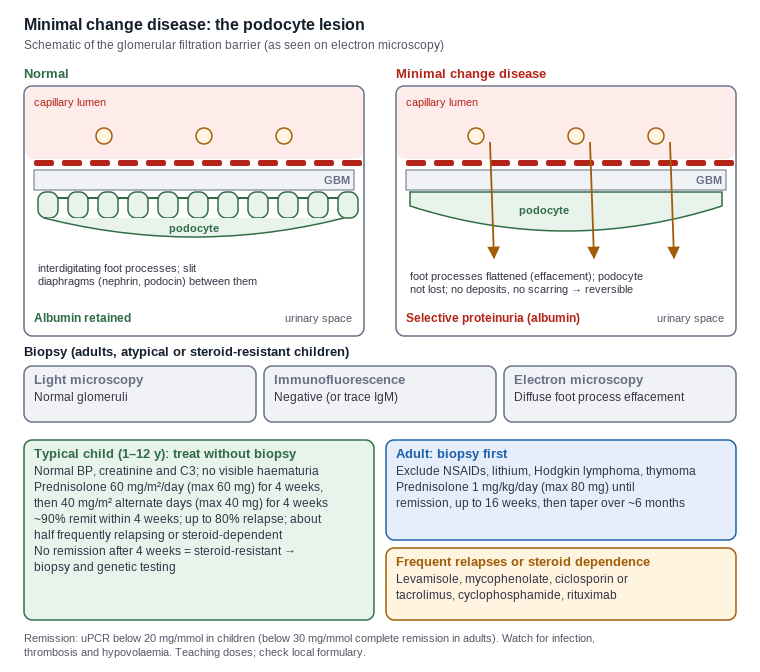
Minimal change disease (MCD) is a podocytopathy in which the glomeruli look normal on light microscopy, immunofluorescence is negative and electron microscopy shows diffuse effacement of podocyte foot processes. It causes most nephrotic syndrome in children aged 1–10 years and about 10–15% in adults. Onset is abrupt, often after a viral infection, with heavy selective proteinuria and marked oedema; blood pressure and kidney function are usually normal, though adults can develop AKI. Most cases are idiopathic; secondary causes include NSAIDs, lithium, Hodgkin lymphoma and other lymphoid cancers. Anti-nephrin autoantibodies found in many patients support an autoimmune mechanism. Children are treated with prednisolone without biopsy, and about 90% enter remission within 4 weeks; adults respond more slowly and need biopsy first. Relapses are common. Frequently relapsing or steroid-dependent disease is treated with steroid-sparing drugs such as rituximab, calcineurin inhibitors, cyclophosphamide, mycophenolate or levamisole. Steroid-responsive disease has an excellent kidney prognosis.
Patient case, mechanism, investigations, management, flashcards and exam-style questions.Open the lesson →
Key facts
- MCD: normal light microscopy, negative immunofluorescence, diffuse foot process effacement on electron microscopy
- Commonest cause of nephrotic syndrome in children (peak 2–6 years, boys more than girls); about 10–15% of adult nephrotic syndrome
- Typical child: abrupt periorbital oedema, often after an upper respiratory infection, normal BP, normal creatinine, normal C3, no visible haematuria
- Children are treated empirically with prednisolone; biopsy only if steroid-resistant after 4 weeks or atypical features
- About 90% of children respond to steroids, but up to 80% relapse and around half become frequently relapsing or steroid-dependent
- Adults usually need biopsy first, respond more slowly (up to 16 weeks of steroids) and more often have AKI
- Secondary MCD: NSAIDs (often with interstitial nephritis), lithium, Hodgkin lymphoma, thymoma and atopy
- Anti-nephrin antibodies, described in 2022 and validated in 2024, are present in many patients with active MCD and fall with remission
Differential diagnosis
| Condition | Clues | Key test |
|---|---|---|
| Focal segmental glomerulosclerosis | Steroid resistance, hypertension, haematuria or reduced GFR; segmental sclerosis on biopsy | Kidney biopsy, genetic testing |
| Membranous nephropathy | Older adult, insidious onset, thrombosis | Anti-PLA2R antibody, biopsy |
| Diffuse mesangial proliferation or IgM nephropathy | Steroid-dependent course with mesangial changes | Biopsy with IgM immunofluorescence |
| Lupus nephritis class V | Young woman with nephrotic syndrome and systemic features | ANA, anti-dsDNA, complement, biopsy |
| C3 glomerulopathy or post-infectious GN | Haematuria, hypertension and low C3 | Complement levels, biopsy |
| Congenital nephrotic syndrome | Onset before 3 months of age, large placenta | Genetic testing (NPHS1, NPHS2) |
Exam pearls
Guideline
KDIGO 2025 Clinical Practice Guideline for the Management of Nephrotic Syndrome in Children and KDIGO 2021 Clinical Practice Guideline for the Management of Glomerular Diseases (adult MCD)
References
- Kidney Disease: Improving Global Outcomes (KDIGO) Glomerular Diseases Work Group. KDIGO 2021 Clinical Practice Guideline for the Management of Glomerular Diseases. Kidney Int 2021.
- Kidney Disease: Improving Global Outcomes (KDIGO) Nephrotic Syndrome in Children Work Group. KDIGO 2025 Clinical Practice Guideline for the Management of Nephrotic Syndrome in Children. Kidney Int 2025.
- Hengel FE, Dehde S, Lassé M, et al.. Autoantibodies targeting nephrin in podocytopathies. N Engl J Med 2024.
- Watts AJB, Keller KH, Lerner G, et al.. Discovery of autoantibodies targeting nephrin in minimal change disease supports a novel autoimmune etiology. J Am Soc Nephrol 2022.
- Vivarelli M, Massella L, Ruggiero B, Emma F.. Minimal change disease. Clin J Am Soc Nephrol 2017.
- Waldman M, Crew RJ, Valeri A, et al.. Adult minimal-change disease: clinical characteristics, treatment, and outcomes. Clin J Am Soc Nephrol 2007.
Related topics
By Dr Khalid Seidi (B.Sc., M.D.) · MedEd World Clinical Knowledge library. Original teaching content checked against current guidelines (November 2026); confirm the latest local guidance before clinical use. Not a substitute for clinical judgement.