Clinical Knowledge › Internal medicine › Nephrology › Basics of nephrology
Quantifying proteinuria (ACR and PCR)
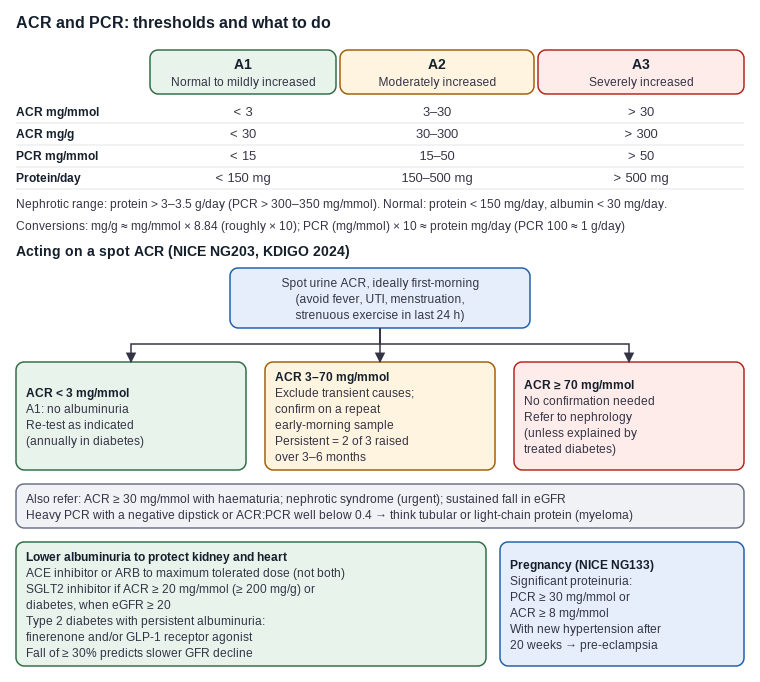
Proteinuria marks kidney damage and strongly predicts kidney failure, cardiovascular events and death, independent of eGFR. Healthy adults excrete under 150 mg of protein and under 30 mg of albumin a day. Because 24-hour collections are cumbersome, proteinuria is quantified on a spot urine as a ratio to creatinine: the albumin:creatinine ratio (ACR) or protein:creatinine ratio (PCR). ACR is more sensitive at low levels and is preferred for screening and staging CKD (A1 <3, A2 3–30, A3 >30 mg/mmol), especially in diabetes and hypertension. PCR measures all proteins and suits heavy glomerular proteinuria and pre-eclampsia; PCR in mg/mmol × 10 roughly equals mg/day. Dipsticks detect albumin only above about 300 mg/L and miss light chains. Raised results are confirmed on an early-morning sample, interpreted against transient causes, and drive treatment: RAS blockade, SGLT2 inhibitors and, in type 2 diabetes, finerenone and GLP-1 receptor agonists lower albuminuria and protect the kidney.
Patient case, mechanism, investigations, management, flashcards and exam-style questions.Open the lesson →
Key facts
- Normal: total protein below 150 mg/day; albumin below 30 mg/day (ACR below 3 mg/mmol or 30 mg/g)
- Albuminuria categories: A1 <3 mg/mmol (<30 mg/g), A2 3–30 mg/mmol (30–300 mg/g), A3 >30 mg/mmol (>300 mg/g)
- mg/g ≈ mg/mmol × 8.84 (roughly ×10); PCR in mg/mmol × 10 ≈ protein in mg/day
- Nephrotic-range proteinuria: above about 3–3.5 g/day (PCR above about 300–350 mg/mmol)
- ACR is preferred for screening and CKD staging; PCR for heavy proteinuria, glomerular disease monitoring and pregnancy
- Confirm an ACR of 3–70 mg/mmol on an early-morning sample; an ACR of 70 or more does not need repeating before acting (NICE)
- Transient proteinuria follows fever, vigorous exercise, UTI and heart failure; orthostatic proteinuria disappears in a supine (first-morning) sample
- An ACR:PCR ratio well below 0.4 suggests non-albumin (tubular or light chain) proteinuria
Differential diagnosis
| Condition | Clues | Key test |
|---|---|---|
| Glomerular proteinuria (diabetic kidney disease, glomerulonephritis) | Albumin predominant; ACR:PCR above 0.4; may be nephrotic range | ACR, PCR, eGFR, serology, biopsy |
| Tubular proteinuria | Low-molecular-weight proteins; PCR much higher than ACR; Fanconi features | Urine β2-microglobulin or retinol-binding protein |
| Overflow proteinuria (myeloma light chains) | Dipstick negative but PCR raised; anaemia, hypercalcaemia, bone pain | Serum free light chains, protein electrophoresis, immunofixation |
| Orthostatic proteinuria | Adolescent or young adult; protein only in upright samples | Split collection: first-morning versus daytime ACR/PCR |
| Transient proteinuria | Fever, intense exercise, UTI, heart failure, seizures | Repeat ACR after recovery |
| Pre-eclampsia | New hypertension after 20 weeks of pregnancy | PCR ≥30 mg/mmol or ACR ≥8 mg/mmol |
Exam pearls
Guideline
KDIGO 2024 CKD guideline, NICE NG203 Chronic kidney disease (2021), KDIGO 2021 glomerular diseases guideline with KDIGO 2025 IgAN/IgAV guideline, and NICE NG133 Hypertension in pregnancy (2019, updated 2023)
References
- KDIGO CKD Work Group.. KDIGO 2024 Clinical Practice Guideline for the Evaluation and Management of Chronic Kidney Disease. Kidney Int 2024.
- National Institute for Health and Care Excellence (NICE). Chronic kidney disease: assessment and management (NG203). NICE guideline 2021.
- Sumida K, Nadkarni GN, Grams ME, et al.. Conversion of urine protein-creatinine ratio or urine dipstick protein to urine albumin-creatinine ratio for use in chronic kidney disease screening and prognosis: an individual participant-based meta-analysis. Ann Intern Med 2020.
- KDIGO Glomerular Diseases Work Group.. KDIGO 2021 Clinical Practice Guideline for the Management of Glomerular Diseases. Kidney Int 2021.
- KDIGO IgAN and IgAV Work Group.. KDIGO 2025 Clinical Practice Guideline for the Management of Immunoglobulin A Nephropathy (IgAN) and Immunoglobulin A Vasculitis (IgAV). Kidney Int 2025.
- National Institute for Health and Care Excellence (NICE). Hypertension in pregnancy: diagnosis and management (NG133). NICE guideline 2019.
Related topics
By Dr Khalid Seidi (B.Sc., M.D.) · MedEd World Clinical Knowledge library. Original teaching content checked against current guidelines (November 2026); confirm the latest local guidance before clinical use. Not a substitute for clinical judgement.