Clinical Knowledge › Internal medicine › Nephrology › Kidney stones, infection and obstruction
Reflux nephropathy
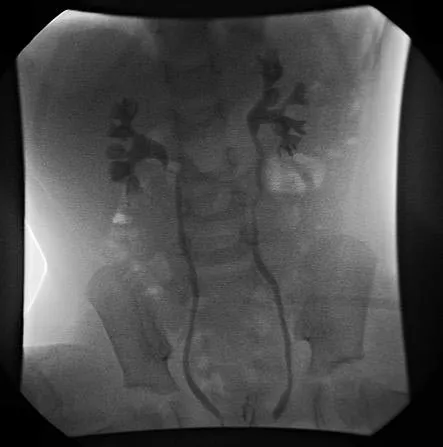
Reflux nephropathy is kidney scarring and loss of function associated with vesicoureteric reflux (VUR), the backward flow of urine from the bladder into the ureter and kidney. It arises in two ways: acquired scarring when infected urine refluxes into the renal papillae during febrile urinary tract infections in early childhood, and congenital dysplasia present at birth, often in boys detected by antenatal hydronephrosis. VUR affects about 1–2% of children and about a third of those with a febrile UTI, and runs in families. Reflux is graded I–V on a voiding cystourethrogram (VCUG); a DMSA scan shows cortical scars. Management in childhood aims to prevent further febrile infections: prompt treatment, treating bladder and bowel dysfunction, continuous antibiotic prophylaxis for selected children (RIVUR showed fewer recurrences but no fewer scars), and endoscopic injection or ureteric reimplantation for breakthrough infections or high-grade reflux. In adults the legacy is hypertension, proteinuria with secondary FSGS, CKD and risks in pregnancy, managed with RAS blockade, BP control and CKD care.
Patient case, mechanism, investigations, management, flashcards and exam-style questions.Open the lesson →
Key facts
- VUR occurs in about 1–2% of children and in about 30% of children investigated after a febrile UTI; siblings and offspring are at high risk (about 30% or more)
- International grading I–V on VCUG: grade I ureter only; grade V gross dilatation and tortuosity with loss of papillary impressions
- Scars form mostly at the upper and lower poles, where compound papillae allow intrarenal reflux; risk is highest in infants and with delayed treatment of febrile UTI
- Congenital reflux nephropathy (dysplasia without infection) is commoner in boys with high-grade VUR and antenatal hydronephrosis
- DMSA scintigraphy 4–6 months after infection is the best test for permanent scarring; VCUG is the reference test for VUR
- Most low-grade VUR resolves spontaneously with growth; bladder and bowel dysfunction (BBD) increases infections and must be treated
- RIVUR (2014): co-trimoxazole prophylaxis halved recurrent UTI but did not reduce renal scarring and increased resistant organisms
- Adult consequences: hypertension, proteinuria from secondary FSGS, CKD and pre-eclampsia; treat with ACE inhibitor or ARB, BP control and CKD care
Differential diagnosis
| Condition | Clues | Key test |
|---|---|---|
| Obstructive uropathy (pelviureteric junction or posterior urethral valves) | Hydronephrosis without reflux; poor stream in boys with valves | Ultrasound, VCUG, MAG3 renogram |
| Renal hypodysplasia without reflux | Small kidneys from birth, often with other anomalies | Ultrasound, VCUG negative, genetic testing (CAKUT) |
| Chronic pyelonephritis from obstruction or stones | Scarring with calyceal clubbing over a stone or obstruction | CT KUB or CT urogram |
| Primary FSGS | Nephrotic-range proteinuria without scars | Ultrasound/DMSA, kidney biopsy |
| Renovascular hypertension | Small kidney with hypertension in a young adult | Doppler ultrasound, CT or MR angiography |
| ADPKD | Hypertension and CKD with family history | Ultrasound showing multiple cysts |
Exam pearls
Guideline
EAU/ESPU Paediatric Guidelines on Vesicoureteral Reflux in Children (2023 update, published 2024; within EAU Paediatric Urology Guidelines 2026), with NICE NG224 UTI in under 16s (2022) and KDIGO 2024 CKD
References
- Gnech M, 't Hoen L, Zachou A, et al.. Update and summary of the European Association of Urology/European Society of Paediatric Urology paediatric guidelines on vesicoureteral reflux in children. Eur Urol 2024.
- European Association of Urology (EAU). EAU Guidelines on Paediatric Urology. EAU Guidelines Office, Arnhem 2026.
- National Institute for Health and Care Excellence (NICE). Urinary tract infection in under 16s: diagnosis and management (NG224). 2022.
- RIVUR Trial Investigators; Hoberman A, Greenfield SP, Mattoo TK, et al.. Antimicrobial prophylaxis for children with vesicoureteral reflux. N Engl J Med 2014.
- American Academy of Pediatrics, Subcommittee on Urinary Tract Infection. Urinary tract infection: clinical practice guideline for the diagnosis and management of the initial UTI in febrile infants and children 2 to 24 months. Pediatrics 2011.
- Lebowitz RL, Olbing H, Parkkulainen KV, Smellie JM, Tamminen-Möbius TE.. International system of radiographic grading of vesicoureteric reflux. Pediatr Radiol 1985.
Related topics
By Dr Khalid Seidi (B.Sc., M.D.) · MedEd World Clinical Knowledge library. Original teaching content checked against current guidelines (November 2026); confirm the latest local guidance before clinical use. Not a substitute for clinical judgement.