Clinical Knowledge › Anaesthesiology › Fluids, blood and perioperative physiology
Stress response to surgery
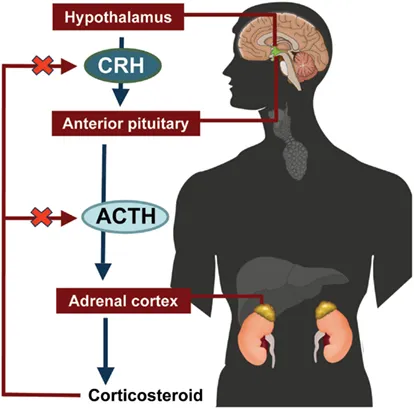
The stress response to surgery is the coordinated neuroendocrine, metabolic, inflammatory and immunological reaction to tissue injury, pain, blood loss, fasting and anaesthesia. Afferent nociceptive and cytokine signals activate the hypothalamic–pituitary–adrenal axis and sympathetic nervous system, raising cortisol, catecholamines, glucagon, growth hormone, antidiuretic hormone and aldosterone, while insulin action falls. The result is hyperglycaemia and insulin resistance, protein catabolism with negative nitrogen balance, lipolysis, salt and water retention with low urine output, and an acute-phase response driven mainly by interleukin-6. Its size is proportional to the extent of injury. It once aided survival, but after planned surgery it contributes to infection, cardiac ischaemia, thrombosis, fluid overload, muscle loss, fatigue and slow recovery. Anaesthetists modify it with regional blocks, multimodal analgesia, minimally invasive surgery, carbohydrate loading, normothermia, glucose control and enhanced recovery care, and must give glucocorticoid cover to patients who cannot mount a cortisol response.
Patient case, mechanism, investigations, management, flashcards and exam-style questions.Open the lesson →
Key facts
- Hypothalamic CRH → pituitary ACTH → cortisol: cortisol rises within minutes of incision, peaks at about 4–6 hours and normal negative feedback is overridden
- Sympathoadrenal activation raises adrenaline and noradrenaline, causing tachycardia, hypertension, glycogenolysis and increased myocardial oxygen demand
- Antidiuretic hormone and aldosterone cause water and sodium retention, potassium loss and physiological postoperative oliguria for about 24–48 hours
- Metabolism: hyperglycaemia from gluconeogenesis, glycogenolysis and insulin resistance; protein breakdown and negative nitrogen balance; lipolysis
- Interleukin-6 is the main cytokine, peaking at 12–24 hours in proportion to tissue damage; it drives CRP, fibrinogen and hepcidin production
- Acute-phase changes: CRP and fibrinogen rise, albumin and transferrin fall, iron is sequestered and coagulation becomes procoagulant
- Neuraxial block with local anaesthetic blunts the endocrine response to lower abdominal and limb surgery; it does little to the cytokine response
- Prednisolone 5 mg/day or more for a month or longer can suppress the HPA axis: give hydrocortisone cover (for example 100 mg IV at induction for major surgery; teaching dose; check local protocol)
Differential diagnosis
| Condition | Clues | Key test |
|---|---|---|
| Physiological postoperative oliguria | Low urine volume in first 24 hours, stable haemodynamics, high urine osmolality | Clinical assessment; lactate; trend, not single values |
| Hypovolaemia or bleeding | Tachycardia, falling blood pressure, cool peripheries, falling Hb | Haemoglobin, lactate, fluid challenge response |
| Acute kidney injury | Rising creatinine with oliguria beyond 24–48 hours | Serum creatinine, KDIGO criteria, urinalysis |
| Sepsis or anastomotic leak | CRP rising after day 3 instead of falling, fever, tachycardia, ileus | CRP trend, lactate, CT |
| Adrenal crisis | Refractory hypotension, hyponatraemia, hypoglycaemia in a patient on long-term steroids | Random cortisol (do not delay hydrocortisone) |
| Postoperative hyponatraemia from hypotonic fluids | Confusion, nausea, seizures with sodium below 130 mmol/L | Serum sodium; review fluid prescription |
| Stress hyperglycaemia versus undiagnosed diabetes | Hyperglycaemia after surgery | HbA1c distinguishes chronic diabetes |
Exam pearls
Guideline
ERAS Society colorectal guideline (2018) and NICE NG180 Perioperative care (2020); Association of Anaesthetists/RCP/Society for Endocrinology perioperative glucocorticoid guideline (2020)
References
- Desborough JP.. The stress response to trauma and surgery. Br J Anaesth 2000.
- Gustafsson UO, Scott MJ, Hubner M, et al.. Guidelines for perioperative care in elective colorectal surgery: Enhanced Recovery After Surgery (ERAS) Society recommendations: 2018. World J Surg 2019.
- National Institute for Health and Care Excellence. Perioperative care in adults (NG180). NICE, London 2020.
- Woodcock T, Barker P, Daniel S, et al.. Guidelines for the management of glucocorticoids during the peri-operative period for patients with adrenal insufficiency. Anaesthesia 2020.
- Corcoran TB, Myles PS, Forbes AB, et al.. Dexamethasone and surgical-site infection. N Engl J Med 2021.
- Devereaux PJ, Yang H, Yusuf S, et al.. Effects of extended-release metoprolol succinate in patients undergoing non-cardiac surgery (POISE trial): a randomised controlled trial. Lancet 2008.
Related topics
By Dr Khalid Seidi (B.Sc., M.D.) · MedEd World Clinical Knowledge library. Original teaching content checked against current guidelines (November 2026); confirm the latest local guidance before clinical use. Not a substitute for clinical judgement.