Clinical Knowledge › Internal medicine › Rheumatology and immunology › Clinical problems
Acute monoarthritis: approach to the patient
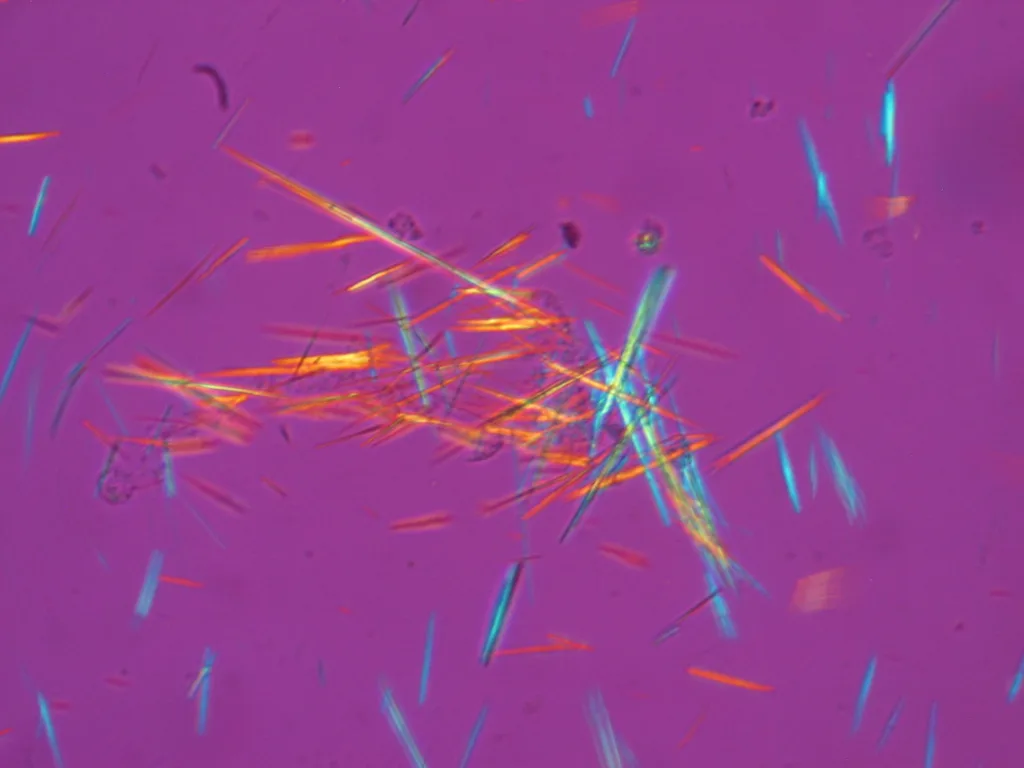
Acute monoarthritis is pain, swelling and warmth of a single joint developing over hours to days. The first priority is to exclude septic arthritis, which destroys cartilage within days and carries a mortality of about 10% in adults; no single history item, examination finding or blood test rules it out. The key investigation is joint aspiration before antibiotics, with Gram stain, culture, white cell count and polarised light microscopy for crystals. Gout (negatively birefringent needles) and calcium pyrophosphate deposition disease (weakly positively birefringent rhomboids) are the commonest non-infective causes; other causes include trauma and haemarthrosis, reactive arthritis, gonococcal infection, Lyme disease, osteoarthritis flares and the first presentation of an inflammatory arthritis. Crystals do not exclude coexistent infection. Prosthetic joints are aspirated by orthopaedic surgeons, not in the emergency department. While results are awaited, a febrile or unwell patient with a turbid aspirate should start empirical intravenous antibiotics; crystal flares are treated with colchicine, an NSAID or a glucocorticoid once infection is reasonably excluded.
Patient case, mechanism, investigations, management, flashcards and exam-style questions.Open the lesson →
Key facts
- A hot swollen joint is septic arthritis until proven otherwise; aspirate before starting antibiotics
- Fever is absent in up to half of adults with septic arthritis, and a normal serum urate does not exclude gout
- Synovial fluid white cell count above 50 × 10⁹/L (over 90% neutrophils) strongly suggests infection, but lower counts do not exclude it
- Gout: needle-shaped, strongly negatively birefringent monosodium urate crystals; CPPD: rhomboid, weakly positively birefringent crystals
- Crystals and infection can coexist: always send fluid for Gram stain and culture as well as microscopy
- Staphylococcus aureus is the commonest cause of septic arthritis; consider Neisseria gonorrhoeae in sexually active young adults
- Prosthetic joint infection: refer to orthopaedics for aspiration in theatre or clinic; do not aspirate in the emergency department
- Treat gout flares with colchicine, an NSAID or a short glucocorticoid course, chosen by comorbidities (teaching doses; check local formulary)
Differential diagnosis
| Condition | Clues | Key test |
|---|---|---|
| Septic arthritis | Very painful joint, fever or rigors, immunosuppression, diabetes, prosthesis, recent injection | Aspiration: Gram stain, culture; blood cultures |
| Gout | Sudden onset overnight, first MTP joint, diuretics, alcohol, chronic kidney disease, tophi | Polarised microscopy: negatively birefringent needles |
| Calcium pyrophosphate deposition (acute CPP crystal arthritis) | Older patient, knee or wrist, intercurrent illness or surgery, chondrocalcinosis on X-ray | Microscopy: weakly positively birefringent rhomboids |
| Disseminated gonococcal infection | Young sexually active adult, migratory arthralgia, tenosynovitis, scanty pustules | NAAT from urethra, cervix, rectum and throat; synovial and blood culture |
| Reactive arthritis | Asymmetric lower-limb arthritis 1–4 weeks after diarrhoea or urethritis, enthesitis, conjunctivitis | Clinical; stool culture, chlamydia NAAT; sterile fluid |
| Haemarthrosis | Trauma, anticoagulants, haemophilia; blood-stained fluid; fat globules suggest fracture | Aspirate appearance, coagulation screen, X-ray |
| Periarticular cellulitis or bursitis | Swelling over olecranon or prepatellar bursa; joint movement relatively preserved | Clinical examination; bursal aspiration if needed |
| Lyme arthritis | Tick exposure in endemic area, knee effusion, earlier erythema migrans | Lyme serology (two-tier) |
Exam pearls
Guideline
BSR/BOA/RCGP/BSAC guideline on the hot swollen joint in adults (2006); EBJIS SANJO guideline on septic arthritis in native joints (2023); ACR gout guideline (2020), EULAR gout recommendations (2016 update) and NICE NG219 Gout (2022); ACR/EULAR CPPD classification criteria (2023)
References
- Coakley G, Mathews C, Field M, et al.. BSR & BHPR, BOA, RCGP and BSAC guidelines for management of the hot swollen joint in adults. Rheumatology (Oxford) 2006.
- Ravn C, Neyt J, Benito N, et al.. Guideline for management of septic arthritis in native joints (SANJO). J Bone Jt Infect 2023.
- FitzGerald JD, Dalbeth N, Mikuls T, et al.. 2020 American College of Rheumatology guideline for the management of gout. Arthritis Care Res (Hoboken) 2020.
- National Institute for Health and Care Excellence (NICE). Gout: diagnosis and management (NG219). NICE guideline 2022.
- Abhishek A, Tedeschi SK, Pascart T, et al.. The 2023 ACR/EULAR classification criteria for calcium pyrophosphate deposition disease. Ann Rheum Dis 2023.
- Mathews CJ, Weston VC, Jones A, Field M, Coakley G. Bacterial septic arthritis in adults. Lancet 2010.
Related topics
By Dr Khalid Seidi (B.Sc., M.D.) · MedEd World Clinical Knowledge library. Original teaching content checked against current guidelines (November 2026); confirm the latest local guidance before clinical use. Not a substitute for clinical judgement.