Clinical Knowledge › Internal medicine › Cardiology and angiology › Pericardial diseases and cardiac tumours
Acute pericarditis
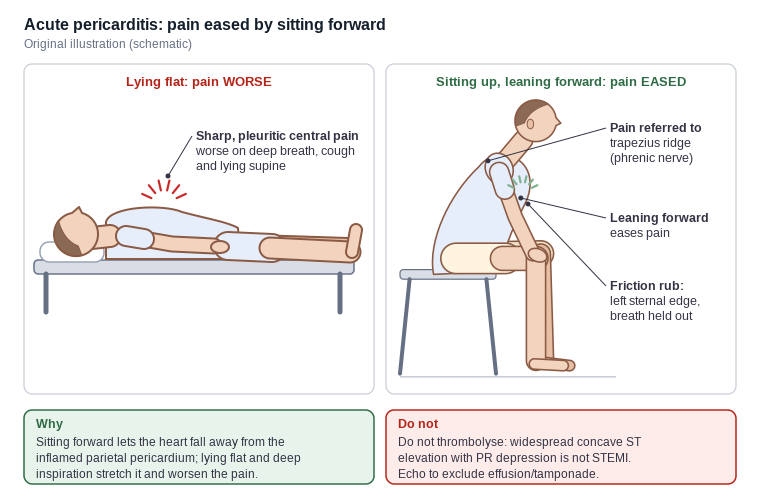
Acute pericarditis is inflammation of the pericardial layers and the commonest pericardial disease, accounting for about 5% of non-ischaemic chest pain in emergency departments. In high-income countries most cases are idiopathic or presumed viral, whereas tuberculosis dominates where it is endemic, especially with HIV. The typical patient has sharp pleuritic chest pain that eases on sitting forward, a pericardial friction rub, widespread concave ST elevation with PR depression, raised CRP and sometimes an effusion. The 2025 ESC guideline places pericarditis and myocarditis within one inflammatory myopericardial syndrome, gives CRP and cardiac MRI evidence of inflammation more diagnostic weight. First-line therapy is high-dose aspirin or an NSAID with tapering plus colchicine for 3 months, which halves recurrence. Low-dose corticosteroids are second line, and interleukin-1 blockers (anakinra, rilonacept) are reserved for recurrent, steroid-dependent disease. Recurrence affects 15–30%; tamponade and constriction are uncommon after viral or idiopathic pericarditis.
Patient case, mechanism, investigations, management, flashcards and exam-style questions.Open the lesson →
Key facts
- Commonest causes: idiopathic or viral in high-income countries; tuberculosis in endemic regions, especially with HIV
- Classic triad: pleuritic chest pain relieved by leaning forward, pericardial rub, widespread concave ST elevation with PR depression
- Diagnosis needs a typical clinical picture plus supportive findings: rub, ECG changes, raised CRP, new or worsening effusion, or pericardial inflammation on CMR
- High-risk features (fever above 38 °C, subacute onset, large effusion or tamponade, NSAID failure, raised troponin, immunosuppression, anticoagulation, trauma) warrant admission
- First line: aspirin or ibuprofen at high dose for 1–2 weeks then taper, plus colchicine 0.5 mg once or twice daily (by weight) for 3 months
- Corticosteroids are second line at low dose (prednisone 0.2–0.5 mg/kg/day) and raise recurrence risk if used first
- Interleukin-1 blockers (anakinra, rilonacept) are for recurrent pericarditis with raised CRP that is colchicine-resistant and steroid-dependent
- Restrict strenuous exercise for at least 1 month (ESC 2025), then return individually once symptoms and CRP have settled
Differential diagnosis
| Condition | Clues | Key test |
|---|---|---|
| ST-elevation myocardial infarction | Pressure-like pain, territorial convex ST elevation with reciprocal depression, Q waves | Serial ECG, troponin rise and fall, echo wall-motion abnormality, angiography |
| Myocarditis or myopericarditis | Raised troponin, arrhythmia, reduced LV function | Troponin, echocardiography, cardiac MRI |
| Pulmonary embolism | Pleuritic pain with hypoxaemia, tachycardia, DVT risk | Wells score, D-dimer, CTPA |
| Aortic dissection | Tearing pain to the back, pulse deficit; may cause haemopericardium | CT aortography, TOE |
| Pneumonia or pleurisy | Fever, cough, focal crackles; pain not positional | Chest X-ray, CRP, sputum culture |
| Early repolarisation | Young, asymptomatic; J-point notching; ST/T ratio in V6 below 0.25; no PR depression | Compare with old ECGs; normal CRP |
| Gastro-oesophageal reflux or musculoskeletal pain | Burning or reproducible chest-wall pain | Normal ECG and CRP; clinical response |
Exam pearls
Guideline
2025 ESC Guidelines for the management of myocarditis and pericarditis (replacing the 2015 ESC pericardial disease guideline)
References
- Schulz-Menger J, Collini V, Gröschel J, et al.. 2025 ESC Guidelines for the management of myocarditis and pericarditis. Eur Heart J 2025.
- Adler Y, Charron P, Imazio M, et al.. 2015 ESC Guidelines for the diagnosis and management of pericardial diseases. Eur Heart J 2015.
- Imazio M, Bobbio M, Cecchi E, et al.. Colchicine in addition to conventional therapy for acute pericarditis: results of the COlchicine for acute PEricarditis (COPE) trial. Circulation 2005.
- Imazio M, Brucato A, Cemin R, et al.. A randomized trial of colchicine for acute pericarditis. N Engl J Med 2013.
- Klein AL, Imazio M, Cremer P, et al.. Phase 3 Trial of Interleukin-1 Trap Rilonacept in Recurrent Pericarditis. N Engl J Med 2021.
- Imazio M, Cecchi E, Demichelis B, et al.. Indicators of poor prognosis of acute pericarditis. Circulation 2007.
Related topics
By Dr Khalid Seidi (B.Sc., M.D.) · MedEd World Clinical Knowledge library. Original teaching content checked against current guidelines (November 2026); confirm the latest local guidance before clinical use. Not a substitute for clinical judgement.