Clinical Knowledge › Surgery › Vascular surgery
Arterial ulcers
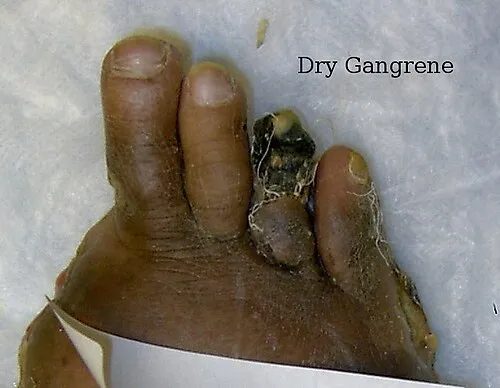
Arterial (ischaemic) ulcers are wounds that fail to heal because arterial inflow to the skin is inadequate, almost always from atherosclerotic peripheral arterial disease. An ulcer present for more than two weeks in a limb with PAD defines chronic limb-threatening ischaemia (CLTI), the severest stage, with a high risk of amputation and death. Typical ulcers are painful, punched-out and dry, on the toes, heel, lateral malleolus or pressure points, in a cold, hairless, pulseless foot with rest pain that improves with dependency. Diagnosis rests on bedside perfusion tests: ankle–brachial pressure index (ABPI), toe pressures and toe–brachial index because ankle pressures are falsely high in diabetes and kidney disease, then duplex ultrasound and CT or MR angiography to plan revascularisation. Global Vascular Guidelines stage limb threat with WIfI (Wound, Ischaemia, foot Infection) and plan treatment by patient risk, limb severity and anatomy (PLAN). Healing needs restored blood flow by endovascular treatment or bypass, plus best medical therapy, infection control, offloading and appropriate wound care; compression is dangerous. Unsalvageable or septic limbs need amputation.
Patient case, mechanism, investigations, management, flashcards and exam-style questions.Open the lesson →
Key facts
- CLTI = PAD plus ischaemic rest pain, gangrene, or a lower-limb ulcer present for more than 2 weeks (Global Vascular Guidelines 2019)
- Arterial ulcers are painful, punched-out, dry and pale-based, on toes, heel, lateral malleolus and pressure points
- ABPI 0.9 or less confirms PAD; under about 0.5 (ankle pressure under 50 mmHg) indicates severe ischaemia; above 1.4 means incompressible calcified vessels
- Toe pressure under 30 mmHg or TcPO2 under 30 mmHg indicates ischaemia severe enough to impair healing; use toe pressures in diabetes and CKD
- WIfI stages limb threat; GLASS stages anatomical complexity; PLAN (Patient, Limb, ANatomy) guides the revascularisation choice
- BEST-CLI: vein bypass with good great saphenous vein outperformed endovascular-first; BASIL-2: endovascular-first gave better amputation-free survival for infrapopliteal disease
- Best medical therapy: smoking cessation, antiplatelet, high-intensity statin (LDL under 1.4 mmol/L), diabetes and BP control; low-dose rivaroxaban plus aspirin after revascularisation
- Never apply full compression bandaging when ABPI is under 0.5; reduced compression only with specialist advice when ABPI is 0.5–0.8
Differential diagnosis
| Condition | Clues | Key test |
|---|---|---|
| Venous ulcer | Shallow, sloughy, gaiter area above medial malleolus, haemosiderin and lipodermatosclerosis, pulses present | ABPI over 0.8; venous duplex |
| Neuropathic (diabetic) ulcer | Painless, under metatarsal heads or toe tips, callus rim, warm foot | Monofilament test; X-ray/MRI for osteomyelitis; toe pressures |
| Mixed arterial–venous ulcer | Venous features with weak pulses | ABPI 0.5–0.8 |
| Vasculitic ulcer | Multiple, painful, purpuric edge, systemic features | ANCA, ANA, complement, biopsy |
| Pyoderma gangrenosum | Rapid, violaceous undermined edge, pathergy, IBD | Clinical, biopsy to exclude others |
| Marjolin ulcer (squamous cell carcinoma) | Rolled everted edge in a long-standing ulcer or scar | Biopsy of the edge |
| Hypertensive (Martorell) ulcer | Very painful lateral calf ulcer in long-standing hypertension or diabetes with normal pulses | Normal ABPI; biopsy shows arteriolosclerosis |
Exam pearls
Guideline
Global Vascular Guidelines on CLTI (2019), ESC 2024 Guidelines on peripheral arterial and aortic diseases, ACC/AHA 2024 Lower extremity PAD guideline, ESVS 2024 asymptomatic PAD and claudication guideline, and IWGDF/ESVS/SVS 2023 PAD in diabetic foot ulcer guideline
References
- Conte MS, Bradbury AW, Kolh P, et al.. Global Vascular Guidelines on the Management of Chronic Limb-Threatening Ischemia. Eur J Vasc Endovasc Surg 2019.
- Mazzolai L, Teixido-Tura G, Lanzi S, et al.. 2024 ESC Guidelines for the management of peripheral arterial and aortic diseases. Eur Heart J 2024.
- Gornik HL, Aronow HD, Goodney PP, et al.. 2024 ACC/AHA/AACVPR/APMA/ABC/SCAI/SVM/SVN/SVS/SIR/VESS Guideline for the Management of Lower Extremity Peripheral Artery Disease. Circulation 2024.
- Nordanstig J, Behrendt CA, Baumgartner I, et al.. European Society for Vascular Surgery (ESVS) 2024 Clinical Practice Guidelines on the Management of Asymptomatic Lower Limb Peripheral Arterial Disease and Intermittent Claudication. Eur J Vasc Endovasc Surg 2024.
- Fitridge R, Chuter V, Mills J, et al.. The intersocietal IWGDF, ESVS, SVS guidelines on peripheral artery disease in people with diabetes and a foot ulcer. Diabetes Metab Res Rev 2023.
- Farber A, Menard MT, Conte MS, et al.. Surgery or endovascular therapy for chronic limb-threatening ischemia. N Engl J Med 2022.
Related topics
By Dr Khalid Seidi (B.Sc., M.D.) · MedEd World Clinical Knowledge library. Original teaching content checked against current guidelines (November 2026); confirm the latest local guidance before clinical use. Not a substitute for clinical judgement.