Clinical Knowledge › Surgery › Vascular surgery
Lower limb amputation
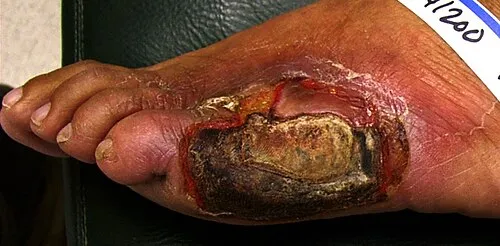
Lower limb amputation removes part of the leg when it is dead, dangerous or a useless burden to the patient. In high-income countries most major amputations follow chronic limb-threatening ischaemia, usually with diabetes, when revascularisation is impossible or has failed; trauma, uncontrollable infection (wet gangrene, necrotising soft-tissue infection, gas gangrene) and malignancy are other causes. Minor amputations (toes, rays, transmetatarsal) aim to preserve a walking foot; major amputations are transtibial (below knee), through-knee and transfemoral (above knee). The level is chosen to balance healing, which needs adequate skin perfusion, against function: keeping the knee greatly reduces the energy cost of walking with a prosthesis. Good care is multidisciplinary: timely decision-making, consultant-led daytime surgery, perineural analgesia, antibiotic and thromboprophylaxis, prevention of contractures and early rehabilitation. Complications include wound failure and re-amputation, infection, phantom and residual limb pain, contracture, falls, venous thromboembolism and cardiovascular death; mortality after major vascular amputation is high, so goals and consent must be discussed honestly.
Patient case, mechanism, investigations, management, flashcards and exam-style questions.Open the lesson →
Key facts
- Indications ('3 Ds'): dead (unreconstructable ischaemia, gangrene), dangerous (sepsis, necrotising infection, malignancy), damned nuisance (painful, useless, deformed limb); plus severe trauma
- Most major amputations in high-income countries are due to PAD, with diabetes in over half
- Minor: toe, ray, transmetatarsal, midfoot; major: Syme, transtibial, through-knee, transfemoral, hip disarticulation
- Transtibial amputation keeps the knee: energy cost of walking is much lower and prosthetic use more likely than after transfemoral amputation
- Staged guillotine amputation controls sepsis first; the definitive amputation follows once infection settles
- Prevent knee flexion contracture after transtibial (knee straight) and hip flexion contracture after transfemoral amputation (prone lying)
- Phantom sensation is almost universal and phantom pain affects most patients at some time; perineural catheters, gabapentinoids and mirror therapy may help
- 30-day mortality after major vascular amputation is roughly 1 in 10 (higher above knee), and a third to a half of patients die within a year
Differential diagnosis
| Condition | Clues | Key test |
|---|---|---|
| Salvageable CLTI | Ischaemic tissue loss with a target vessel and usable vein or endovascular option | Duplex, CT or catheter angiography; vascular MDT |
| Diabetic foot osteomyelitis | Ulcer probing to bone, sausage toe, raised CRP | X-ray, MRI, bone biopsy; may need only ray amputation |
| Necrotising soft-tissue infection | Pain out of proportion, rapidly spreading erythema, crepitus, sepsis | Clinical; urgent surgical exploration; LRINEC is not diagnostic |
| Gas gangrene (clostridial myonecrosis) | Severe pain, bronze skin, crepitus after contaminated wound | X-ray or CT gas in muscle; immediate debridement |
| Acute limb ischaemia | Sudden pain, pallor, pulselessness, paraesthesia, paralysis | Urgent revascularisation if viable; amputation if irreversible (fixed mottling, rigor) |
| Mangled extremity | High-energy injury with bone, soft tissue, nerve and vascular damage | Clinical assessment; scores (for example MESS) inform but do not decide alone |
| Soft-tissue or bone sarcoma | Enlarging deep mass, night pain | MRI and biopsy at a sarcoma centre; limb salvage preferred where possible |
Exam pearls
Guideline
Global Vascular Guidelines on CLTI (2019), IWGDF/ESVS/SVS 2023 PAD in diabetic foot ulcer guideline, ESVS 2025 vascular trauma guideline, VSGBI best practice pathway for major amputation surgery (2016) and NCEPOD 'Lower limb amputation: working together' (2014)
References
- Conte MS, Bradbury AW, Kolh P, et al.. Global Vascular Guidelines on the Management of Chronic Limb-Threatening Ischemia. Eur J Vasc Endovasc Surg 2019.
- Mazzolai L, Teixido-Tura G, Lanzi S, et al.. 2024 ESC Guidelines for the management of peripheral arterial and aortic diseases. Eur Heart J 2024.
- Fitridge R, Chuter V, Mills J, et al.. The intersocietal IWGDF, ESVS, SVS guidelines on peripheral artery disease in people with diabetes and a foot ulcer. Diabetes Metab Res Rev 2023.
- Wahlgren CM, Aylwin C, Davenport RA, et al.. European Society for Vascular Surgery (ESVS) 2025 Clinical Practice Guidelines on the Management of Vascular Trauma. Eur J Vasc Endovasc Surg 2025.
- Vascular Society of Great Britain and Ireland. A best practice clinical care pathway for major amputation surgery. VSGBI 2016.
- National Confidential Enquiry into Patient Outcome and Death (NCEPOD). Lower limb amputation: working together. NCEPOD 2014.
Related topics
By Dr Khalid Seidi (B.Sc., M.D.) · MedEd World Clinical Knowledge library. Original teaching content checked against current guidelines (November 2026); confirm the latest local guidance before clinical use. Not a substitute for clinical judgement.