Clinical Knowledge › Surgery › Breast and endocrine surgery
Breast screening
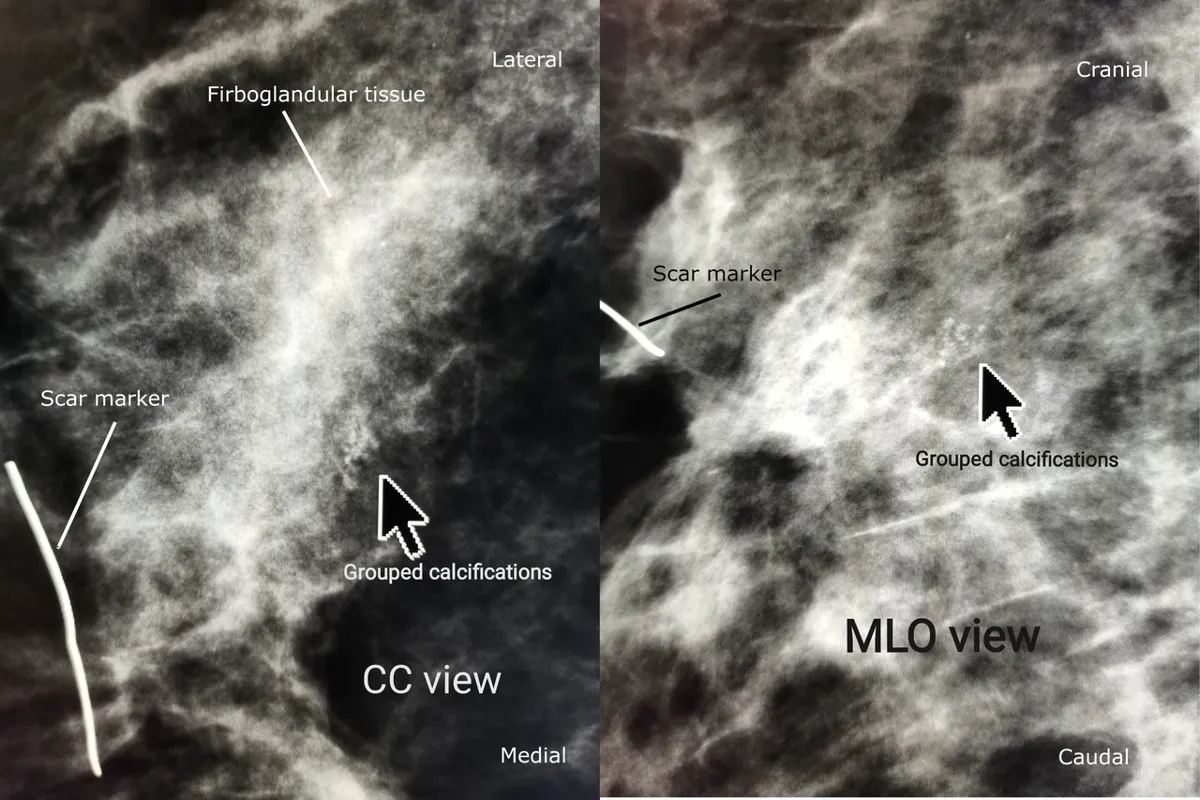
Breast screening uses mammography to find breast cancer in women without symptoms, when tumours are smaller and more often node-negative, so treatment can be less extensive and deaths fewer. Population programmes invite women of average risk at fixed intervals: the NHS invites women aged 50 to 71 every 3 years, the European Commission recommends biennial screening at 50–69 (with options from 45 and to 74), and the US Preventive Services Task Force (2024) recommends biennial mammography from 40 to 74. In invited women, screening reduces breast cancer mortality by about 20%, but it also causes false-positive recalls, biopsies, anxiety and overdiagnosis of cancers that would never have caused harm. Women at higher risk because of BRCA1/2 or TP53 variants, a strong family history or chest irradiation at a young age need earlier, more intensive surveillance with annual MRI. Dense breasts reduce mammographic sensitivity; supplemental MRI, tomosynthesis and artificial intelligence reading are active areas of change. Symptomatic women need triple assessment, not screening.
Patient case, mechanism, investigations, management, flashcards and exam-style questions.Open the lesson →
Key facts
- Screening is for asymptomatic women; any woman with a lump or other symptom needs diagnostic triple assessment, not a screening appointment
- NHS: women aged 50 to their 71st birthday invited every 3 years (self-referral after 71); two-view mammography with double reading
- USPSTF 2024: biennial screening mammography for women aged 40–74 (grade B); evidence insufficient for 75 and over and for supplemental imaging in dense breasts
- European Commission guidelines: biennial screening 50–69 (strong), with conditional options at 45–49 and 70–74
- Benefit: about 20% relative reduction in breast cancer mortality in women invited; harms include false positives, overdiagnosis (about 3 overdiagnosed per death prevented in the UK review), anxiety and small radiation risk
- High-risk women (BRCA1/2 or TP53 carriers, untested women with a high carrier probability, US lifetime risk of 20% or more, chest irradiation before 30) need annual MRI from a younger age, with or without mammography
- Dense breasts lower sensitivity and raise risk; supplemental MRI found more cancers and halved interval cancers in extremely dense breasts (DENSE trial)
- Lead-time and length-time bias and overdiagnosis make survival from diagnosis a misleading measure; screening is judged by mortality in randomised trials
Differential diagnosis
| Condition | Clues | Key test |
|---|---|---|
| Average-risk population screening | No significant family history, no high-risk variant, no chest irradiation | Invite to national programme (age and interval by country) |
| Moderate familial risk | One first-degree relative diagnosed under 40 or two relatives at older ages | Formal risk estimate; annual mammography from 40 in many guidelines |
| High genetic risk (BRCA1/2, PALB2) | Known variant, high carrier probability or very high calculated lifetime risk | Annual MRI from about 25–30, mammography added from about 30–40 |
| Very high risk – TP53 (Li–Fraumeni) | Sarcoma, brain and early breast cancers in family | Annual MRI from 20; avoid routine mammography radiation where possible |
| Previous chest irradiation | Mantle radiotherapy for Hodgkin lymphoma before age 30 | Annual MRI and mammography starting about 8 years after radiotherapy (not before 25) |
| Symptomatic woman | Lump, skin or nipple change, discharge | Diagnostic triple assessment – not screening |
Exam pearls
Guideline
USPSTF Breast Cancer Screening Recommendation (2024), NHS Breast Screening Programme (England, current), European Commission Initiative on Breast Cancer guidelines (2021), ACR higher-than-average risk recommendations (2023) and NICE CG164 Familial breast cancer (2013, updated 2023)
References
- US Preventive Services Task Force; Nicholson WK, Silverstein M, Wong JB, et al.. Screening for breast cancer: US Preventive Services Task Force recommendation statement. JAMA 2024.
- NHS England. NHS Breast Screening Programme: screening programme overview and standards. GOV.UK 2024.
- European Commission Initiative on Breast Cancer. European guidelines on breast cancer screening and diagnosis. European Commission Joint Research Centre 2021.
- Monticciolo DL, Newell MS, Moy L, Lee CS, Destounis SV. Breast cancer screening for women at higher-than-average risk: updated recommendations from the ACR. J Am Coll Radiol 2023.
- National Institute for Health and Care Excellence. Familial breast cancer: classification, care and managing breast cancer and related risks in people with a family history of breast cancer (CG164). NICE 2013.
- Independent UK Panel on Breast Cancer Screening. The benefits and harms of breast cancer screening: an independent review. Lancet 2012.
Related topics
By Dr Khalid Seidi (B.Sc., M.D.) · MedEd World Clinical Knowledge library. Original teaching content checked against current guidelines (November 2026); confirm the latest local guidance before clinical use. Not a substitute for clinical judgement.