Clinical Knowledge › Anaesthesiology › Basics of anaesthesiology
Cardiopulmonary exercise testing and functional capacity
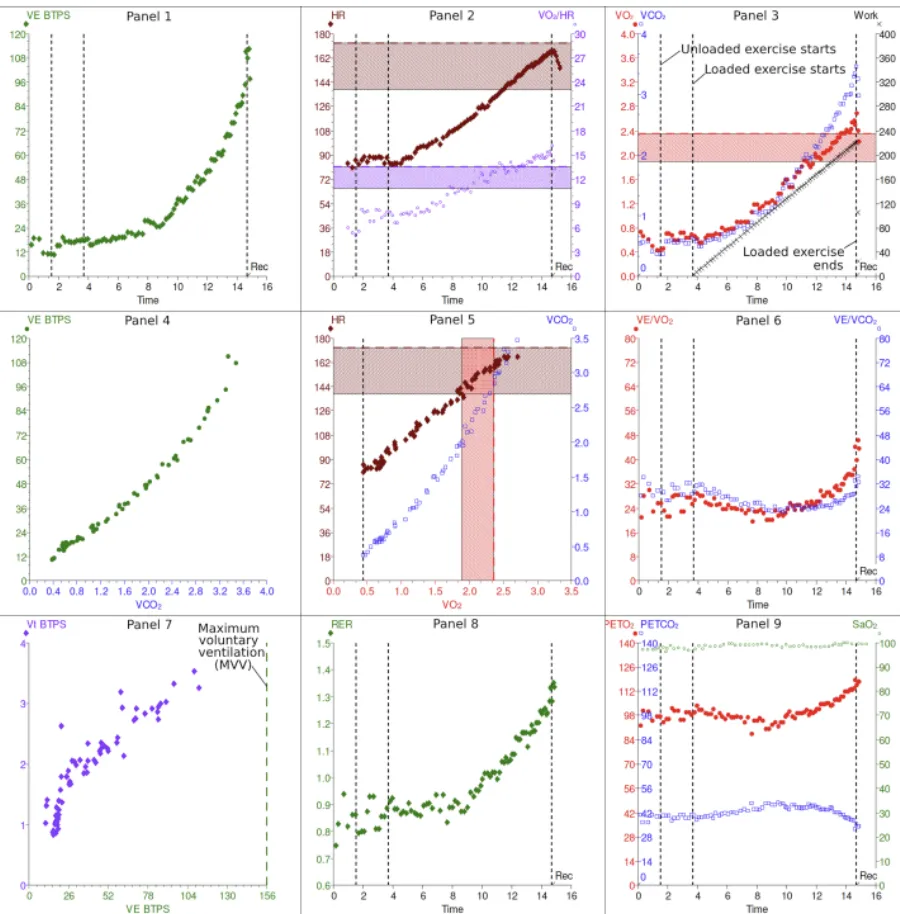
Functional capacity is the ability to increase oxygen delivery and use to meet a rise in demand, such as the stress response to major surgery. It can be estimated by history (metabolic equivalents, METs; 4 METs is about climbing two flights of stairs), by questionnaires such as the Duke Activity Status Index (DASI), by field tests (shuttle walk, 6-minute walk, stair climb) or measured objectively by cardiopulmonary exercise testing (CPET). CPET is a symptom-limited incremental cycle test with breath-by-breath gas analysis, ECG, blood pressure and oximetry. Its key outputs are the anaerobic threshold (AT), peak oxygen uptake (VO2 peak) and ventilatory efficiency (VE/VCO2). An AT below about 11 mL/kg/min, a low VO2 peak and a high VE/VCO2 are associated with more complications and deaths after major abdominal and thoracic surgery. The METS study showed that clinicians' subjective estimates are unreliable and that DASI added prognostic value. CPET results inform shared decision-making, critical care allocation and prehabilitation (POETTS 2018).
Patient case, mechanism, investigations, management, flashcards and exam-style questions.Open the lesson →
Key facts
- 1 MET = resting oxygen consumption of about 3.5 mL O2/kg/min; 4 METs (about 14 mL/kg/min) = climbing two flights of stairs without stopping
- Subjective assessment detected inability to reach 4 METs with only about 19% sensitivity in the METS study (Lancet 2018)
- DASI: 12-item questionnaire (score 0–58.2); estimated VO2 peak = 0.43 × DASI + 9.6 mL/kg/min; a score of about 34 or less suggests poor capacity
- CPET outputs: anaerobic threshold (AT), VO2 peak, VE/VCO2 slope or value at AT, O2 pulse, heart rate and breathing reserve, ECG changes
- Classic thresholds: AT below 11 mL/kg/min (Older 1993) and VO2 peak below about 15 mL/kg/min indicate increased risk after major surgery; VE/VCO2 above about 34 adds risk
- Lung resection (ERS/ESTS): VO2 peak above 20 mL/kg/min (or above 75% predicted) is low risk; below 10 mL/kg/min (or below 35% predicted) is high risk
- Absolute contraindications include acute MI within days, unstable angina, uncontrolled arrhythmia, symptomatic severe aortic stenosis, decompensated heart failure, acute PE and SpO2 85% or less at rest
- Uses: shared decision-making, choice of operation or non-operative option, critical care booking, detection of new disease, and targeting prehabilitation
Differential diagnosis
| Condition | Clues | Key test |
|---|---|---|
| Deconditioning | Low AT and VO2 peak with normal pattern, heart rate and breathing reserve preserved | CPET; improves with training |
| Cardiac limitation (ischaemia or heart failure) | Low AT, flat or falling O2 pulse, ST depression, little heart rate reserve | CPET with ECG; echocardiography |
| Ventilatory limitation (COPD) | Breathing reserve below about 15%, high respiratory rate, possible desaturation | Spirometry; CPET |
| Pulmonary vascular disease | High VE/VCO2, low end-tidal CO2, desaturation on exercise | Echocardiography; CTPA or V/Q |
| Anaemia | Low O2 delivery with low VO2 peak | Full blood count |
| Musculoskeletal or neurological limitation | Stops for leg pain or weakness before physiological limits (low RER) | Clinical; consider arm ergometry |
| Poor effort | Peak respiratory exchange ratio below about 1.0, heart rate well below predicted | RER at peak; repeat test |
Exam pearls
Guideline
POETTS perioperative CPET consensus guidelines 2018; ESC non-cardiac surgery guidelines 2022; ACC/AHA perioperative guideline 2024
References
- Levett DZH, Jack S, Swart M, et al.. Perioperative cardiopulmonary exercise testing (CPET): consensus clinical guidelines on indications, organization, conduct, and physiological interpretation. Br J Anaesth 2018.
- Older P, Smith R, Courtney P, Hone R.. Preoperative evaluation of cardiac failure and ischemia in elderly patients by cardiopulmonary exercise testing. Chest 1993.
- Wijeysundera DN, Pearse RM, Shulman MA, et al.. Assessment of functional capacity before major non-cardiac surgery: an international, prospective cohort study. Lancet 2018.
- Halvorsen S, Mehilli J, Cassese S, et al.. 2022 ESC Guidelines on cardiovascular assessment and management of patients undergoing non-cardiac surgery. Eur Heart J 2022.
- Thompson A, Fleischmann KE, Smilowitz NR, et al.. 2024 AHA/ACC/ACS/ASNC/HRS/SCA/SCCT/SCMR/SVM guideline for perioperative cardiovascular management for noncardiac surgery. Circulation 2024.
- Horvath B, Kloesel B, Todd MM, Cole DJ, Prielipp RC.. The evolution, current value, and future of the American Society of Anesthesiologists physical status classification system. Anesthesiology 2021.
Related topics
By Dr Khalid Seidi (B.Sc., M.D.) · MedEd World Clinical Knowledge library. Original teaching content checked against current guidelines (November 2026); confirm the latest local guidance before clinical use. Not a substitute for clinical judgement.