Clinical Knowledge › Internal medicine › Cardiology and angiology › Clinical problems
Chest pain: approach to the patient
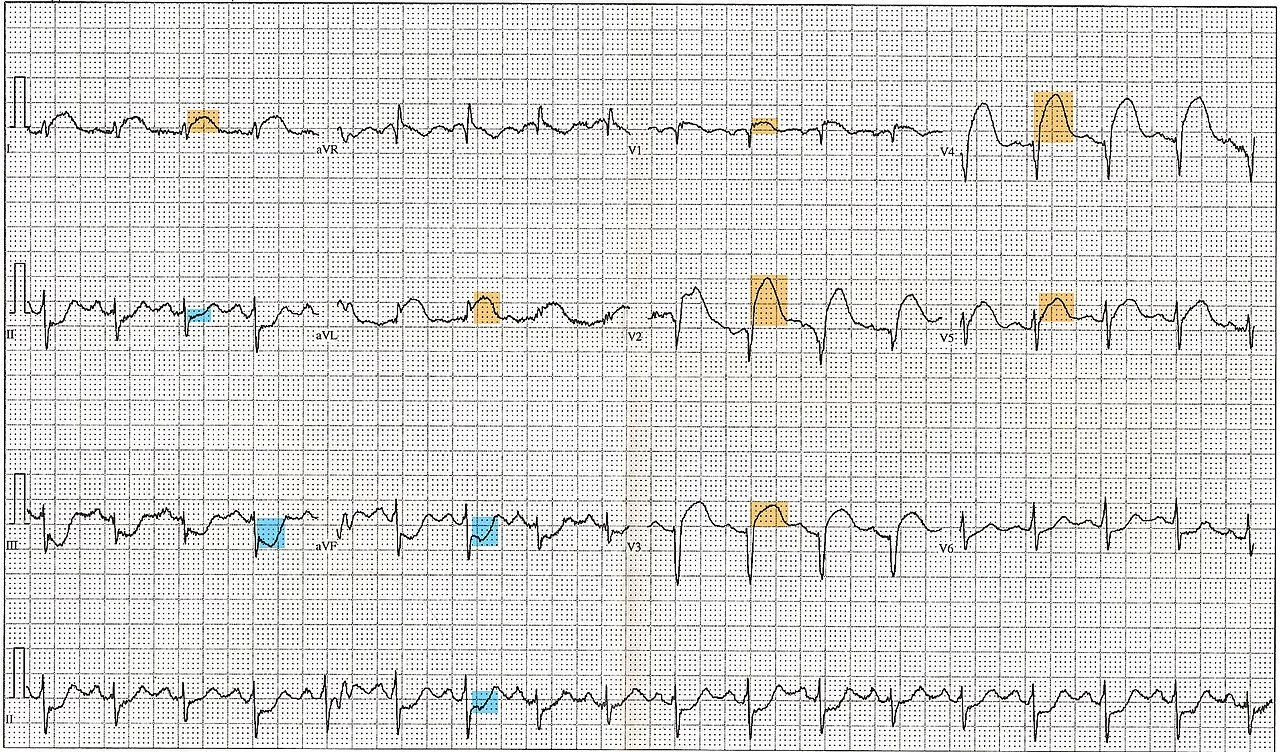
Chest pain is one of the commonest reasons for emergency and primary care visits. Most episodes are musculoskeletal, gastro-oesophageal or anxiety-related, but the first task is to identify the few conditions that kill quickly: acute coronary syndrome, aortic dissection, pulmonary embolism, tension pneumothorax, cardiac tamponade and oesophageal rupture. Every patient with acute chest pain needs observations, a focused history and examination and a 12-lead ECG within 10 minutes. ST elevation triggers immediate reperfusion; otherwise high-sensitivity troponin pathways (0h/1h or 0h/2h) combined with risk scores such as HEART rule myocardial infarction in or out. Tearing pain, pulse or blood pressure differences or a new aortic regurgitation murmur demand CT aortography, and pleuritic pain with breathlessness prompts a probability score for pulmonary embolism. For stable, recurrent chest pain, the 2024 ESC guideline estimates clinical likelihood of coronary disease and favours CT coronary angiography or functional imaging.
Patient case, mechanism, investigations, management, flashcards and exam-style questions.Open the lesson →
Key facts
- Six immediately life-threatening causes: acute coronary syndrome, aortic dissection, pulmonary embolism, tension pneumothorax, cardiac tamponade, oesophageal rupture
- Record and read a 12-lead ECG within 10 minutes of arrival; ST elevation or STEMI equivalent means immediate reperfusion
- Use high-sensitivity troponin with a validated 0h/1h or 0h/2h pathway to rule out or rule in NSTEMI
- Typical angina: constricting discomfort in the chest, neck, jaw or arm, brought on by exertion and relieved by rest or nitrate within 5 minutes
- HEART score (History, ECG, Age, Risk factors, Troponin) 0–3 identifies low-risk patients suitable for early discharge
- Aortic dissection: abrupt severe tearing or ripping pain radiating to the back, pulse deficit, BP difference above 20 mmHg, new AR murmur; CT aortography
- Pleuritic pain with breathlessness and tachycardia: Wells or Geneva score, D-dimer if not high probability, CT pulmonary angiography
- Stable chest pain: CT coronary angiography is first-line when the clinical likelihood of obstructive disease is low to moderate
Differential diagnosis
| Condition | Clues | Key test |
|---|---|---|
| Acute coronary syndrome | Pressure-like pain with radiation to arm or jaw, sweating, risk factors; ECG ischaemia | ECG within 10 minutes, hs-troponin, angiography |
| Aortic dissection | Sudden tearing pain to back, pulse or BP asymmetry, AR murmur, neurological deficit | CT aortography; TOE if unstable |
| Pulmonary embolism | Pleuritic pain, breathlessness, tachycardia, hypoxaemia, DVT signs, risk factors | Wells/Geneva, D-dimer, CT pulmonary angiography |
| Tension pneumothorax | Sudden pain and breathlessness, absent breath sounds, tracheal deviation, hypotension | Clinical diagnosis; immediate decompression |
| Acute pericarditis | Sharp pain worse lying flat, better leaning forward, friction rub, diffuse ST elevation | ECG, CRP, echocardiography |
| Oesophageal rupture (Boerhaave) | Severe pain after forceful vomiting, subcutaneous emphysema, shock | CT chest with oral contrast |
| Gastro-oesophageal reflux or spasm | Burning retrosternal pain related to meals or lying, relieved by antacid | Trial of PPI after cardiac causes excluded; endoscopy if alarm features |
| Musculoskeletal pain | Localised, reproducible on palpation or movement, recent strain | Clinical diagnosis after ECG and risk assessment |
Exam pearls
Guideline
2021 AHA/ACC multisociety chest pain guideline, 2023 ESC and 2025 ACC/AHA acute coronary syndromes guidelines, 2024 ESC chronic coronary syndromes and 2024 ESC peripheral arterial and aortic diseases guidelines
References
- Gulati M, Levy PD, Mukherjee D, et al.. 2021 AHA/ACC/ASE/CHEST/SAEM/SCCT/SCMR Guideline for the Evaluation and Diagnosis of Chest Pain. Circulation 2021.
- Byrne RA, Rossello X, Coughlan JJ, et al.. 2023 ESC Guidelines for the management of acute coronary syndromes. Eur Heart J 2023.
- Rao SV, O'Donoghue ML, Ruel M, et al.. 2025 ACC/AHA/ACEP/NAEMSP/SCAI Guideline for the Management of Patients With Acute Coronary Syndromes. Circulation 2025.
- Vrints C, Andreotti F, Koskinas KC, et al.. 2024 ESC Guidelines for the management of chronic coronary syndromes. Eur Heart J 2024.
- Backus BE, Six AJ, Kelder JC, et al.. A prospective validation of the HEART score for chest pain patients at the emergency department. Int J Cardiol 2013.
- Mazzolai L, Teixido-Tura G, Lanzi S, et al.. 2024 ESC Guidelines for the management of peripheral arterial and aortic diseases. Eur Heart J 2024.
Related topics
By Dr Khalid Seidi (B.Sc., M.D.) · MedEd World Clinical Knowledge library. Original teaching content checked against current guidelines (November 2026); confirm the latest local guidance before clinical use. Not a substitute for clinical judgement.