Clinical Knowledge › Internal medicine › Cardiology and angiology › Clinical problems
Hypotension: approach to the patient
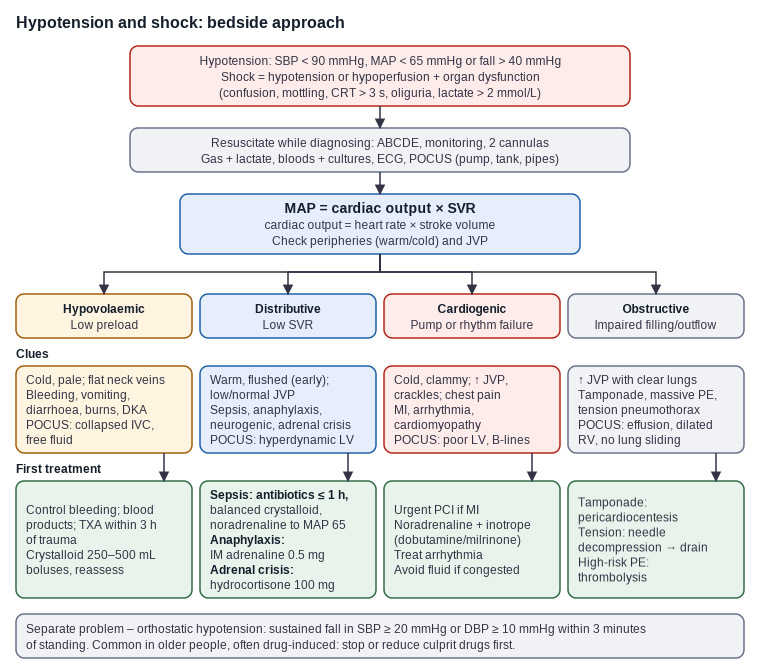
Hypotension is usually defined as a systolic blood pressure below 90 mmHg, a mean arterial pressure (MAP) below 65 mmHg, or a large fall from the patient's usual value. A low reading may be normal in healthy young adults; perfusion is what matters. Shock is circulatory failure with inadequate tissue oxygen delivery, shown by confusion, cool mottled skin, slow capillary refill, oliguria and a raised lactate. Because MAP equals cardiac output multiplied by systemic vascular resistance, shock falls into four groups: hypovolaemic (bleeding, fluid loss), distributive (sepsis, anaphylaxis, neurogenic, adrenal crisis), cardiogenic (pump or rhythm failure) and obstructive (tamponade, massive pulmonary embolism, tension pneumothorax). Resuscitate while diagnosing: ABCDE, lactate, ECG and point-of-care ultrasound, then targeted treatment – antibiotics and noradrenaline in sepsis, IM adrenaline in anaphylaxis, blood and haemorrhage control, revascularisation in cardiogenic shock and relief of obstruction. Orthostatic hypotension is a common separate problem in older people, often drug-induced.
Patient case, mechanism, investigations, management, flashcards and exam-style questions.Open the lesson →
Key facts
- Hypotension: SBP under 90 mmHg or MAP under 65 mmHg (or a fall of more than about 40 mmHg from baseline); shock = hypotension or hypoperfusion with signs of organ dysfunction
- MAP = cardiac output × systemic vascular resistance; cardiac output = heart rate × stroke volume – every shock type fits one of these terms
- Four shock types: hypovolaemic, distributive, cardiogenic and obstructive; cold peripheries suggest low output, warm peripheries suggest vasodilatation
- Septic shock (Sepsis-3): vasopressors needed to keep MAP 65 mmHg or more and lactate above 2 mmol/L despite adequate fluids
- Sepsis-induced hypotension: balanced crystalloid (around 30 mL/kg in the first 3 hours, reassessing), antibiotics within 1 hour, noradrenaline first-line vasopressor targeting MAP 65
- Anaphylaxis: IM adrenaline 0.5 mg (0.5 mL of 1 mg/mL) in the anterolateral thigh for adults, repeated after 5 minutes if needed
- Obstructive shock needs the obstruction relieved: pericardiocentesis for tamponade, needle or finger decompression for tension pneumothorax, thrombolysis for high-risk PE
- Orthostatic hypotension: sustained fall of systolic BP of 20 mmHg or more or diastolic of 10 mmHg or more within 3 minutes of standing
Differential diagnosis
| Condition | Clues | Key test |
|---|---|---|
| Hypovolaemic shock (haemorrhage, GI or renal losses, burns) | Cold, flat neck veins, postural drop, obvious or occult bleeding | Hb, lactate, POCUS (collapsing IVC, free fluid) |
| Septic shock | Fever or hypothermia, source of infection, warm or cold peripheries | Lactate, blood cultures, source imaging |
| Anaphylaxis | Rapid onset after trigger, urticaria, angioedema, wheeze | Clinical; mast cell tryptase |
| Cardiogenic shock | Chest pain, crackles, raised JVP, cold and clammy, arrhythmia | ECG, troponin, echo |
| Obstructive shock (tamponade, PE, tension pneumothorax) | Raised JVP with clear lungs; muffled sounds, pulsus paradoxus, tracheal deviation | POCUS: effusion, dilated RV, absent lung sliding |
| Neurogenic shock | Spinal injury, bradycardia, warm dry skin | Clinical; spinal imaging |
| Adrenal crisis | Known steroid use or Addison's, vomiting, hyponatraemia, hyperkalaemia | Cortisol (do not delay hydrocortisone) |
| Orthostatic hypotension / reflex syncope | Symptoms on standing, drugs, autonomic failure; recovers lying down | Lying and standing BP, ECG |
Exam pearls
Guideline
Surviving Sepsis Campaign 2021 and Sepsis-3 definitions, 2025 ACC cardiogenic shock consensus, 2026 ESC heart failure guideline, ERC 2025 resuscitation guidelines, WAO 2020 anaphylaxis guidance, 2026 AHA/ACC acute pulmonary embolism guideline, 2018 ESC syncope guideline and 2011 consensus definition of orthostatic hypotension
References
- Evans L, Rhodes A, Alhazzani W, et al.. Surviving Sepsis Campaign: International Guidelines for Management of Sepsis and Septic Shock 2021. Crit Care Med 2021.
- Singer M, Deutschman CS, Seymour CW, et al.. The Third International Consensus Definitions for Sepsis and Septic Shock (Sepsis-3). JAMA 2016.
- Sinha SS, Morrow DA, Kapur NK, Kataria R, Roswell RO.. 2025 Concise Clinical Guidance: an ACC Expert Consensus Statement on the evaluation and management of cardiogenic shock. J Am Coll Cardiol 2025.
- Køber L, Adamo M, Ruwald AC, et al.. 2026 ESC Guidelines for the management of heart failure. Eur Heart J 2026.
- Brignole M, Moya A, de Lange FJ, et al.. 2018 ESC Guidelines for the diagnosis and management of syncope. Eur Heart J 2018.
- Freeman R, Wieling W, Axelrod FB, et al.. Consensus statement on the definition of orthostatic hypotension, neurally mediated syncope and the postural tachycardia syndrome. Clin Auton Res 2011.
Related topics
By Dr Khalid Seidi (B.Sc., M.D.) · MedEd World Clinical Knowledge library. Original teaching content checked against current guidelines (November 2026); confirm the latest local guidance before clinical use. Not a substitute for clinical judgement.