Clinical Knowledge › Internal medicine › Haematology and oncology › Basics of haematology and oncology
Coagulation tests (PT, APTT, fibrinogen, D-dimer)
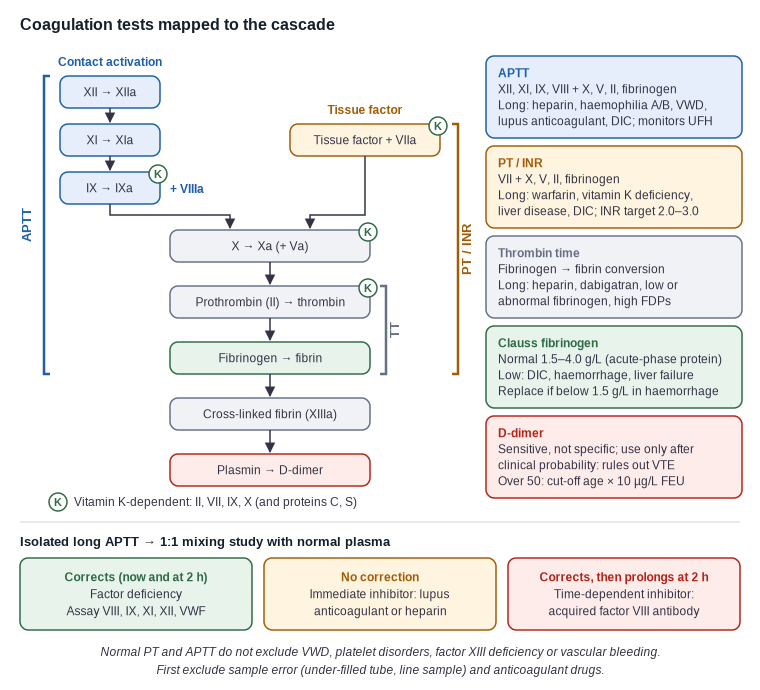
The coagulation screen – prothrombin time (PT) with INR, activated partial thromboplastin time (APTT), fibrinogen and often thrombin time – measures how quickly citrated plasma clots after a trigger. PT reflects the extrinsic and common pathways (factors VII, X, V, II, fibrinogen) and is prolonged by warfarin, vitamin K deficiency and liver disease; APTT reflects the intrinsic and common pathways (XII, XI, IX, VIII) and is prolonged by heparin, haemophilia, von Willebrand disease and lupus anticoagulant. A mixing study separates factor deficiency (corrects) from an inhibitor (does not). Fibrinogen falls in DIC, massive haemorrhage and severe liver disease. D-dimer, a breakdown product of cross-linked fibrin, is sensitive but not specific: its value is ruling out venous thromboembolism when clinical probability is low, using age-adjusted or probability-adjusted cut-offs. The ISTH 2025 DIC score combines platelets, D-dimer, PT and fibrinogen. Normal screening tests do not exclude mild bleeding disorders, platelet dysfunction or factor XIII deficiency.
Patient case, mechanism, investigations, management, flashcards and exam-style questions.Open the lesson →
Key facts
- PT/INR: factors VII, X, V, II and fibrinogen; INR standardises PT for vitamin K antagonist monitoring (target usually 2.0–3.0)
- APTT: factors XII, XI, IX, VIII plus the common pathway; used to monitor unfractionated heparin
- Isolated prolonged APTT with bleeding: haemophilia A or B, VWD or acquired factor VIII inhibitor; without bleeding: lupus anticoagulant or factor XII deficiency
- Mixing study (1:1 with normal plasma): correction = factor deficiency; no correction = inhibitor (lupus anticoagulant, acquired factor VIII antibody, heparin)
- Clauss fibrinogen normal 1.5–4.0 g/L; below 1.5 g/L in major haemorrhage should be replaced (cryoprecipitate or fibrinogen concentrate)
- D-dimer: high sensitivity, low specificity; use only after clinical probability assessment; age-adjusted cut-off = age × 10 µg/L FEU in patients over 50
- ISTH 2025 overt DIC score ≥5 from platelets, D-dimer (multiples of upper limit), PT prolongation and fibrinogen
- Normal PT and APTT do not exclude VWD, platelet disorders, factor XIII deficiency or vascular bleeding
Differential diagnosis
| Condition | Clues | Key test |
|---|---|---|
| Vitamin K antagonist or vitamin K deficiency | Prolonged PT/INR, normal or mildly long APTT, normal fibrinogen; malnutrition, antibiotics, malabsorption | Vitamin K trial; factor II, VII, IX, X |
| Liver disease | Prolonged PT, later APTT; low albumin; factor VIII normal or high | LFTs, factor V and VIII |
| DIC | Prolonged PT and APTT, low fibrinogen and platelets, very high D-dimer in sepsis, trauma, APL, obstetric events | ISTH DIC score; repeat serially |
| Haemophilia A or B | Isolated long APTT that corrects on mixing; joint or muscle bleeds; male | Factor VIII and IX assays |
| Lupus anticoagulant | Isolated long APTT not corrected by mixing; thrombosis or pregnancy loss, not bleeding | dRVVT and LA-sensitive APTT with confirm step |
| Heparin contamination or therapy | Long APTT and thrombin time, normal reptilase time | Anti-Xa level; check line sampling |
| Pre-analytical artefact | Under-filled citrate tube or haematocrit >0.55 falsely prolongs clotting times | Repeat correctly filled sample; adjust citrate |
Exam pearls
Guideline
ISTH SSC updated definition and scoring of DIC (2025), ISTH lupus anticoagulant guidance (2020) and ESC/ERS acute pulmonary embolism guideline (2019) for D-dimer use
References
- Iba T, Levy JH, Maier CL, et al.. Updated definition and scoring of disseminated intravascular coagulation in 2025: communication from the ISTH SSC Subcommittee on Disseminated Intravascular Coagulation. J Thromb Haemost 2025.
- Taylor FB Jr, Toh CH, Hoots WK, Wada H, Levi M.. Towards definition, clinical and laboratory criteria, and a scoring system for disseminated intravascular coagulation. Thromb Haemost 2001.
- Devreese KMJ, de Groot PG, de Laat B, et al.. Guidance from the Scientific and Standardization Committee for lupus anticoagulant/antiphospholipid antibodies of the ISTH: update of the guidelines for lupus anticoagulant detection and interpretation. J Thromb Haemost 2020.
- Konstantinides SV, Meyer G, Becattini C, et al.. 2019 ESC Guidelines for the diagnosis and management of acute pulmonary embolism developed in collaboration with the European Respiratory Society (ERS). Eur Heart J 2020.
- Bain BJ.. Blood Cells: A Practical Guide. Wiley-Blackwell 2022.
- Cuker A, Arepally GM, Chong BH, et al.. American Society of Hematology 2018 guidelines for management of venous thromboembolism: heparin-induced thrombocytopenia. Blood Adv 2018.
Related topics
By Dr Khalid Seidi (B.Sc., M.D.) · MedEd World Clinical Knowledge library. Original teaching content checked against current guidelines (November 2026); confirm the latest local guidance before clinical use. Not a substitute for clinical judgement.