Clinical Knowledge › Internal medicine › Haematology and oncology › Basics of haematology and oncology
Full blood count and blood film interpretation
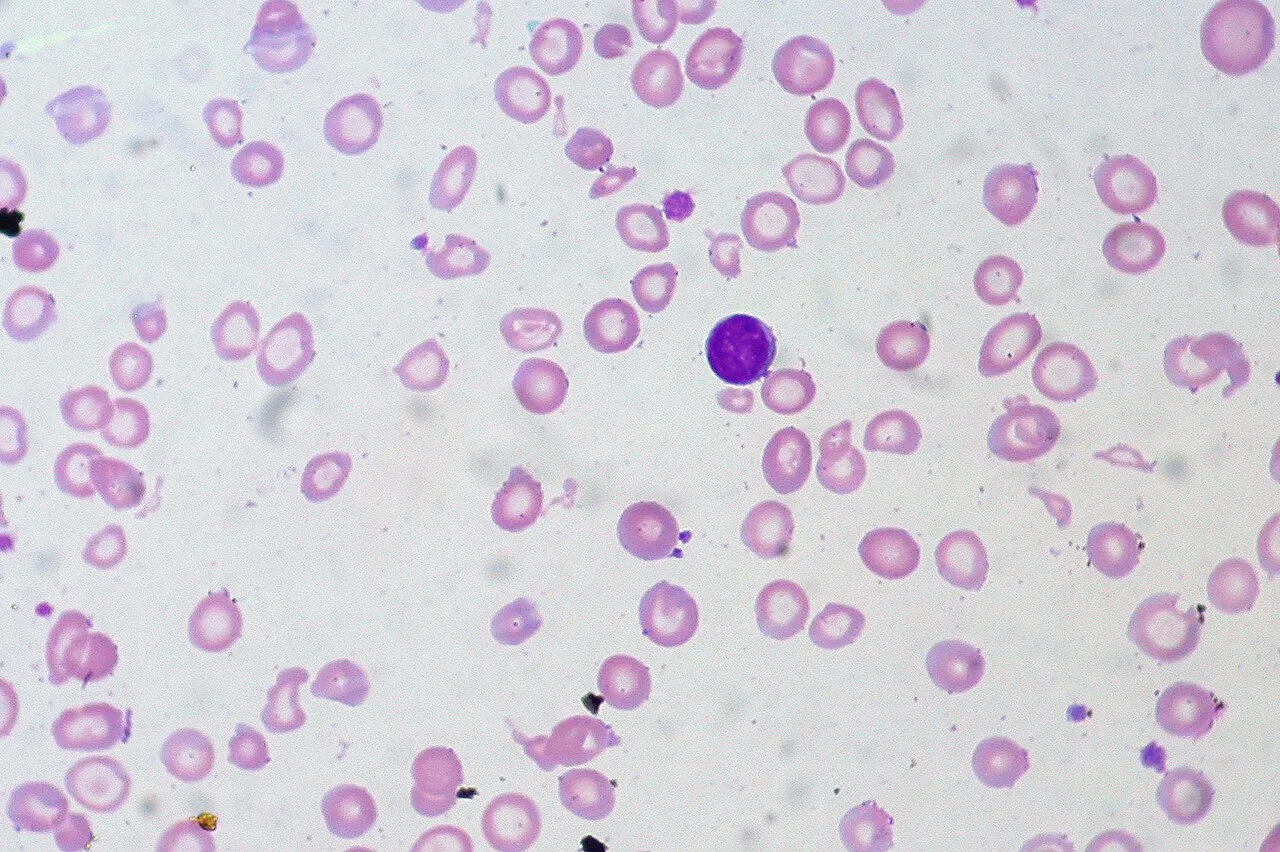
The full blood count (FBC, complete blood count) is the most requested blood test in medicine. An automated analyser measures haemoglobin, red cell count and indices (MCV, MCH, MCHC, RDW), the white cell count with a five-part differential, and platelets; many also report reticulocytes and immature granulocytes. The blood film adds what numbers cannot: red cell shape (spherocytes, schistocytes, target and sickle cells), inclusions, white cell maturity (blasts, Auer rods, smear cells) and platelet clumps. Interpretation is systematic: check the patient and sample, look at each cell line, ask whether one or several lines are affected, compare with previous results, and decide whether the film needs urgent review. Reference ranges vary with age, sex, pregnancy, altitude and ancestry; WHO 2024 updated haemoglobin cut-offs for anaemia. Critical findings – blasts, fragmented red cells with low platelets, severe neutropenia, very high white counts – need same-day action.
Patient case, mechanism, investigations, management, flashcards and exam-style questions.Open the lesson →
Key facts
- WHO 2024 anaemia thresholds at sea level: Hb <130 g/L (13.0 g/dL) in men, <120 g/L in non-pregnant women, <110 g/L in pregnancy (first and third trimesters) and <105 g/L in the second trimester
- MCV classifies anaemia: microcytic <80 fL, normocytic 80–100 fL, macrocytic >100 fL
- MCHC above about 370 g/L suggests spherocytes or an artefact (cold agglutinins, lipaemia); it is rarely a true finding otherwise
- A raised RDW means mixed cell sizes: early iron deficiency, combined deficiency or recent transfusion; thalassaemia trait often has a normal RDW
- Reticulocyte count separates underproduction (low) from haemolysis or bleeding (high); a normal response to anaemia is above about 100 × 10⁹/L
- Neutropenia: mild 1.0–1.5, moderate 0.5–1.0, severe <0.5 × 10⁹/L; Duffy-null associated neutrophil count is a benign variant common in people of African and Middle Eastern ancestry
- Low platelets with platelet clumps on the film is EDTA pseudothrombocytopenia: repeat in a citrate tube
- Blasts, schistocytes with thrombocytopenia, or a white count above 100 × 10⁹/L need same-day haematology review
Differential diagnosis
| Condition | Clues | Key test |
|---|---|---|
| True anaemia | Low Hb confirmed on repeat, with symptoms or a falling trend | Repeat FBC, reticulocytes, film, haematinics |
| Haemodilution | Low Hb after large IV fluid volumes or in late pregnancy, other lines diluted too | Repeat after fluid balance; compare earlier counts |
| EDTA pseudothrombocytopenia | Very low platelets with no bleeding; clumps on film | Repeat count in citrate or heparin tube |
| Cold agglutinins | Low RBC count, very high MCV and MCHC; agglutinates on film | Warm the sample to 37 °C and repeat; DAT |
| Spurious leucocytosis | Nucleated red cells or unlysed red cells counted as white cells | Film review; corrected WCC |
| Benign Duffy-null associated neutrophil count | Mild persistent neutropenia, well person of African or Middle Eastern ancestry, no infections | Duffy (Fy a−b−) phenotype; repeat counts |
| Sample ageing | Delayed sample: MCV rises, platelets fall, white cells look smudged | Repeat fresh sample |
Exam pearls
Guideline
WHO Guideline on haemoglobin cutoffs to define anaemia (2024) with ICSH recommendations on blood cell morphology (2015) and WHO-HAEM5 / ICC 2022 classifications
References
- World Health Organization. Guideline on haemoglobin cutoffs to define anaemia in individuals and populations. WHO, Geneva 2024.
- Palmer L, Briggs C, McFadden S, et al.. ICSH recommendations for the standardization of nomenclature and grading of peripheral blood cell morphological features. Int J Lab Hematol 2015.
- Bain BJ.. Diagnosis from the blood smear. N Engl J Med 2005.
- Bain BJ.. Blood Cells: A Practical Guide. Wiley-Blackwell 2022.
- Snook J, Bhala N, Beales ILP, et al.. British Society of Gastroenterology guidelines for the management of iron deficiency anaemia in adults. Gut 2021.
- Khoury JD, Solary E, Abla O, et al.. The 5th edition of the World Health Organization Classification of Haematolymphoid Tumours: Myeloid and Histiocytic/Dendritic Neoplasms. Leukemia 2022.
Related topics
By Dr Khalid Seidi (B.Sc., M.D.) · MedEd World Clinical Knowledge library. Original teaching content checked against current guidelines (November 2026); confirm the latest local guidance before clinical use. Not a substitute for clinical judgement.