Clinical Knowledge › Internal medicine › Nephrology › Chronic kidney disease and kidney replacement therapy
Conservative kidney management
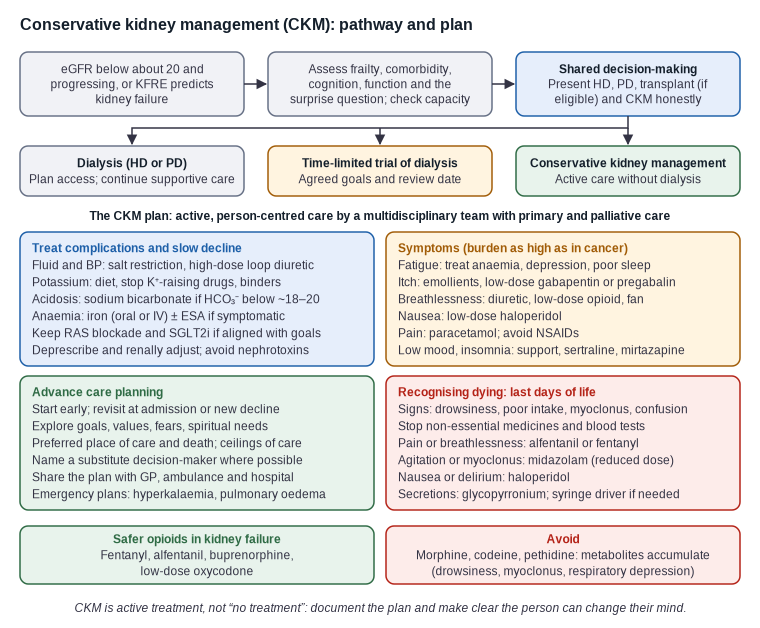
Conservative kidney management (CKM) is planned, holistic care for a person with kidney failure who chooses, through shared decision-making, not to start dialysis. It is active treatment, not 'no treatment': it continues measures that slow kidney decline, manages complications such as anaemia, acidosis, fluid overload and hyperkalaemia, treats symptoms (fatigue, itch, breathlessness, nausea, pain, low mood), supports nutrition and carers, and plans for the end of life with advance care planning. It suits mainly older, frail people with several serious illnesses, in whom dialysis may add little or no survival but brings a heavy burden of travel, hospital stays and procedures. Evidence comes from observational studies: dialysis may prolong life in fitter patients, but the gain shrinks with age, frailty and comorbidity, while CKM is linked with similar quality of life, fewer hospital admissions and more deaths at home. The ASN 2026 guidance, KDIGO 2024 and NICE NG107 all ask clinicians to present CKM alongside dialysis and transplantation as a valid option.
Patient case, mechanism, investigations, management, flashcards and exam-style questions.Open the lesson →
Key facts
- CKM is active, person-centred care of kidney failure without dialysis, delivered by a multidisciplinary team with primary and palliative care
- It should be offered as an option alongside haemodialysis, peritoneal dialysis and transplantation to everyone approaching kidney failure
- Survival benefit of dialysis is small or uncertain in people aged about 80 or more with frailty or major comorbidity, especially ischaemic heart disease
- Prognostic tools help: the 'surprise question', frailty scales, comorbidity scores and the KFRE (interpreted with the competing risk of death)
- Core medical care: BP and fluid control with loop diuretics, potassium management, sodium bicarbonate for acidosis, iron and ESA for symptomatic anaemia, and renally appropriate prescribing
- Symptom burden is as high as in cancer: fatigue, pruritus, breathlessness, pain, poor appetite, insomnia, restless legs and depression
- Safer opioids in kidney failure are fentanyl, alfentanil, buprenorphine and low-dose oxycodone; avoid morphine, codeine and pethidine
- Advance care planning should cover preferred place of care and death, ceilings of treatment and the option of a time-limited trial of dialysis
Differential diagnosis
| Condition | Clues | Key test |
|---|---|---|
| Conservative kidney management (planned) | Informed choice not to dialyse; holistic active care | Documented shared decision and care plan |
| Dialysis decision deferred (watchful waiting) | Patient undecided or eGFR stable; may still choose dialysis | Regular review of symptoms and eGFR |
| Time-limited trial of dialysis | Dialysis started with agreed review point and goals | Review against agreed goals |
| Withdrawal from dialysis | Patient already on dialysis chooses to stop | Survival usually days to weeks; palliative plan |
| Reversible deterioration | AKI on CKD from drugs, infection, obstruction or volume depletion | History, drug review, ultrasound, urine |
| Depression affecting decisions | Low mood, hopelessness driving refusal | Screen and treat; reassess decision |
| Lack of capacity | Delirium or dementia affects understanding | Capacity assessment; best-interests process |
Exam pearls
Guideline
ASN Kidney Health Guidance on Conservative Management (2026), KDIGO 2024 CKD guideline, NICE NG107 renal replacement therapy and conservative management (2018) and KDIGO 2015 supportive care controversies conference
References
- Wong SPY, Schell JO, Bursic AE, et al.. ASN Kidney Health Guidance on Conservative Management in People with Kidney Failure. J Am Soc Nephrol 2026.
- Kidney Disease: Improving Global Outcomes (KDIGO) CKD Work Group. KDIGO 2024 Clinical Practice Guideline for the Evaluation and Management of Chronic Kidney Disease. Kidney Int 2024.
- National Institute for Health and Care Excellence (NICE). Renal replacement therapy and conservative management (NG107). NICE guideline 2018.
- Davison SN, Levin A, Moss AH, et al.. Executive summary of the KDIGO Controversies Conference on Supportive Care in Chronic Kidney Disease: developing a roadmap to improving quality care. Kidney Int 2015.
- Yang JW, Natale P, Kim S, et al.. Conservative kidney management versus dialysis for stage 5 chronic kidney disease in older people. Cochrane Database Syst Rev 2025.
- Scripcariu D, Covic A, Agavriloaei LM, et al.. Dialysis versus conservative kidney management in older adults: why one size does not fit all. Int Urol Nephrol 2026.
Related topics
By Dr Khalid Seidi (B.Sc., M.D.) · MedEd World Clinical Knowledge library. Original teaching content checked against current guidelines (November 2026); confirm the latest local guidance before clinical use. Not a substitute for clinical judgement.