Clinical Knowledge › Internal medicine › Nephrology › Chronic kidney disease and kidney replacement therapy
Peritoneal dialysis
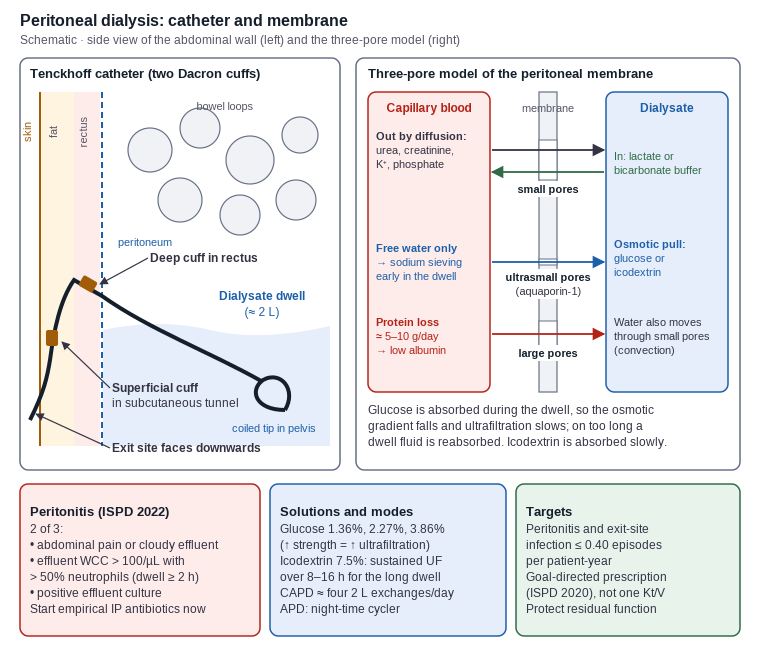
Peritoneal dialysis (PD) uses the patient's own peritoneum as the dialysis membrane. Dialysate containing glucose or icodextrin runs in through a tunnelled Tenckhoff catheter, dwells and is drained: solutes move by diffusion down concentration gradients and water is removed by osmotic ultrafiltration. It is done at home, either as continuous ambulatory PD (CAPD, about four manual exchanges a day) or automated PD (APD, a night-time cycler). Compared with haemodialysis it preserves residual kidney function longer, avoids vascular access and needles, and lets people work and travel; survival is broadly similar. The main threats are peritonitis (cloudy effluent and abdominal pain), exit-site infection, mechanical problems (poor drainage, leaks, hernias, hydrothorax), glucose absorption, hypokalaemia and, rarely, encapsulating peritoneal sclerosis. The ISPD 2020 prescribing recommendations moved from a single Kt/V target to person-centred, goal-directed PD, and the ISPD 2022 and 2023 updates set peritonitis and exit-site infection rate targets of no more than 0.40 episodes per patient-year.
Patient case, mechanism, investigations, management, flashcards and exam-style questions.Open the lesson →
Key facts
- PD removes solutes by diffusion across the peritoneal capillaries and water by osmotic ultrafiltration created by glucose (1.36%, 2.27%, 3.86%; 1.5–4.25% dextrose in North America) or icodextrin
- CAPD uses about four 2-litre exchanges a day; APD uses a cycler overnight, often with a daytime dwell of icodextrin
- Peritonitis is diagnosed by 2 of 3: abdominal pain or cloudy effluent, effluent white cells above 100/µL with over 50% neutrophils (after a dwell of at least 2 hours), and positive effluent culture
- Start empirical intraperitoneal antibiotics at once, covering Gram-positives (vancomycin or a first-generation cephalosporin) and Gram-negatives (ceftazidime, cefepime or an aminoglycoside)
- ISPD 2022 targets: overall peritonitis rate no more than 0.40 episodes per patient-year and more than 80% of patients peritonitis-free each year
- Remove the catheter for refractory peritonitis (effluent not clear after 5 days of appropriate antibiotics), fungal peritonitis, and relapsing peritonitis or exit-site/tunnel infection that will not settle
- The peritoneal equilibration test (4-hour dialysate-to-plasma creatinine ratio) classifies membranes as fast (high) or slow (low) transporters and guides dwell length
- PD preserves residual kidney function better than haemodialysis; protecting it (avoid nephrotoxins, consider RAS blockade, avoid hypovolaemia) improves survival and fluid control
Differential diagnosis
| Condition | Clues | Key test |
|---|---|---|
| PD peritonitis (bacterial) | Cloudy bag, abdominal pain, fever; effluent WCC above 100/µL, over 50% neutrophils | Effluent cell count, Gram stain and culture in blood culture bottles |
| Secondary (surgical) peritonitis | Multiple enteric organisms, anaerobes, free air, very ill patient | CT abdomen, surgical review |
| Eosinophilic peritonitis | Cloudy effluent early after catheter insertion, eosinophils above 10%, sterile cultures | Effluent differential count |
| Chylous or haemorrhagic effluent | Milky effluent with high triglycerides (calcium-channel blockers, lymphoma); bloody effluent with menstruation or ovulation | Effluent triglycerides, haematocrit |
| Exit-site or tunnel infection | Pus, redness at exit site, tenderness along tunnel; effluent may be clear | Exit-site swab, ultrasound of tunnel |
| Spontaneous bacterial peritonitis in cirrhosis | Ascites without a catheter, liver disease | Ascitic neutrophils 250/µL or more |
| Encapsulating peritoneal sclerosis | Long PD duration, recurrent obstruction, weight loss, poor ultrafiltration | CT showing thickened, calcified peritoneum and cocooned bowel |
Exam pearls
Guideline
ISPD practice recommendations: prescribing high-quality goal-directed PD (2020), peritonitis (2022 update) and catheter-related infection (2023 update), with KDIGO 2024 CKD guideline
References
- Li PK, Chow KM, Cho Y, et al.. ISPD peritonitis guideline recommendations: 2022 update on prevention and treatment. Perit Dial Int 2022.
- Chow KM, Li PK, Cho Y, et al.. ISPD Catheter-related Infection Recommendations: 2023 Update. Perit Dial Int 2023.
- Brown EA, Blake PG, Boudville N, et al.. International Society for Peritoneal Dialysis practice recommendations: Prescribing high-quality goal-directed peritoneal dialysis. Perit Dial Int 2020.
- Wang AY, Dong J, Xu X, Davies S. Volume management as a key dimension of a high-quality PD prescription. Perit Dial Int 2020.
- Teitelbaum I, Glickman J, Neu A, et al.. KDOQI US Commentary on the 2020 ISPD Practice Recommendations for Prescribing High-Quality Goal-Directed Peritoneal Dialysis. Am J Kidney Dis 2021.
- Kidney Disease: Improving Global Outcomes (KDIGO) CKD Work Group. KDIGO 2024 Clinical Practice Guideline for the Evaluation and Management of Chronic Kidney Disease. Kidney Int 2024.
Related topics
By Dr Khalid Seidi (B.Sc., M.D.) · MedEd World Clinical Knowledge library. Original teaching content checked against current guidelines (November 2026); confirm the latest local guidance before clinical use. Not a substitute for clinical judgement.