Clinical Knowledge › Internal medicine › Nephrology › Chronic kidney disease and kidney replacement therapy
Kidney disease in pregnancy
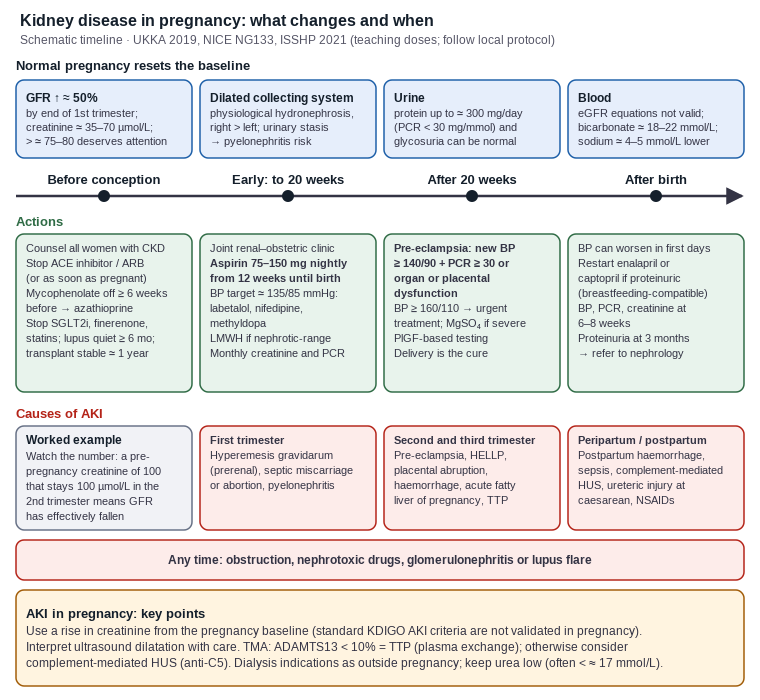
Pregnancy changes the kidney profoundly: GFR rises by about half, so serum creatinine falls and a 'normal' non-pregnant value may hide significant disease; the collecting systems dilate; proteinuria up to about 300 mg/day and glycosuria can be normal. Kidney disease in pregnancy covers three situations. First, women with pre-existing CKD, lupus nephritis, a transplant or on dialysis, who face more pre-eclampsia, preterm birth and fetal growth restriction and risk losing kidney function; outcomes are best with pre-conception planning, stable disease, safe drugs and multidisciplinary care. Second, acute kidney injury in pregnancy, from hyperemesis and sepsis early to pre-eclampsia, HELLP, haemorrhage, acute fatty liver and thrombotic microangiopathy later. Third, new kidney disease unmasked by pregnancy. Key actions are replacing ACE inhibitors, ARBs and mycophenolate before conception, low-dose aspirin from 12 weeks, treating BP to about 135/85 mmHg with labetalol or nifedipine, thromboprophylaxis in nephrotic women, and following women up after pre-eclampsia or AKI.
Patient case, mechanism, investigations, management, flashcards and exam-style questions.Open the lesson →
Key facts
- GFR rises about 50% by the end of the first trimester; creatinine falls, and values above about 75–80 µmol/L (0.85–0.9 mg/dL) deserve attention; eGFR equations are not valid in pregnancy
- Normal pregnancy brings physiological hydronephrosis (right more than left), proteinuria up to about 300 mg/day (PCR below 30 mg/mmol), glycosuria and mild respiratory alkalosis
- Pre-existing CKD raises the risk of pre-eclampsia, preterm birth and growth restriction; risk rises with CKD stage, hypertension and proteinuria
- Stop ACE inhibitors and ARBs before conception or as soon as pregnancy is confirmed (fetal renal toxicity in later pregnancy); stop mycophenolate at least 6 weeks before conception; stop SGLT2 inhibitors, finerenone and statins
- Aspirin 75–150 mg nightly from 12 weeks until birth for women with CKD (high pre-eclampsia risk); ASPRE used 150 mg; teaching dose, check local guidance
- Target BP about 135/85 mmHg using labetalol, nifedipine or methyldopa; CHAP showed benefit from treating mild chronic hypertension
- Lupus nephritis should be quiescent for at least 6 months before conception; continue hydroxychloroquine; azathioprine and tacrolimus are compatible with pregnancy
- Pre-eclampsia is new hypertension after 20 weeks with proteinuria or maternal organ or uteroplacental dysfunction; delivery is the cure; magnesium sulfate prevents eclampsia
Differential diagnosis
| Condition | Clues | Key test |
|---|---|---|
| Pre-eclampsia | New hypertension after 20 weeks with proteinuria or organ dysfunction; low PlGF | BP, urine PCR, platelets, LFTs, creatinine, sFlt-1/PlGF |
| Lupus nephritis flare | Active sediment (red cell casts), low complement, rising anti-dsDNA, may be before 20 weeks | C3, C4, anti-dsDNA, urine microscopy; biopsy if early |
| HELLP syndrome | Haemolysis, raised liver enzymes, low platelets, epigastric pain | Blood film, LDH, ALT, platelets |
| Acute fatty liver of pregnancy | Third trimester, vomiting, hypoglycaemia, jaundice, coagulopathy | Glucose, bilirubin, clotting, Swansea criteria |
| Pregnancy-associated TMA (TTP or complement-mediated HUS) | Severe thrombocytopenia and haemolysis; TTP antepartum, aHUS often postpartum | ADAMTS13 activity, blood film |
| Acute pyelonephritis | Fever, loin pain, pyuria; more common in pregnancy | Urine culture, ultrasound |
| Prerenal AKI | Hyperemesis gravidarum, haemorrhage, sepsis | Volume assessment, urine sodium |
| Pre-existing undiagnosed CKD | Proteinuria or hypertension before 20 weeks | Pre-pregnancy results, ultrasound, postpartum review |
Exam pearls
Guideline
UK Kidney Association guideline on pregnancy and renal disease (2019), NICE NG133 hypertension in pregnancy (2019, updated 2023), ISSHP 2021 recommendations, KDIGO 2024 lupus nephritis guideline and KDIGO 2025 Women and Kidney Health Controversies Conference
References
- Wiles K, Chappell L, Clark K, et al.. Clinical practice guideline on pregnancy and renal disease. BMC Nephrol 2019.
- National Institute for Health and Care Excellence (NICE). Hypertension in pregnancy: diagnosis and management (NG133). NICE guideline 2019.
- Magee LA, Brown MA, Hall DR, et al.. The 2021 International Society for the Study of Hypertension in Pregnancy classification, diagnosis & management recommendations for international practice. Pregnancy Hypertens 2022.
- Piccoli GB, Ahmed SB, Fakhouri F, et al.. Women and kidney health: conclusions from a Kidney Disease: Improving Global Outcomes (KDIGO) Controversies Conference. Kidney Int 2025.
- Kidney Disease: Improving Global Outcomes (KDIGO) Lupus Nephritis Work Group. KDIGO 2024 Clinical Practice Guideline for the Management of Lupus Nephritis. Kidney Int 2024.
- Rolnik DL, Wright D, Poon LC, et al.. Aspirin versus Placebo in Pregnancies at High Risk for Preterm Preeclampsia. N Engl J Med 2017.
Related topics
By Dr Khalid Seidi (B.Sc., M.D.) · MedEd World Clinical Knowledge library. Original teaching content checked against current guidelines (November 2026); confirm the latest local guidance before clinical use. Not a substitute for clinical judgement.