Clinical Knowledge › Neurology › Basics of neurology
Electroencephalography (EEG)
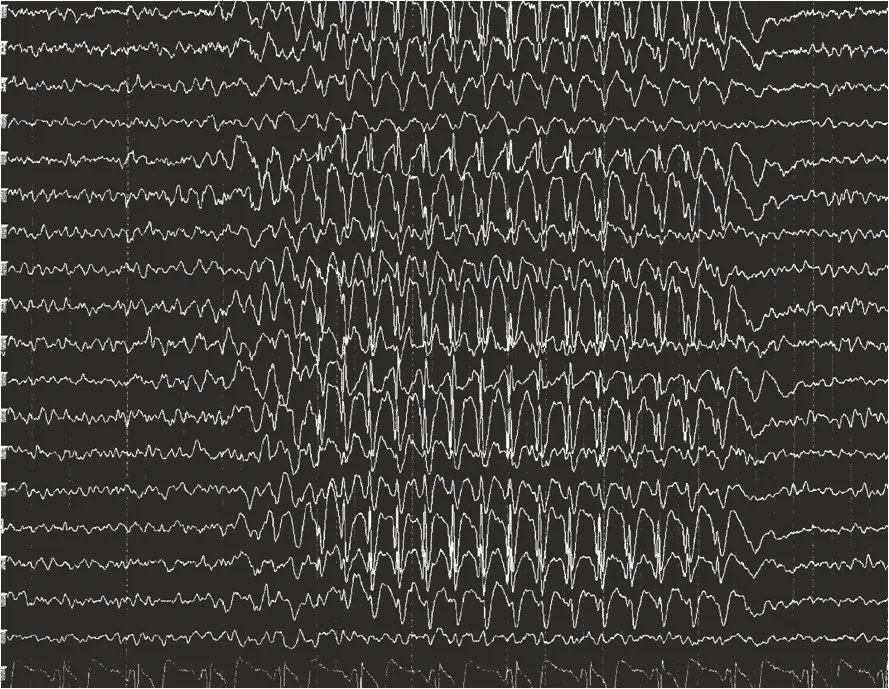
Electroencephalography records summed postsynaptic potentials of cortical pyramidal neurones through scalp electrodes placed by the international 10–20 system. The normal awake adult record shows a posterior dominant alpha rhythm (8–13 Hz) that attenuates with eye opening; beta (>13 Hz), theta (4–7 Hz) and delta (<4 Hz) activity vary with age, drowsiness and drugs. EEG supports – but rarely makes – a diagnosis of epilepsy: interictal epileptiform discharges (spikes, sharp waves) are found in only about half of people with epilepsy on a single routine recording and occur in a small proportion of healthy people. Yield rises with sleep deprivation, repeated recordings, ambulatory and video-telemetry. Classic patterns include 3 Hz generalised spike-and-wave (absence epilepsy), hypsarrhythmia (infantile spasms), generalised polyspike-wave (juvenile myoclonic epilepsy), periodic sharp wave complexes (sporadic CJD) and lateralised periodic discharges (HSV encephalitis, acute structural lesions). EEG is essential for diagnosing non-convulsive status epilepticus and supports coma prognosis.
Patient case, mechanism, investigations, management, flashcards and exam-style questions.Open the lesson →
Key facts
- Alpha 8–13 Hz (posterior, eyes closed); beta >13 Hz; theta 4–7 Hz; delta <4 Hz
- A normal interictal EEG does not exclude epilepsy; an abnormal EEG alone does not diagnose it
- Routine EEG detects interictal epileptiform discharges in about 30–50% of people with epilepsy; sleep-deprived and repeated recordings increase yield
- EEG should not be used to diagnose epilepsy after a probable syncope (NICE NG217)
- 3 Hz generalised spike-and-wave provoked by hyperventilation = childhood absence epilepsy
- Hypsarrhythmia = infantile spasms (West syndrome)
- Continuous EEG is needed to diagnose non-convulsive status epilepticus in unexplained reduced consciousness
- Benzodiazepines increase beta activity; hepatic encephalopathy causes triphasic waves
Differential diagnosis
| Condition | Clues | Key test |
|---|---|---|
| Generalised epilepsy | Generalised spike-wave or polyspike-wave discharges | Sleep-deprived EEG |
| Focal epilepsy | Focal spikes or sharp waves | Routine or sleep EEG, MRI epilepsy protocol |
| Non-convulsive status epilepticus | Continuous or recurrent rhythmic discharges with impaired consciousness | Continuous EEG; response to benzodiazepine |
| Metabolic encephalopathy | Generalised slowing, triphasic waves | Bloods (ammonia, urea, sodium) |
| Psychogenic non-epileptic seizures | Normal background during events | Video-EEG telemetry |
| Syncope | Brief generalised slowing then flattening during event, normal otherwise | History, ECG, tilt test |
| Creutzfeldt–Jakob disease | Periodic sharp wave complexes about 1 per second | MRI DWI, CSF RT-QuIC |
Exam pearls
Guideline
NICE NG217 Epilepsies (2022), ILAE updated seizure classification (2025) and definition of epilepsy (2014), and ACNS Standardised Critical Care EEG Terminology (2021)
References
- National Institute for Health and Care Excellence (NICE). Epilepsies in children, young people and adults (NG217). NICE guideline 2022.
- Beniczky S, Trinka E, Wirrell E, et al.. Updated classification of epileptic seizures: Position paper of the International League Against Epilepsy. Epilepsia 2025.
- Fisher RS, Acevedo C, Arzimanoglou A, et al.. ILAE official report: a practical clinical definition of epilepsy. Epilepsia 2014.
- Hirsch LJ, Fong MWK, Leitinger M, et al.. American Clinical Neurophysiology Society's Standardized Critical Care EEG Terminology: 2021 Version. J Clin Neurophysiol 2021.
- Greer DM, Kirschen MP, Lewis A, et al.. Pediatric and Adult Brain Death/Death by Neurologic Criteria Consensus Guideline. Neurology 2023.
- Papadakis MA, Rabow MW, McQuaid KR, eds.. CURRENT Medical Diagnosis & Treatment 2026. McGraw Hill 2026.
Related topics
By Dr Khalid Seidi (B.Sc., M.D.) · MedEd World Clinical Knowledge library. Original teaching content checked against current guidelines (November 2026); confirm the latest local guidance before clinical use. Not a substitute for clinical judgement.