Clinical Knowledge › Internal medicine › Nephrology › Relevant pharmacology
Erythropoiesis-stimulating agents
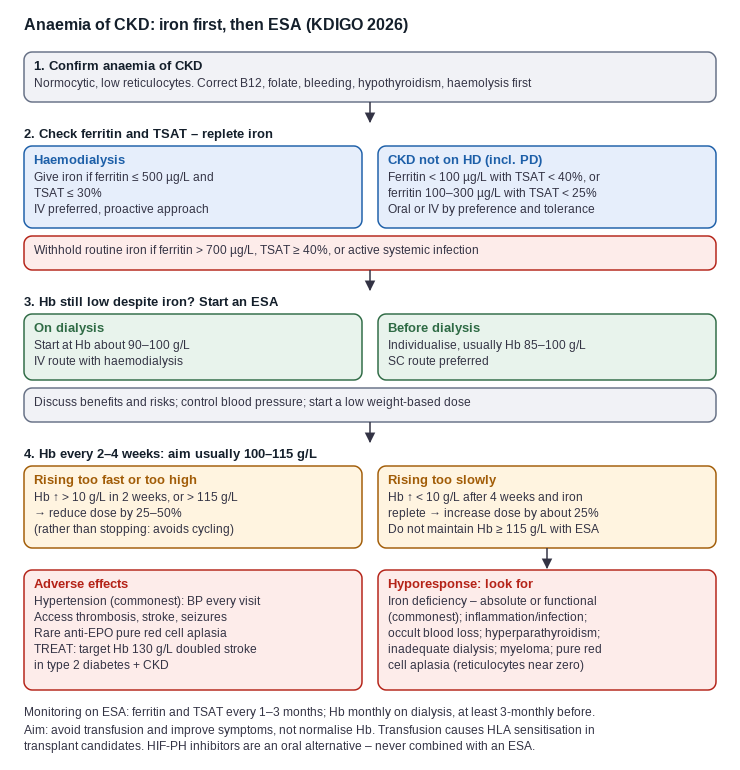
Erythropoiesis-stimulating agents (ESAs) are recombinant or modified erythropoietins that bind the erythropoietin receptor on red cell precursors and replace the hormone the failing kidney no longer makes in adequate amounts. The class includes short-acting epoetin alfa and beta (given two or three times weekly), longer-acting darbepoetin alfa (weekly or fortnightly) and methoxy polyethylene glycol-epoetin beta (monthly), and biosimilars. Before starting, iron must be replete and other causes of anaemia corrected. Trials that aimed for normal haemoglobin showed more stroke, hypertension, access thrombosis and, in people with previous cancer, more cancer deaths, without fewer cardiovascular events. KDIGO 2026 therefore advises starting at haemoglobin of about 90–100 g/L on dialysis, individualising the threshold before dialysis, and not using an ESA to keep haemoglobin at 115 g/L or above. Hypertension is the commonest adverse effect; pure red cell aplasia is rare. Poor response usually means iron deficiency, inflammation or blood loss. Oral HIF-prolyl hydroxylase inhibitors are an alternative in some countries.
Patient case, mechanism, investigations, management, flashcards and exam-style questions.Open the lesson →
Key facts
- Erythropoietin is made by peritubular interstitial fibroblasts in the renal cortex in response to hypoxia via HIF; CKD causes relative EPO deficiency
- Correct iron deficiency, B12 or folate deficiency, bleeding and inflammation before starting an ESA
- KDIGO 2026: start ESA at Hb about 90–100 g/L on dialysis; individualise (often 85–100 g/L) before dialysis
- Aim for Hb usually 100–115 g/L; do not use an ESA to maintain Hb at 115 g/L or above
- If Hb rises by more than about 10 g/L in 2 weeks, reduce the dose by 25–50%
- TREAT (2009): darbepoetin aiming for Hb 130 g/L doubled stroke risk in type 2 diabetes with CKD without reducing cardiovascular or kidney events
- Hypertension is the commonest adverse effect; others are access thrombosis, stroke, seizures and rare anti-EPO antibody pure red cell aplasia
- Commonest cause of ESA hyporesponsiveness is absolute or functional iron deficiency; PIVOTAL supports proactive IV iron in haemodialysis
Differential diagnosis
| Condition | Clues | Key test |
|---|---|---|
| Iron deficiency (absolute) | Ferritin below 100 µg/L, low TSAT; often GI loss or dialysis blood loss | Ferritin, TSAT, GI evaluation |
| Functional iron deficiency | Ferritin normal or high, TSAT below 20–25% with inflammation or on ESA | TSAT, CRP, reticulocyte haemoglobin |
| Inflammation or infection | Raised CRP, infected access or catheter, hyporesponse | CRP, cultures |
| Occult blood loss | Falling Hb despite rising ESA dose | Faecal testing, endoscopy |
| Pure red cell aplasia | Sudden severe anaemia, reticulocytes near zero, after months of ESA | Reticulocyte count, anti-EPO antibodies, marrow |
| Haematological malignancy or myeloma | Hyporesponse with other cytopenias, high protein gap | Blood film, protein electrophoresis, light chains |
| Severe hyperparathyroidism or inadequate dialysis | Marrow fibrosis or uraemic suppression | PTH, dialysis adequacy (Kt/V) |
Exam pearls
Guideline
KDIGO 2026 Clinical Practice Guideline for the Management of Anemia in CKD (replacing KDIGO 2012), with NICE NG203 (2021)
References
- Babitt JL, Berns JS, Bozkurt B, et al.. KDIGO 2026 Clinical Practice Guideline for the Management of Anemia in CKD: executive summary. Kidney Int 2026.
- Kidney Disease: Improving Global Outcomes (KDIGO) Anemia Work Group. KDIGO Clinical Practice Guideline for Anemia in Chronic Kidney Disease. Kidney Int Suppl 2012.
- Pfeffer MA, Burdmann EA, Chen CY, et al.. A trial of darbepoetin alfa in type 2 diabetes and chronic kidney disease. N Engl J Med 2009.
- Singh AK, Szczech L, Tang KL, et al.. Correction of anemia with epoetin alfa in chronic kidney disease. N Engl J Med 2006.
- Macdougall IC, White C, Anker SD, et al.. Intravenous iron in patients undergoing maintenance hemodialysis. N Engl J Med 2019.
- Besarab A, Bolton WK, Browne JK, et al.. The effects of normal as compared with low hematocrit values in patients with cardiac disease who are receiving hemodialysis and epoetin. N Engl J Med 1998.
Related topics
By Dr Khalid Seidi (B.Sc., M.D.) · MedEd World Clinical Knowledge library. Original teaching content checked against current guidelines (November 2026); confirm the latest local guidance before clinical use. Not a substitute for clinical judgement.