Clinical Knowledge › Internal medicine › Nephrology › Relevant pharmacology
SGLT2 inhibitors in kidney disease
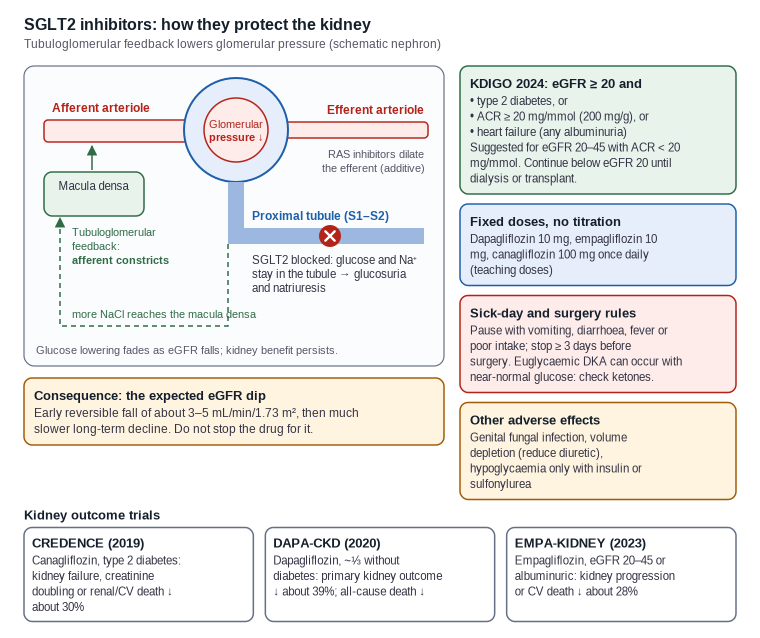
Sodium–glucose co-transporter 2 (SGLT2) inhibitors, dapagliflozin, empagliflozin and canagliflozin, block glucose and sodium reabsorption in the early proximal tubule. Developed as glucose-lowering drugs, they are now a foundation of kidney protection with or without diabetes. More sodium reaching the macula densa restores tubuloglomerular feedback, constricts the afferent arteriole and lowers glomerular pressure; tubular oxygen demand also falls. The result is a small, expected early eGFR dip followed by much slower long-term decline. CREDENCE, DAPA-CKD and EMPA-KIDNEY showed roughly 30–40% fewer kidney failure or major eGFR-decline events, and fewer heart failure admissions. KDIGO 2024 recommends them for CKD with eGFR 20 mL/min/1.73 m² or more when there is type 2 diabetes, albuminuria (ACR 20 mg/mmol or more) or heart failure, and suggests them for lower albuminuria. Glucose lowering fades as eGFR falls, but kidney benefit does not. Main risks are genital fungal infection, volume depletion and euglycaemic ketoacidosis, managed by sick-day rules and stopping before surgery.
Patient case, mechanism, investigations, management, flashcards and exam-style questions.Open the lesson →
Key facts
- SGLT2 in the S1–S2 proximal tubule reabsorbs about 90% of filtered glucose with sodium; inhibition causes glucosuria and natriuresis
- Kidney protection comes from afferent arteriolar constriction via restored tubuloglomerular feedback, lowering intraglomerular pressure
- Expect an early reversible eGFR dip of about 3–5 mL/min/1.73 m²; do not stop the drug for it
- KDIGO 2024: start in CKD with eGFR 20 or more if type 2 diabetes, ACR 20 mg/mmol (200 mg/g) or more, or heart failure; continue below eGFR 20 until dialysis or transplant
- Fixed teaching doses with no titration: dapagliflozin 10 mg, empagliflozin 10 mg, canagliflozin 100 mg once daily (check local formulary)
- DAPA-CKD and EMPA-KIDNEY included many people without diabetes; DAPA-CKD also lowered all-cause mortality
- Euglycaemic diabetic ketoacidosis can occur with near-normal glucose; stop at least 3 days before planned surgery and during acute illness
- They reduce hyperkalaemia, gout and heart failure admissions, which makes RAS inhibitor and MRA therapy easier to maintain
Differential diagnosis
| Condition | Clues | Key test |
|---|---|---|
| Expected haemodynamic eGFR dip | Small fall (about 3–5 mL/min) within weeks, then stable | Repeat eGFR at 2–4 weeks if concerned |
| Volume depletion or prerenal AKI | Larger fall with vomiting, diarrhoea, high-dose diuretics | Clinical volume status, urea, postural BP |
| Euglycaemic diabetic ketoacidosis | Malaise, vomiting, rapid breathing, glucose below 14 mmol/L, high anion gap | Blood ketones, venous gas, anion gap |
| Starvation or alcoholic ketoacidosis | Ketosis with poor intake or alcohol excess, no SGLT2 inhibitor | History, ketones, lactate |
| Genital candidiasis | Vulvovaginal or balanitis itch and discharge in first months | Clinical; swab if recurrent |
| Necrotising fasciitis of the perineum (Fournier gangrene) | Pain out of proportion, fever, perineal swelling | Urgent surgical review; CT |
| Urinary tract infection | Dysuria, frequency; glycosuria makes dipstick glucose positive by design | Urine culture |
Exam pearls
Guideline
KDIGO 2024 CKD guideline and KDIGO 2022 diabetes in CKD guideline
References
- Kidney Disease: Improving Global Outcomes (KDIGO) CKD Work Group. KDIGO 2024 Clinical Practice Guideline for the Evaluation and Management of Chronic Kidney Disease. Kidney Int 2024.
- Kidney Disease: Improving Global Outcomes (KDIGO) Diabetes Work Group. KDIGO 2022 Clinical Practice Guideline for Diabetes Management in Chronic Kidney Disease. Kidney Int 2022.
- Perkovic V, Jardine MJ, Neal B, et al.. Canagliflozin and renal outcomes in type 2 diabetes and nephropathy. N Engl J Med 2019.
- Heerspink HJL, Stefánsson BV, Correa-Rotter R, et al.. Dapagliflozin in patients with chronic kidney disease. N Engl J Med 2020.
- The EMPA-KIDNEY Collaborative Group; Herrington WG, Staplin N, Wanner C, et al.. Empagliflozin in patients with chronic kidney disease. N Engl J Med 2023.
- The EMPA-KIDNEY Collaborative Group; Herrington WG, Staplin N, et al.. Long-Term Effects of Empagliflozin in Patients with Chronic Kidney Disease. N Engl J Med 2025.
Related topics
By Dr Khalid Seidi (B.Sc., M.D.) · MedEd World Clinical Knowledge library. Original teaching content checked against current guidelines (November 2026); confirm the latest local guidance before clinical use. Not a substitute for clinical judgement.