Clinical Knowledge › Radiology › Abdominal X-ray interpretation
Ingested and inserted foreign bodies
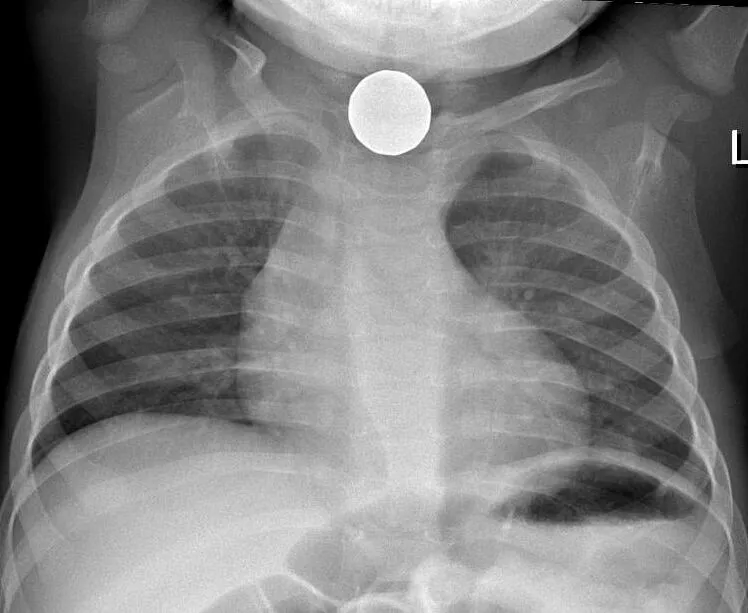
Foreign bodies reach the gastrointestinal tract by ingestion (accidental in children, food bolus or bones in adults, deliberate in people with mental illness, prisoners or drug couriers) or by rectal insertion. Imaging answers four questions: what is it, where is it, has it caused harm (obstruction, perforation, mucosal injury) and can it pass. Plain radiographs from mouth to anus show radiopaque objects; coins in the oesophagus lie en face on the AP film, and a button battery is identified by its double-ring (halo) outline and lateral step-off, a true emergency because it can burn through the oesophagus within hours. Multiple magnets risk pressure necrosis and fistula. Fish and chicken bones, wood and plastic are often invisible on plain films, so CT is used when perforation or a radiolucent object is suspected. Barium swallow is avoided. Non-contrast CT is the best test for drug packets in body packers. Rectal foreign bodies need an AXR and erect chest X-ray to show the object and exclude perforation before removal.
Patient case, mechanism, investigations, management, flashcards and exam-style questions.Open the lesson →
Key facts
- Most ingested foreign bodies (about 80-90%) pass spontaneously; 10-20% need endoscopic removal and about 1% surgery
- Children: coins are commonest; image from mouth to anus (neck, chest and abdomen, including the nasopharynx in young children)
- Button battery: double-ring or halo sign on AP and step-off on lateral; an oesophageal battery needs removal as soon as possible, ideally within 2 hours
- ESPGHAN 2021: honey (children over 1 year) or sucralfate may be given before removal when ingestion is recent, but must not delay endoscopy
- Multiple magnets, or a magnet with another metal object, can attract across bowel walls causing necrosis, fistula and perforation; early removal while in reach
- ESGE 2016: emergency endoscopy (ideally within 2 hours, at latest 6 hours) for oesophageal batteries, sharp objects and complete oesophageal obstruction; CT for suspected perforation; no barium swallow
- Fish bones, chicken bones, wood, plastic and aluminium are often poorly seen on radiographs; CT is more sensitive
- Body packers: non-contrast CT is most sensitive for packets; endoscopic removal is contraindicated because of rupture risk
Differential diagnosis
| Condition | Clues | Key test |
|---|---|---|
| Oesophageal button battery | Toddler with drooling, refusal to feed, or unwitnessed ingestion | AP and lateral X-ray: double-ring and step-off |
| Oesophageal coin | Child with dysphagia after swallowing a coin | AP X-ray: single-density disc en face |
| Inhaled (airway) foreign body | Choking, cough, unilateral wheeze, air trapping | Chest X-ray inspiratory and expiratory; bronchoscopy |
| Food bolus impaction | Adult with sudden dysphagia and drooling after meat | Clinical; endoscopy; X-ray only if bone suspected |
| Fish or chicken bone impaction | Sharp pain on swallowing, localised to neck | Lateral soft tissue neck film; CT if negative and symptomatic |
| Multiple magnet ingestion | Child with abdominal pain; magnets may appear as one | Serial AXR; urgent removal if not progressing or symptomatic |
| Body packing | Traveller with abdominal pain or toxicity, or detained at border | Non-contrast CT abdomen |
| Rectal foreign body | Anal pain, bleeding, inability to remove object | AXR and erect chest X-ray; CT if perforation suspected |
Exam pearls
Guideline
ESGE clinical guideline on upper GI foreign bodies in adults (2016) with ESPGHAN button battery position paper (2021) and NASPGHAN foreign body report (2015)
References
- Birk M, Bauerfeind P, Deprez PH, et al.. Removal of foreign bodies in the upper gastrointestinal tract in adults: European Society of Gastrointestinal Endoscopy (ESGE) clinical guideline. Endoscopy 2016.
- Kramer RE, Lerner DG, Lin T, et al.. Management of ingested foreign bodies in children: a clinical report of the NASPGHAN Endoscopy Committee. J Pediatr Gastroenterol Nutr 2015.
- Mubarak A, Benninga MA, Broekaert I, et al.. Diagnosis, management, and prevention of button battery ingestion in childhood: a European Society for Paediatric Gastroenterology Hepatology and Nutrition position paper. J Pediatr Gastroenterol Nutr 2021.
- Traub SJ, Hoffman RS, Nelson LS.. Body packing: the internal concealment of illicit drugs. N Engl J Med 2003.
- Goldberg JE, Steele SR.. Rectal foreign bodies. Surg Clin North Am 2010.
- Tarasconi A, Perrone G, Davies J, et al.. Anorectal emergencies: WSES-AAST guidelines. World J Emerg Surg 2021.
Related topics
By Dr Khalid Seidi (B.Sc., M.D.) · MedEd World Clinical Knowledge library. Original teaching content checked against current guidelines (November 2026); confirm the latest local guidance before clinical use. Not a substitute for clinical judgement.