Clinical Knowledge › Radiology › Abdominal X-ray interpretation
Toxic megacolon on abdominal X-ray
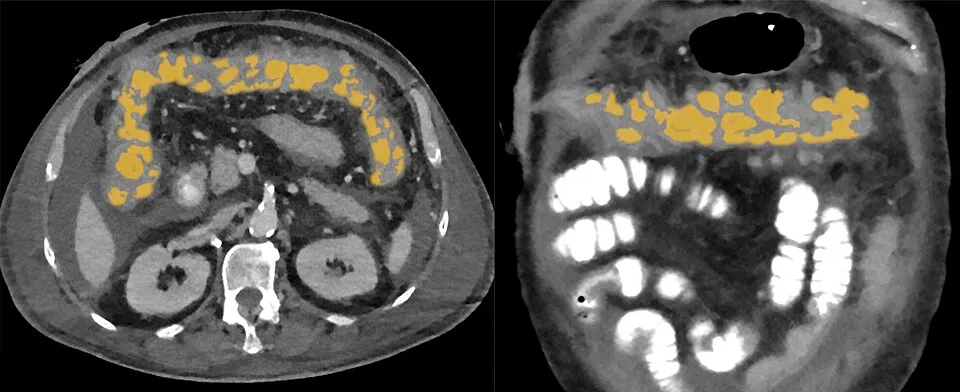
Toxic megacolon is a non-obstructive dilatation of the colon to 6 cm or more in a systemically toxic patient with colitis. Ulcerative colitis and Crohn colitis remain the classic causes, but Clostridioides difficile, other infective colitides, CMV and ischaemic colitis now account for a large share. Opioids, antimotility and anticholinergic drugs, hypokalaemia and early endoscopy or barium studies can precipitate it. On the supine abdominal X-ray the transverse colon, the most anterior segment, is usually the widest; the haustra are lost or grossly thickened, mucosal islands and thumbprinting reflect deep ulceration and oedema, and dilated small bowel gas loops are a poor prognostic sign. The diagnosis is clinical plus radiological (Jalan criteria). The AXR is used on admission in acute severe colitis and repeated, often daily, while the colon is dilated; CT is added for suspected perforation, abscess or uncertain cause. Free gas, worsening dilatation or no improvement within 24-72 hours of intensive medical therapy mean urgent subtotal colectomy.
Patient case, mechanism, investigations, management, flashcards and exam-style questions.Open the lesson →
Key facts
- Definition: total or segmental non-obstructive colonic dilatation of at least 6 cm with systemic toxicity
- Jalan criteria: radiographic colonic distension plus at least 3 of fever above 38.6 °C, heart rate above 120/min, white cell count above 10.5 × 10⁹/L, anaemia, plus at least 1 of dehydration, altered consciousness, electrolyte disturbance or hypotension
- The transverse colon is the usual site measured on a supine film because gas rises to this most anterior segment
- AXR signs: dilated colon, loss of haustra or thick oedematous haustra, mucosal islands (pseudopolyps), thumbprinting and irregular colonic contour
- Small bowel gas distension and mucosal islands on the admission film in acute severe ulcerative colitis predict failure of medical therapy
- Causes: ulcerative colitis, Crohn colitis, C. difficile, Salmonella, Shigella, Campylobacter, Shiga toxin-producing E. coli, CMV in immunosuppressed patients, ischaemic colitis
- Precipitants: opioids, loperamide and other antimotility drugs, anticholinergics, hypokalaemia, hypomagnesaemia, colonoscopy and barium enema
- Perforation markedly increases mortality; CT is the most sensitive test for free gas, abscess and wall necrosis
Differential diagnosis
| Condition | Clues | Key test |
|---|---|---|
| Toxic megacolon in ulcerative colitis | Known or new bloody diarrhoea, toxicity, transverse colon at least 6 cm | AXR plus clinical criteria; flexible sigmoidoscopy without full preparation |
| C. difficile colitis with megacolon | Recent antibiotics or hospital stay, leucocytosis, may have little diarrhoea once ileus sets in | Stool GDH and toxin tests; CT accordion sign |
| Acute colonic pseudo-obstruction | Post-operative or medically unwell, not toxic, no colitis | Normal haustra, normal mucosa on CT, no wall thickening |
| Mechanical large bowel obstruction | Colicky pain, absolute constipation, no colitis | CT transition point |
| Sigmoid volvulus | Inverted-U loop from pelvis | CT whirl sign |
| Ischaemic colitis | Older patient with vascular disease, watershed distribution | CT: segmental wall thickening, thumbprinting at splenic flexure |
| CMV colitis | Immunosuppressed or steroid-refractory colitis | Biopsy with immunohistochemistry |
Exam pearls
Guideline
BSG guidelines on inflammatory bowel disease in adults (2025) with ECCO ulcerative colitis medical and surgical guidelines (2022) and ESCMID C. difficile treatment update (2021)
References
- Autenrieth DM, Baumgart DC.. Toxic megacolon. Inflamm Bowel Dis 2012.
- Jalan KN, Sircus W, Card WI, et al.. An experience of ulcerative colitis. I. Toxic dilation in 55 cases. Gastroenterology 1969.
- Moran GW, Gordon M, Sinopolou V, et al.. British Society of Gastroenterology guidelines on inflammatory bowel disease in adults: 2025. Gut 2025.
- Raine T, Bonovas S, Burisch J, et al.. ECCO guidelines on therapeutics in ulcerative colitis: medical treatment. J Crohns Colitis 2022.
- Spinelli A, Bonovas S, Burisch J, et al.. ECCO guidelines on therapeutics in ulcerative colitis: surgical treatment. J Crohns Colitis 2022.
- van Prehn J, Reigadas E, Vogelzang EH, et al.. European Society of Clinical Microbiology and Infectious Diseases: 2021 update on the treatment guidance document for Clostridioides difficile infection in adults. Clin Microbiol Infect 2021.
Related topics
By Dr Khalid Seidi (B.Sc., M.D.) · MedEd World Clinical Knowledge library. Original teaching content checked against current guidelines (November 2026); confirm the latest local guidance before clinical use. Not a substitute for clinical judgement.