Clinical Knowledge › Paediatrics › Paediatric cardiology
Innocent heart murmurs
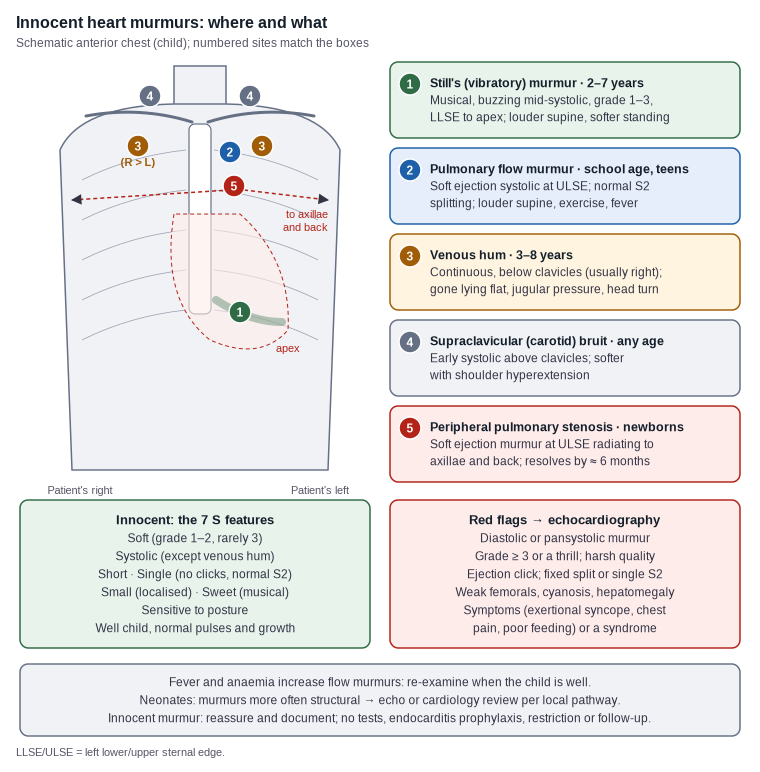
Innocent (functional, physiological) heart murmurs are sounds produced by normal blood flow through a structurally normal heart and great vessels. They are heard in up to 70–80% of children at some point, most often between 2 and 7 years, and become louder with fever, anaemia, exercise or anxiety. The five common types are Still's vibratory murmur at the left lower sternal edge, the pulmonary flow murmur at the upper left sternal edge, the venous hum below the clavicles, the supraclavicular (carotid) bruit, and peripheral pulmonary artery stenosis of the newborn. An innocent murmur is soft (grade 1–2, rarely 3), short, systolic (except the continuous venous hum), changes with posture, and occurs in a well child with normal pulses, normal second heart sound and no added sounds. Murmurs that are diastolic, pansystolic, harsh, loud (grade 3 or more or with a thrill), or accompanied by symptoms, abnormal pulses, cyanosis, clicks or an abnormal S2 suggest structural disease and need echocardiography. Neonatal murmurs carry a higher risk of structural disease. Confident diagnosis allows reassurance without unnecessary tests, endocarditis prophylaxis or activity restriction.
Patient case, mechanism, investigations, management, flashcards and exam-style questions.Open the lesson →
Key facts
- Up to 70–80% of children have an innocent murmur at some time; peak 2–7 years
- Remember the 7 S features: soft, systolic, short, single (no clicks), small (localised), sweet (musical), sensitive to posture
- Still's murmur: vibratory, musical, mid-systolic, left lower sternal edge to apex, loudest supine, softer on standing
- Venous hum: continuous, below the clavicles (right more than left), disappears lying flat or with gentle jugular compression or neck rotation
- Peripheral pulmonary artery stenosis: soft ejection murmur in neonates radiating to axillae and back; resolves by about 6 months
- Red flags: diastolic or pansystolic murmur, grade 3 or more or a thrill, harsh quality, clicks, fixed or single S2, symptoms, weak femoral pulses, cyanosis
- Fever and anaemia increase flow murmurs: re-examine the child when well
- No endocarditis prophylaxis, activity restriction or follow-up is needed for an innocent murmur
Differential diagnosis
| Condition | Clues | Key test |
|---|---|---|
| Ventricular septal defect | Harsh pansystolic murmur at left lower sternal edge, often with thrill | Echocardiography |
| Atrial septal defect | Soft ejection murmur at upper left sternal edge with fixed split S2 | Echocardiography; ECG (right bundle branch pattern) |
| Pulmonary valve stenosis | Ejection click varying with respiration, harsh ejection murmur radiating to back | Echocardiography |
| Aortic stenosis or bicuspid aortic valve | Ejection click at apex, murmur at right upper sternal edge radiating to neck | Echocardiography |
| Patent ductus arteriosus | Continuous machinery murmur below left clavicle, does not vanish lying flat; bounding pulses | Echocardiography |
| Coarctation of the aorta | Murmur at the back; weak or delayed femoral pulses; arm hypertension | Four-limb blood pressure; echocardiography |
| Hypertrophic cardiomyopathy | Ejection murmur louder on standing or Valsalva; family history of sudden death | ECG; echocardiography |
| High-flow states (anaemia, fever, thyrotoxicosis) | Louder flow murmur with tachycardia | Full blood count; re-examine when well |
Exam pearls
Guideline
ACC/AAP/AHA 2014 appropriate use criteria for initial outpatient paediatric echocardiography, newborn pulse oximetry screening strategies (AAP/AHA 2011) and AHA 2021 scientific statement on endocarditis prevention
References
- Campbell RM, Douglas PS, Eidem BW, et al.. ACC/AAP/AHA/ASE/HRS/SCAI/SCCT/SCMR/SOPE 2014 appropriate use criteria for initial transthoracic echocardiography in outpatient pediatric cardiology. J Am Coll Cardiol 2014.
- Frank JE, Jacobe KM.. Evaluation and management of heart murmurs in children. Am Fam Physician 2011.
- Kemper AR, Mahle WT, Martin GR, et al.. Strategies for implementing screening for critical congenital heart disease. Pediatrics 2011.
- Wilson WR, Gewitz M, Lockhart PB, et al.. Prevention of viridans group streptococcal infective endocarditis: a scientific statement from the American Heart Association. Circulation 2021.
- Park MK, Salamat M.. Park's Pediatric Cardiology for Practitioners. 2021.
- Hoffman JI, et al.. The incidence of congenital heart disease. J Am Coll Cardiol 2002.
Related topics
By Dr Khalid Seidi (B.Sc., M.D.) · MedEd World Clinical Knowledge library. Original teaching content checked against current guidelines (November 2026); confirm the latest local guidance before clinical use. Not a substitute for clinical judgement.