Clinical Knowledge › Paediatrics › Paediatric cardiology
Pulmonary and aortic stenosis in children
Pulmonary stenosis (PS) and aortic stenosis (AS) are the commonest congenital obstructions to ventricular outflow, making up about 8–10% and 3–6% of congenital heart disease respectively. Most are valvar: a domed, fused pulmonary valve, or a bicuspid or unicuspid aortic valve. Subvalvar and supravalvar forms also occur, and syndromes give clues: dysplastic pulmonary valves in Noonan syndrome, supravalvar aortic stenosis with branch pulmonary stenosis in Williams syndrome, and bicuspid valves with coarctation in Turner syndrome. Presentation depends on severity and age. Critical stenosis in the newborn is duct-dependent: critical PS causes cyanosis, and critical AS causes shock with weak pulses when the duct closes; both need prostaglandin E1 and urgent intervention. Older children are usually asymptomatic, with an ejection systolic murmur, an ejection click and a thrill; severe AS can cause exertional chest pain, syncope and sudden death. Echocardiography grades severity. Balloon valvuloplasty is first-line for valvar PS and for most childhood valvar AS; surgical valvotomy, Ross procedure or valve replacement follow when needed, with lifelong follow-up for regurgitation and restenosis.
Patient case, mechanism, investigations, management, flashcards and exam-style questions.Open the lesson →
Key facts
- PS is about 8–10% and AS about 3–6% of congenital heart disease; bicuspid aortic valve affects 1–2% of the population, more often males
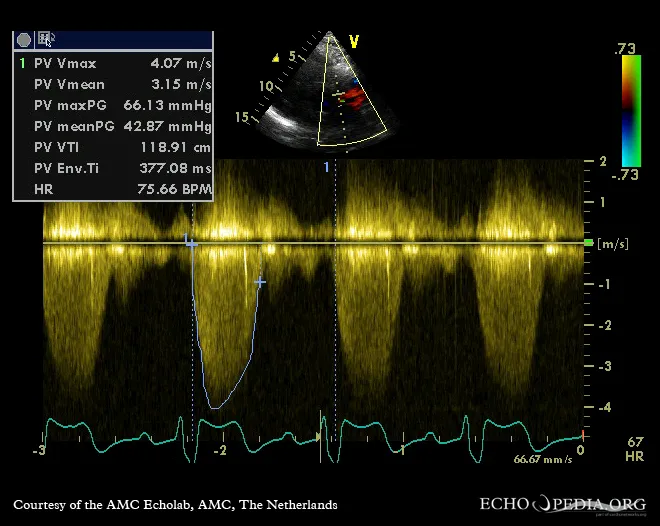
- Echo severity (peak velocity / peak instantaneous gradient): mild under 3 m/s (under 36 mmHg), moderate 3–4 m/s (36–64 mmHg), severe over 4 m/s (over 64 mmHg)
- PS ejection click varies with respiration (softer on inspiration); AS ejection click at the apex does not vary
- Critical PS (neonate): cyanosis from right-to-left atrial shunting, duct-dependent pulmonary blood flow; critical AS: shock and weak pulses when the duct closes
- Prostaglandin E1 (alprostadil) keeps the duct open in duct-dependent lesions; watch for apnoea
- Balloon pulmonary valvuloplasty is first-line for valvar PS with a gradient above about 40 mmHg or RV dysfunction; results are excellent except for dysplastic valves (Noonan)
- Balloon aortic valvuloplasty is indicated for a resting catheter gradient of 50 mmHg or more, or 40 mmHg or more with symptoms or ECG ischaemia; the main complication is aortic regurgitation
- Syndromes: Noonan (dysplastic PS, HCM), Williams (supravalvar AS, peripheral PS, hypercalcaemia), Turner (bicuspid AV, coarctation), Alagille (peripheral PS)
Differential diagnosis
| Condition | Clues | Key test |
|---|---|---|
| Innocent pulmonary flow murmur | Soft, no click, normal S2 splitting, no thrill | Clinical; echocardiography if doubt |
| Atrial septal defect | Pulmonary flow murmur with fixed split S2 | Echocardiography |
| Tetralogy of Fallot | Cyanosis, RV outflow murmur that softens in spells, single S2 | Echocardiography |
| Hypertrophic cardiomyopathy | Ejection murmur louder on standing or Valsalva; no click | ECG; echocardiography; family screening |
| Coarctation of the aorta | Weak or delayed femorals; arm hypertension; often with bicuspid AV | Four-limb BP; echocardiography |
| Ventricular septal defect | Pansystolic murmur at left lower sternal edge | Echocardiography |
| Neonatal sepsis or metabolic disease (for critical AS) | Shock and acidosis in the first week | Echocardiography distinguishes; cultures, metabolic screen |
Exam pearls
Guideline
AHA scientific statement on cardiac catheterisation and intervention in paediatric cardiac disease (2011), 2025 ACC/AHA/HRS/ISACHD/SCAI ACHD guideline, 2020 ESC ACHD guideline and 2020 ACC/AHA valvular heart disease guideline
References
- Feltes TF, Bacha E, Beekman RH 3rd, et al.. Indications for cardiac catheterization and intervention in pediatric cardiac disease: a scientific statement from the American Heart Association. Circulation 2011.
- Gurvitz M, Krieger EV, Fuller S, et al.. 2025 ACC/AHA/HRS/ISACHD/SCAI guideline for the management of adults with congenital heart disease. Circulation 2025.
- Baumgartner H, De Backer J, Babu-Narayan SV, et al.. 2020 ESC Guidelines for the management of adult congenital heart disease. Eur Heart J 2021.
- Otto CM, Nishimura RA, Bonow RO, et al.. 2020 ACC/AHA guideline for the management of patients with valvular heart disease. Circulation 2021.
- Wilson WR, Gewitz M, Lockhart PB, et al.. Prevention of viridans group streptococcal infective endocarditis: a scientific statement from the American Heart Association. Circulation 2021.
- Park MK, Salamat M.. Park's Pediatric Cardiology for Practitioners. 2021.
Related topics
By Dr Khalid Seidi (B.Sc., M.D.) · MedEd World Clinical Knowledge library. Original teaching content checked against current guidelines (November 2026); confirm the latest local guidance before clinical use. Not a substitute for clinical judgement.