Clinical Knowledge › Radiology › Radiation safety and contrast media
Iodinated contrast media and adverse reactions
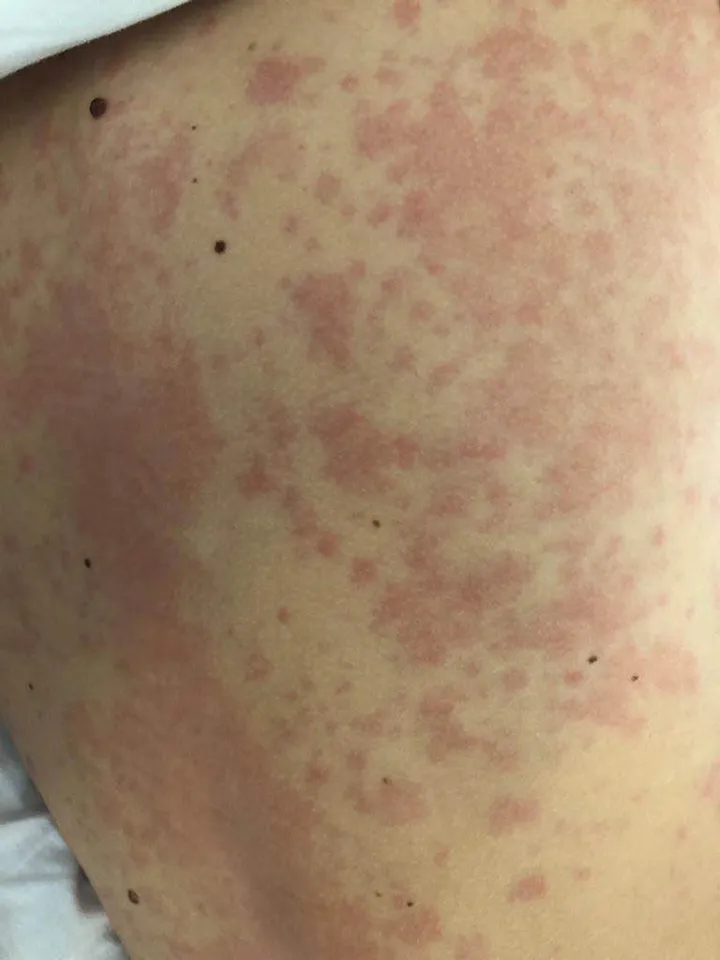
Iodinated contrast media (ICM) are tri-iodinated benzene derivatives that raise X-ray attenuation in vessels and enhancing tissues during CT, angiography and fluoroscopy. Modern intravascular practice uses non-ionic low-osmolar agents (for example iohexol, iopamidol, iomeprol) or the iso-osmolar dimer iodixanol, which have far fewer reactions than the old ionic high-osmolar agents. Acute reactions within an hour are either allergic-like (hypersensitivity: urticaria, angio-oedema, bronchospasm, anaphylaxis) or physiological (warmth, nausea, vasovagal reaction, arrhythmia). Allergic-like reactions occur in under 1% of injections and severe ones in fewer than 1 in 10 000. Delayed rashes can follow hours to a week later. A previous reaction to ICM is the main risk factor; shellfish or povidone-iodine allergy is not. Intramuscular adrenaline is the key treatment for anaphylaxis. The 2025 ESUR guidelines advise serum tryptase after moderate or severe reactions, allergy referral and a skin-test-guided change of agent rather than corticosteroid premedication, whose benefit is small.
Patient case, mechanism, investigations, management, flashcards and exam-style questions.Open the lesson →
Key facts
- Classification: ionic or non-ionic; monomer or dimer; high-osmolar (5–8 × plasma), low-osmolar (about 2–3 ×) and iso-osmolar (about 290 mOsm/kg, iodixanol)
- Acute reactions occur within 1 hour: allergic-like (urticaria, angio-oedema, bronchospasm, anaphylaxis) or physiological (heat, metallic taste, nausea, vasovagal, arrhythmia, seizures)
- With non-ionic low-osmolar agents allergic-like reactions are about 0.2–0.7% of injections; severe reactions under 1 in 10 000; deaths extremely rare
- Strongest risk factor: previous reaction to iodinated contrast; asthma and multiple allergies add modestly; shellfish and topical iodine allergy are NOT contraindications
- Anaphylaxis: adrenaline 0.5 mg IM (0.5 mL of 1 mg/mL) in adults and children over 12, repeat after 5 minutes; high-flow oxygen; IV fluids; salbutamol for bronchospasm
- Vasovagal reaction: hypotension with bradycardia; legs up, IV fluid, atropine 0.6–1 mg IV if persistent
- Measure serum tryptase 1–4 hours after onset of a moderate or severe reaction and again at least 24 hours after recovery; refer to an allergist and document the specific agent
- Delayed (non-immediate) reactions, 1 hour to 1 week: mostly maculopapular rash; rarely severe cutaneous reactions; other late effects are iodine-induced thyroid dysfunction and contrast-associated AKI
Differential diagnosis
| Condition | Clues | Key test |
|---|---|---|
| Contrast anaphylaxis | Urticaria, wheeze, stridor, hypotension with tachycardia within minutes of injection | Clinical; tryptase at 1–4 hours |
| Vasovagal reaction | Hypotension with bradycardia, pallor, sweating; no urticaria | Heart rate; response to leg elevation and atropine |
| Physiological (chemotoxic) reaction | Warmth, metallic taste, nausea, transient vomiting | Self-limiting; reassure |
| Contrast extravasation | Swelling and pain at the cannula site during power injection | Inspection; limb perfusion and sensation |
| Pulmonary embolism or cardiac event coincidental to the scan | Collapse in a patient being scanned for chest pain | ECG, scan images, troponin |
| Anxiety or panic reaction | Hyperventilation, paraesthesia, normal BP and saturation | Observation; normal vital signs |
| Delayed drug eruption | Maculopapular rash 1–7 days after contrast | History; skin testing with delayed readings |
Exam pearls
Guideline
ESUR Contrast Media Safety Committee hypersensitivity guidelines (2025, parts 1 and 2) and ACR Manual on Contrast Media (current edition)
References
- van der Molen AJ, et al.. Hypersensitivity reactions to contrast media: Part 1. Management of immediate and non-immediate hypersensitivity reactions in adults. Updated guidelines by the ESUR Contrast Media Safety Committee. Eur Radiol 2025.
- van der Molen AJ, et al.. Hypersensitivity reactions to contrast media: Part 2. Prevention of recurrent hypersensitivity reactions in adults. Updated guidelines by the ESUR Contrast Media Safety Committee. Eur Radiol 2025.
- American College of Radiology Committee on Drugs and Contrast Media. ACR Manual on Contrast Media (current online edition). American College of Radiology, Reston VA 2024.
- Katayama H, Yamaguchi K, Kozuka T, et al.. Adverse reactions to ionic and nonionic contrast media. A report from the Japanese Committee on the Safety of Contrast Media. Radiology 1990.
- Lasser EC, Berry CC, Talner LB, et al.. Pretreatment with corticosteroids to alleviate reactions to intravenous contrast material. N Engl J Med 1987.
- Mervak BM, Davenport MS, Ellis JH, Cohan RH.. Rates of breakthrough reactions in inpatients at high risk receiving premedication before contrast-enhanced CT. AJR Am J Roentgenol 2015.
Related topics
By Dr Khalid Seidi (B.Sc., M.D.) · MedEd World Clinical Knowledge library. Original teaching content checked against current guidelines (November 2026); confirm the latest local guidance before clinical use. Not a substitute for clinical judgement.