Clinical Knowledge › Internal medicine › Nephrology › Acid–base disorders
Mixed acid–base disorders
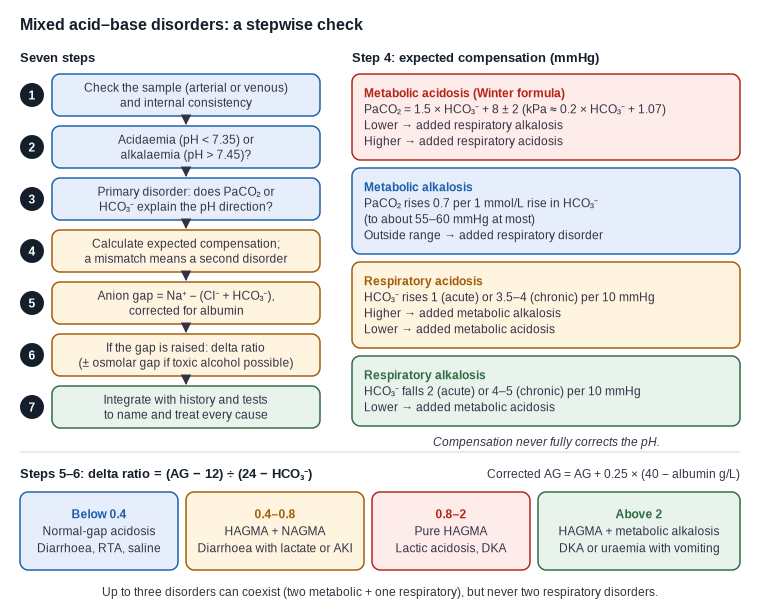
A mixed acid–base disorder is the presence of two or more primary disturbances at the same time, for example a metabolic acidosis with a respiratory alkalosis in salicylate poisoning, or a metabolic acidosis with a metabolic alkalosis in diabetic ketoacidosis with vomiting. They are common in acute illness and easily missed because pH may be near normal. Recognition rests on a fixed sequence: identify the primary disorder from pH, PaCO2 and bicarbonate; calculate the expected compensation (Winter formula for metabolic acidosis, 0.7 rule for metabolic alkalosis, acute and chronic rules for respiratory disorders); a measured value outside the expected range signals a second disorder. In every metabolic acidosis, calculate the anion gap corrected for albumin, then the delta ratio: below 0.4 suggests a normal anion gap acidosis, 0.4–0.8 a combined high and normal gap acidosis, and above 2 a coexisting metabolic alkalosis. Up to three disorders can coexist, but never two respiratory ones. Treatment targets each cause, not the numbers, and avoids correcting appropriate compensation.
Patient case, mechanism, investigations, management, flashcards and exam-style questions.Open the lesson →
Key facts
- Mixed disorder = two or more independent primary disturbances; a normal pH with abnormal PaCO2 and bicarbonate is mixed until proved otherwise
- Compensation never overcorrects pH and takes time: hours for respiratory, 3–5 days for full renal compensation
- Winter formula: expected PaCO2 (mmHg) = 1.5 × HCO3 + 8 ± 2; in kPa about 0.2 × HCO3 + 1.07
- Metabolic alkalosis: PaCO2 rises about 0.7 mmHg (0.09 kPa) for each 1 mmol/L rise in HCO3
- Respiratory acidosis: HCO3 rises 1 mmol/L per 10 mmHg (1.3 kPa) acutely and 3.5–4 chronically; respiratory alkalosis: falls 2 acutely and 4–5 chronically
- Anion gap = Na − (Cl + HCO3); add about 2.5 mmol/L for each 10 g/L fall in albumin below 40 g/L
- Delta ratio = (AG − 12) ÷ (24 − HCO3): below 0.4 NAGMA; 0.4–0.8 mixed HAGMA + NAGMA; 0.8–2 pure HAGMA; above 2 HAGMA + metabolic alkalosis
- Classic mixes: salicylate (HAGMA + respiratory alkalosis), DKA with vomiting (HAGMA + metabolic alkalosis), COPD on diuretics (chronic respiratory acidosis + metabolic alkalosis), cardiac arrest (respiratory + metabolic acidosis)
Differential diagnosis
| Condition | Clues | Key test |
|---|---|---|
| Simple disorder with appropriate compensation | Measured PaCO2 or HCO3 within the expected range | Recalculate compensation with the correct rule |
| Chronic respiratory acidosis with renal compensation | Raised HCO3 that matches the expected chronic rise | History of COPD or obesity hypoventilation; chronic rule |
| Laboratory or sampling error | Values that do not fit Henderson–Hasselbalch | Check pH from PaCO2 and HCO3; repeat sample |
| Venous rather than arterial sample | Low PO2, PaCO2 slightly higher, pH slightly lower | Check sampling; compare saturation |
| Hypoalbuminaemia masking a high anion gap | Normal uncorrected gap with lactate or ketones present | Albumin-corrected anion gap |
| Unmeasured cation or bromide or lithium interference | Low or negative anion gap | Paraprotein, lithium or bromide levels |
Exam pearls
Guideline
No dedicated guideline: physiological (Boston) approach with compensation rules (Berend 2014; Adrogué and Madias 2010), with the 2024 international consensus on hyperglycaemic crises, EXTRIP salicylate recommendations (2015) and BTS emergency oxygen guideline (2017)
References
- Berend K, de Vries AP, Gans RO.. Physiological approach to assessment of acid-base disturbances. N Engl J Med 2014.
- Seifter JL.. Integration of acid-base and electrolyte disorders. N Engl J Med 2014.
- Kraut JA, Madias NE.. Serum anion gap: its uses and limitations in clinical medicine. Clin J Am Soc Nephrol 2007.
- Figge J, Jabor A, Kazda A, Fencl V.. Anion gap and hypoalbuminemia. Crit Care Med 1998.
- Adrogué HJ, Madias NE.. Secondary responses to altered acid-base status: the rules of engagement. J Am Soc Nephrol 2010.
- Rastegar A.. Use of the ΔAG/ΔHCO3- ratio in the diagnosis of mixed acid-base disorders. J Am Soc Nephrol 2007.
Related topics
By Dr Khalid Seidi (B.Sc., M.D.) · MedEd World Clinical Knowledge library. Original teaching content checked against current guidelines (November 2026); confirm the latest local guidance before clinical use. Not a substitute for clinical judgement.