Clinical Knowledge › Internal medicine › Nephrology › Acid–base disorders
Respiratory acidosis
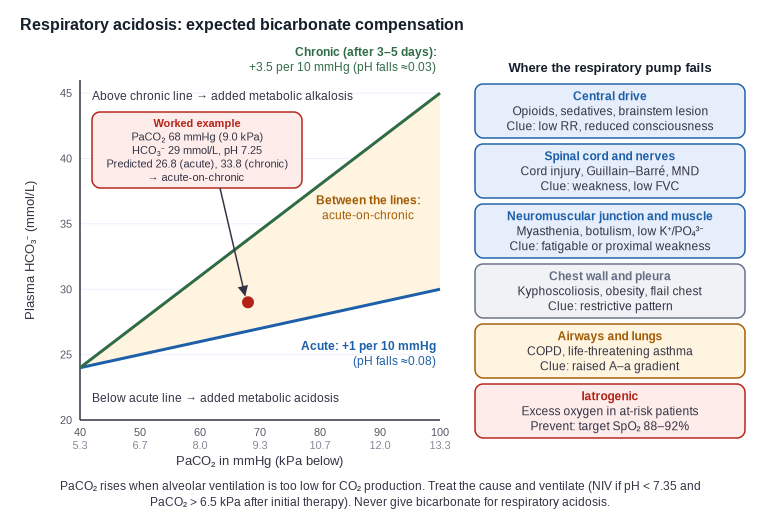
Respiratory acidosis is a primary rise in arterial PaCO2 above about 6.0 kPa (45 mmHg) caused by alveolar hypoventilation, which lowers pH below 7.35 unless the kidneys have had time to compensate. PaCO2 depends on CO2 production divided by alveolar ventilation, so any failure of the respiratory pump can cause it: depressed respiratory drive (opioids, sedatives, brainstem lesions), neuromuscular disease, chest wall disorders and obesity, or lung disease with ventilation–perfusion mismatch such as COPD. In acute hypercapnia bicarbonate rises by only about 1 mmol/L for every 10 mmHg rise in PaCO2; after 3–5 days renal compensation raises it by about 3.5 mmol/L per 10 mmHg, so pH is protected. Patients develop headache, drowsiness, flapping tremor, warm peripheries and, when severe, CO2 narcosis. Management treats the cause, gives controlled oxygen to a target of 88–92% in those at risk, and starts non-invasive ventilation when pH stays below 7.35 with PaCO2 above 6.5 kPa despite optimal medical therapy.
Patient case, mechanism, investigations, management, flashcards and exam-style questions.Open the lesson →
Key facts
- Respiratory acidosis = PaCO2 above 6.0 kPa (45 mmHg) with pH below 7.35 (or a raised PaCO2 with compensatory HCO3⁻ rise)
- PaCO2 ∝ CO2 production / alveolar ventilation: hypercapnia always means alveolar ventilation is inadequate for CO2 production
- Acute: HCO3⁻ rises about 1 mmol/L and pH falls about 0.08 per 10 mmHg rise in PaCO2
- Chronic (after 3–5 days): HCO3⁻ rises about 3.5 mmol/L and pH falls about 0.03 per 10 mmHg rise in PaCO2
- Pure hypoventilation causes hypoxaemia with a normal A–a gradient; a raised gradient means added lung disease
- In patients at risk of hypercapnia (COPD, obesity hypoventilation, neuromuscular disease) target SpO2 88–92%
- NIV is indicated for acute hypercapnic respiratory failure with pH below 7.35 and PaCO2 above 6.5 kPa persisting after initial treatment
- Never give bicarbonate to treat respiratory acidosis: it increases CO2 production and does not fix ventilation
Differential diagnosis
| Condition | Clues | Key test |
|---|---|---|
| Acute exacerbation of COPD | Smoker with increased breathlessness, sputum and wheeze; chronic CO2 retention | ABG, chest X-ray, spirometry when stable |
| Opioid or sedative toxicity | Pinpoint pupils, slow shallow breathing, reduced consciousness | Response to naloxone; drug history and toxicology |
| Obesity hypoventilation syndrome | BMI 30 kg/m² or more, daytime hypercapnia, raised HCO3⁻, sleepiness | ABG; polysomnography; exclude other causes |
| Neuromuscular weakness (Guillain–Barré, myasthenia, MND) | Weak limbs, weak cough, paradoxical abdominal breathing, small FVC | Serial FVC; nerve conduction; acetylcholine receptor antibodies |
| Life-threatening asthma | A normal or rising PaCO2 in a breathless asthmatic is ominous | ABG; peak flow; response to bronchodilators |
| Upper airway obstruction | Stridor, foreign body, angio-oedema or epiglottitis | Airway assessment, laryngoscopy |
| Metabolic alkalosis with compensation | High HCO3⁻ and PaCO2 but pH above 7.45 | pH identifies the primary process |
Exam pearls
Guideline
BTS/ICS guideline for the ventilatory management of acute hypercapnic respiratory failure in adults (2016), BTS guideline for oxygen use in healthcare and emergency settings (2017), ERS/ATS guideline on non-invasive ventilation for acute respiratory failure (2017), ATS obesity hypoventilation syndrome guideline (2019) and GOLD 2026 report
References
- Davidson AC, Banham S, Elliott M, et al.. BTS/ICS guideline for the ventilatory management of acute hypercapnic respiratory failure in adults. Thorax 2016.
- O'Driscoll BR, Howard LS, Earis J, Mak V.. BTS guideline for oxygen use in adults in healthcare and emergency settings. Thorax 2017.
- Rochwerg B, Brochard L, Elliott MW, et al.. Official ERS/ATS clinical practice guidelines: noninvasive ventilation for acute respiratory failure. Eur Respir J 2017.
- Mokhlesi B, Masa JF, Brozek JL, et al.. Evaluation and management of obesity hypoventilation syndrome. An official American Thoracic Society clinical practice guideline. Am J Respir Crit Care Med 2019.
- Global Initiative for Chronic Obstructive Lung Disease (GOLD). Global strategy for the diagnosis, management, and prevention of chronic obstructive pulmonary disease: 2026 report. GOLD 2026.
- Austin MA, Wills KE, Blizzard L, Walters EH, Wood-Baker R.. Effect of high flow oxygen on mortality in chronic obstructive pulmonary disease patients in prehospital setting: randomised controlled trial. BMJ 2010.
Related topics
By Dr Khalid Seidi (B.Sc., M.D.) · MedEd World Clinical Knowledge library. Original teaching content checked against current guidelines (November 2026); confirm the latest local guidance before clinical use. Not a substitute for clinical judgement.