Clinical Knowledge › Ear, nose and throat › External ear
Necrotising (malignant) otitis externa
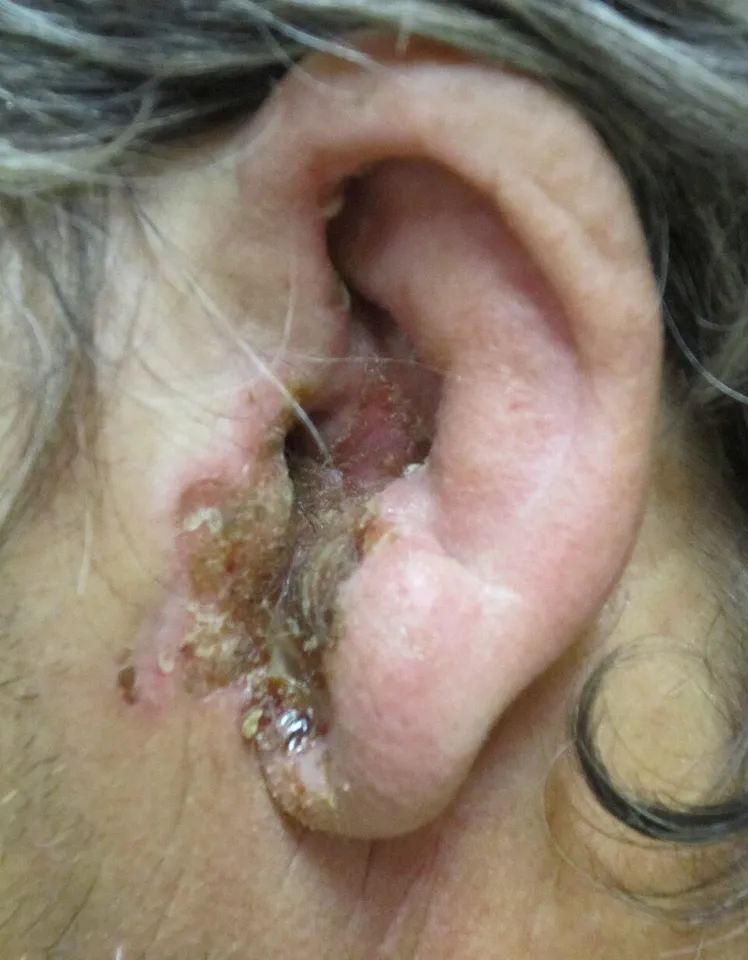
Necrotising (malignant) otitis externa (NOE) is an invasive infection that spreads from the external ear canal into the temporal bone and skull base, causing osteomyelitis. It is not a cancer; 'malignant' reflects its aggressive course. Typical patients are older people with diabetes or other immunosuppression, and Pseudomonas aeruginosa is the usual organism, with Staphylococcus aureus and fungi less often. Suspect it when otalgia is severe, often worse at night and out of proportion to the signs, with otorrhoea that has not settled on standard drops, and granulation tissue on the floor of the canal at the bony–cartilaginous junction. Cranial nerve palsies, most often the facial nerve and later IX–XII, indicate skull base spread. Diagnosis combines clinical features, raised inflammatory markers, culture (and biopsy to exclude carcinoma) and imaging with CT and MRI. Treatment is prolonged antipseudomonal antibiotics, usually for at least 6 weeks, strict glycaemic control, aural toilet and topical therapy, with surgery reserved for selected cases.
Patient case, mechanism, investigations, management, flashcards and exam-style questions.Open the lesson →
Key facts
- NOE is skull base osteomyelitis arising from otitis externa, not a malignancy
- Classic patient: older adult with diabetes (or immunosuppression, including HIV, chemotherapy, renal failure)
- Pseudomonas aeruginosa causes most cases; consider MRSA and fungi (Aspergillus, Candida) if refractory
- Red flag: severe, unremitting otalgia (often nocturnal) with otorrhoea not responding to topical treatment for 2 weeks
- Granulation tissue on the floor of the canal at the bony–cartilaginous junction is the classic sign
- Facial nerve palsy is the commonest cranial neuropathy; IX, X, XI (jugular foramen) and XII indicate advanced skull base disease
- CT shows bone erosion; MRI shows soft tissue and marrow extent; both are used, with nuclear imaging in some centres
- Treat with prolonged antipseudomonal antibiotics (for example ciprofloxacin, often after initial IV therapy), typically 6 weeks or longer
Differential diagnosis
| Condition | Clues | Key test |
|---|---|---|
| Acute otitis externa | Canal oedema and pain responding to drops within days; no bone involvement | Clinical; reassess at 48–72 h |
| Squamous cell carcinoma of the ear canal | Persistent granulation, bleeding, older patient, may coexist | Biopsy of granulation tissue |
| Cholesteatoma or chronic otitis media | Perforation, smelly discharge, conductive loss | Otoscopy under microscope, CT temporal bone |
| Ramsay Hunt syndrome | Vesicles, facial palsy, acute onset | Clinical; VZV PCR |
| Granulomatosis with polyangiitis | Ear disease with nasal, lung or renal involvement | ANCA (PR3), biopsy |
| Nasopharyngeal carcinoma | Unilateral middle ear effusion, neck node, cranial neuropathy | Nasendoscopy and biopsy; MRI |
| Fungal otitis externa (otomycosis) | Itch, fluffy debris with black or white spores, little pain | Microscopy; responds to antifungal drops |
Exam pearls
Guideline
UK consensus definitions for NOE (Delphi, 2023); COSNOE diagnostic criteria and core outcome set (2024); AAO-HNS Acute otitis externa guideline (2014)
References
- Hodgson SH, Khan MM, Patrick-Smith M, et al.. UK consensus definitions for necrotising otitis externa: a Delphi study. BMJ Open 2023.
- Lodhi S, Dodgson K, Dykes M, et al.. Diagnostic criteria and core outcome set development for necrotising otitis externa: the COSNOE Delphi consensus study. J Laryngol Otol 2024.
- Takata J, Hopkins M, Alexander V, et al.. Systematic review of the diagnosis and management of necrotising otitis externa: highlighting the need for high-quality research. Clin Otolaryngol 2023.
- Hopkins ME, Bennett A, Henderson N, et al.. A retrospective review and multi-specialty, evidence-based guideline for the management of necrotising otitis externa. J Laryngol Otol 2020.
- Stapleton E, Watson G.. Emerging themes in necrotising otitis externa: a scoping review of the literature from 2011 to 2020 and recommendations for future research. J Laryngol Otol 2022.
- Rosenfeld RM, Schwartz SR, Cannon CR, et al.. Clinical practice guideline: acute otitis externa. Otolaryngol Head Neck Surg 2014.
Related topics
By Dr Khalid Seidi (B.Sc., M.D.) · MedEd World Clinical Knowledge library. Original teaching content checked against current guidelines (November 2026); confirm the latest local guidance before clinical use. Not a substitute for clinical judgement.