Clinical Knowledge › Ear, nose and throat › Facial nerve and lateral skull base
Other causes of facial nerve palsy
Bell palsy explains about two-thirds of acute lower motor neurone facial palsies, but the rest have an identifiable cause that changes treatment. Causes are best sorted by the course of the nerve: intracranial (pontine stroke, cerebellopontine angle tumours, meningitis), intratemporal (acute otitis media, cholesteatoma, necrotising otitis externa, Ramsay Hunt syndrome, temporal bone fracture, facial nerve schwannoma), extratemporal (parotid malignancy, facial lacerations, parotid surgery, forceps delivery) and systemic (Lyme disease, sarcoidosis, Guillain–Barré syndrome, HIV, diabetes, pregnancy, leukaemia, Melkersson–Rosenthal and Möbius syndromes). Warning features are slow or stepwise onset, no recovery by 3–4 months, recurrence on the same side, isolated branch weakness, other cranial nerve signs, ear disease, hearing loss, a parotid mass and bilateral palsy. Assessment rests on careful otoscopy, parotid and neck examination, audiometry and targeted imaging or serology. Every patient needs eye protection; definitive treatment and facial rehabilitation depend on the cause.
Patient case, mechanism, investigations, management, flashcards and exam-style questions.Open the lesson →
Key facts
- About two-thirds of acute peripheral facial palsies are Bell palsy; one-third have a specific cause
- A slowly progressive palsy, or one not recovering by 3–4 months, is a tumour until proven otherwise (parotid, facial schwannoma, CPA lesion)
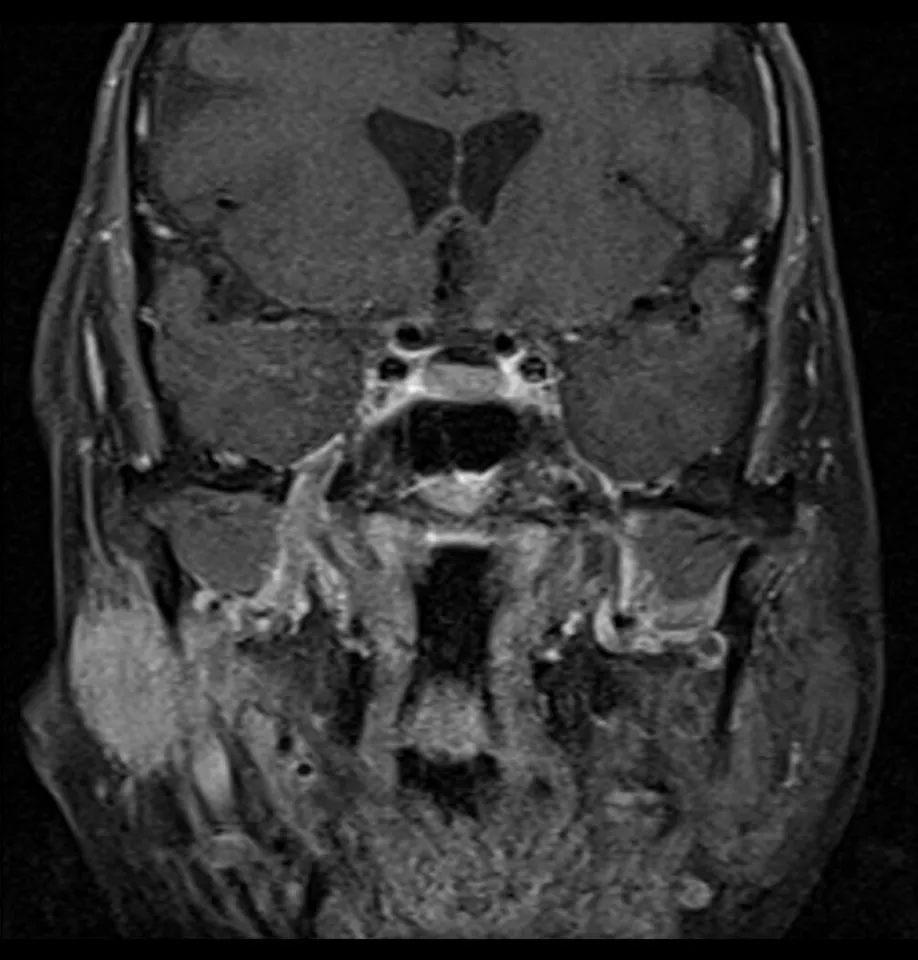
- Facial palsy with a parotid mass indicates malignancy: ultrasound with FNA or core biopsy and MRI
- Acute otitis media is the commonest secondary cause in children: IV antibiotics plus myringotomy
- Bilateral facial palsy is rarely Bell palsy: think Guillain–Barré, Lyme, sarcoidosis, HIV, leukaemia, meningitis
- Lyme facial palsy: doxycycline for 14–21 days (NICE 21 days); may be bilateral; erythema migrans and tick exposure
- Immediate complete palsy after temporal bone fracture or surgery suggests transection and needs early ENT/neurosurgical review
- Recurrent palsy, orofacial oedema and fissured tongue = Melkersson–Rosenthal; congenital VI and VII palsy = Möbius syndrome
Differential diagnosis
| Condition | Clues | Key test |
|---|---|---|
| Bell palsy | Acute (under 72 h), unilateral, isolated; recovery begins within 3 weeks | Clinical; exclude other causes |
| Ramsay Hunt syndrome | Ear pain, vesicles, SNHL or vertigo | Clinical; VZV PCR; audiogram |
| Acute otitis media or cholesteatoma | Otalgia, red bulging drum or attic retraction with smelly discharge | Otoscopy; CT temporal bone |
| Parotid malignancy | Progressive or branch palsy, hard fixed parotid mass, pain | Ultrasound with FNA/core biopsy; MRI |
| Lyme neuroborreliosis | Endemic area, tick bite, erythema migrans, may be bilateral | Borrelia serology; LP if meningitic |
| Guillain–Barré syndrome | Bilateral facial weakness, ascending limb weakness, areflexia | Nerve conduction studies; CSF protein |
| Sarcoidosis (Heerfordt syndrome) | Uveitis, parotid swelling, fever, hilar nodes | Chest imaging, ACE, calcium, tissue biopsy |
| Pontine stroke or tumour | LMN facial palsy with VI palsy and contralateral hemiparesis | MRI brain |
Exam pearls
Guideline
AAO-HNS Bell's palsy CPG (2013, current), NICE NG95 Lyme disease (2018) and IDSA/AAN/ACR Lyme disease guideline (2020)
References
- Baugh RF, Basura GJ, Ishii LE, et al.. Clinical practice guideline: Bell's palsy. Otolaryngol Head Neck Surg 2013.
- Peitersen E. Bell's palsy: the spontaneous course of 2,500 peripheral facial nerve palsies of different etiologies. Acta Otolaryngol Suppl 2002.
- Keane JR. Bilateral seventh nerve palsy: analysis of 43 cases and review of the literature. Neurology 1994.
- Lantos PM, Rumbaugh J, Bockenstedt LK, et al.. 2020 Guidelines for the prevention, diagnosis and treatment of Lyme disease. Clin Infect Dis 2021.
- National Institute for Health and Care Excellence. Lyme disease (NG95). NICE 2018.
- Kim SJ, Lee HY. Acute peripheral facial palsy: recent guidelines and a systematic review of the literature. J Korean Med Sci 2020.
Related topics
By Dr Khalid Seidi (B.Sc., M.D.) · MedEd World Clinical Knowledge library. Original teaching content checked against current guidelines (November 2026); confirm the latest local guidance before clinical use. Not a substitute for clinical judgement.