Clinical Knowledge › Ear, nose and throat › Facial nerve and lateral skull base
Ramsay Hunt syndrome
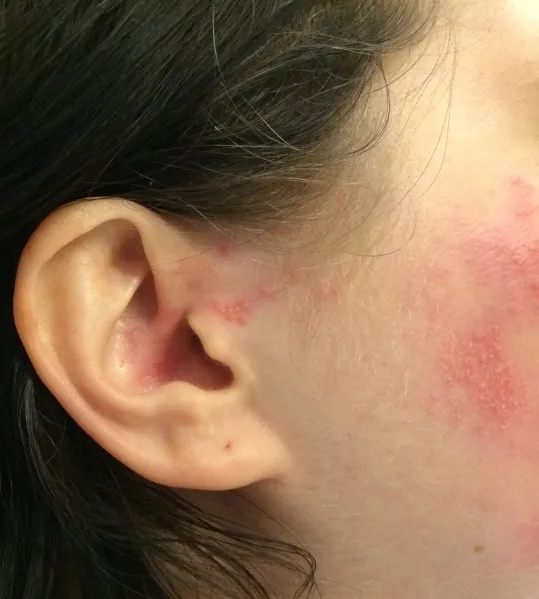
Ramsay Hunt syndrome (herpes zoster oticus with facial palsy) is reactivation of latent varicella-zoster virus (VZV) in the geniculate ganglion of the facial nerve. The classic triad is severe ear pain, a vesicular rash on the concha, external auditory canal or pinna (sometimes on the anterior tongue or soft palate), and an acute ipsilateral lower motor neurone facial palsy that involves the forehead. Spread to the nearby vestibulocochlear nerve causes sensorineural hearing loss, tinnitus and vertigo in a substantial minority. It is the second commonest cause of atraumatic peripheral facial palsy after Bell palsy, mainly affects adults over 60 and immunocompromised people, and has a worse outlook: the palsy is more often complete and recovery less certain. Diagnosis is clinical, supported by vesicle PCR, audiometry and grading on the House–Brackmann scale. Start oral corticosteroid plus an antiviral within 72 hours, protect the eye, control pain, and refer for audiology and ENT review. Recombinant zoster vaccine prevents shingles in eligible groups.
Patient case, mechanism, investigations, management, flashcards and exam-style questions.Open the lesson →
Key facts
- Triad: otalgia, vesicles in the ear (concha, canal, pinna) and ipsilateral lower motor neurone facial palsy
- Cause: reactivation of latent VZV in the geniculate ganglion; risk rises with age and immunosuppression
- Vestibulocochlear involvement (sensorineural hearing loss, tinnitus, vertigo) is common and worsens the outlook
- Vesicles may appear days after the palsy, so re-examine the ear and mouth; zoster sine herpete has no rash
- Treat within 72 hours: prednisolone plus valaciclovir (or aciclovir or famciclovir); antiviral benefit is plausible but RCT evidence is weak
- Protect the cornea: lubricants by day, ointment and taping at night; urgent eye review if the eye is red or painful
- Prognosis is worse than Bell palsy: complete recovery in roughly half to three-quarters, best with early treatment
- Recombinant (non-live) zoster vaccine prevents shingles; vesicles are infectious to people without varicella immunity
Differential diagnosis
| Condition | Clues | Key test |
|---|---|---|
| Bell palsy | No vesicles, less pain, no hearing loss or vertigo | Diagnosis of exclusion; examine ear and mouth repeatedly |
| Acute otitis media or mastoiditis with facial palsy | Red bulging drum, fever, mastoid tenderness | Otoscopy; CT temporal bone |
| Necrotising otitis externa | Older diabetic, granulation on canal floor, night pain | CRP/ESR, CT or MRI skull base |
| Stroke (upper motor neurone weakness) | Forehead spared, limb or speech signs, sudden onset | Urgent CT/MRI brain |
| Lyme neuroborreliosis | Endemic area, tick bite, erythema migrans, may be bilateral | Borrelia serology |
| Herpes zoster ophthalmicus | Forehead and nose vesicles in V1, eye involvement | Slit-lamp examination |
| Cholesteatoma or parotid malignancy | Gradual or progressive palsy, discharge or parotid mass | Otoscopy, MRI, ultrasound with FNA |
Exam pearls
Guideline
No dedicated Ramsay Hunt guideline: principles from the AAO-HNS Bell's palsy CPG (2013, still current), Cochrane review of antivirals in Ramsay Hunt (2008) and UKHSA Green Book shingles chapter (recombinant zoster vaccine programme from 2023)
References
- Sweeney CJ, Gilden DH. Ramsay Hunt syndrome. J Neurol Neurosurg Psychiatry 2001.
- Uscategui T, Dorée C, Chamberlain IJ, Burton MJ. Antiviral therapy for Ramsay Hunt syndrome (herpes zoster oticus with facial palsy) in adults. Cochrane Database Syst Rev 2008.
- Baugh RF, Basura GJ, Ishii LE, et al.. Clinical practice guideline: Bell's palsy. Otolaryngol Head Neck Surg 2013.
- House JW, Brackmann DE. Facial nerve grading system. Otolaryngol Head Neck Surg 1985.
- Kim SJ, Lee HY. Acute peripheral facial palsy: recent guidelines and a systematic review of the literature. J Korean Med Sci 2020.
- UK Health Security Agency. Immunisation against infectious disease (the Green Book), chapter 28a: Shingles (herpes zoster). UKHSA 2023.
Related topics
By Dr Khalid Seidi (B.Sc., M.D.) · MedEd World Clinical Knowledge library. Original teaching content checked against current guidelines (November 2026); confirm the latest local guidance before clinical use. Not a substitute for clinical judgement.