Clinical Knowledge › Internal medicine › Pulmonology › Basics of pulmonology
Pulmonary function tests
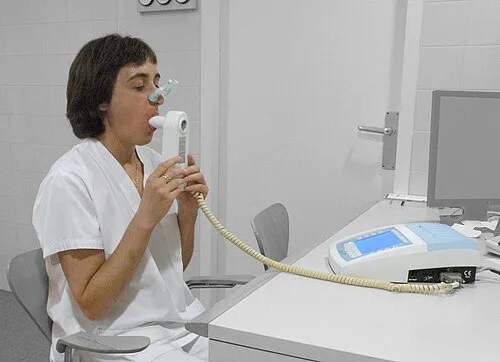
Pulmonary function tests measure how much air the lungs hold, how fast it can be moved and how well oxygen crosses into the blood. Spirometry records forced expiratory volume in 1 second (FEV1) and forced vital capacity (FVC); a reduced FEV1/FVC ratio defines airflow obstruction, as in asthma and COPD, whereas a proportionate fall in both with a normal ratio suggests restriction, which must be confirmed by a low total lung capacity on body plethysmography. Gas transfer (DLCO, TLCO) falls in emphysema, interstitial lung disease, pulmonary vascular disease and anaemia. Bronchodilator responsiveness, peak flow variability, FeNO and bronchial challenge tests support a diagnosis of asthma. The ERS/ATS 2022 standard interprets results against the lower limit of normal and z-scores from GLI reference equations, while GOLD keeps a fixed post-bronchodilator FEV1/FVC below 0.70 to confirm COPD. Good technique, quality grading and clinical context are essential to avoid misdiagnosis.
Patient case, mechanism, investigations, management, flashcards and exam-style questions.Open the lesson →
Key facts
- Obstruction: FEV1/FVC below the lower limit of normal (ERS/ATS 2022) or post-bronchodilator below 0.70 (GOLD, for COPD)
- Restriction cannot be diagnosed by spirometry alone: a low FVC with normal ratio is only suggestive; TLC below the LLN confirms it
- ERS/ATS 2022 grades severity by FEV1 z-score: mild −1.65 to −2.5, moderate −2.5 to −4, severe below −4
- Bronchodilator responsiveness (ERS/ATS 2022): rise in FEV1 or FVC of more than 10% of the predicted value; older asthma criteria use 12% and 200 mL
- GOLD grades airflow obstruction by post-bronchodilator FEV1: 1 ≥80%, 2 50–79%, 3 30–49%, 4 below 30% predicted
- Low DLCO: emphysema, interstitial lung disease, pulmonary vascular disease, anaemia; high DLCO: alveolar haemorrhage, polycythaemia, asthma, obesity
- Flow–volume loop: flattening of both limbs indicates fixed upper airway obstruction; inspiratory flattening alone suggests variable extrathoracic obstruction
- Use race-neutral GLI Global reference equations and report z-scores; percent predicted with a fixed 80% cut-off misclassifies the young and the old
Differential diagnosis
| Condition | Clues | Key test |
|---|---|---|
| Asthma | Variable symptoms, obstruction that reverses or variable PEF | Bronchodilator responsiveness, FeNO, PEF diary or methacholine challenge |
| COPD | Smoker or biomass exposure, persistent post-bronchodilator obstruction | Post-bronchodilator FEV1/FVC below 0.70 |
| Interstitial lung disease | Restriction with low DLCO and KCO | Lung volumes, DLCO and HRCT |
| Extraparenchymal restriction (obesity, chest wall, neuromuscular) | Low TLC with normal or high KCO | Lung volumes, maximal respiratory pressures, supine VC |
| Pulmonary vascular disease (PE, pulmonary hypertension) | Isolated low DLCO with normal spirometry and volumes | Echocardiography, V/Q scan or CT pulmonary angiography |
| Upper airway obstruction | Stridor, flattened flow–volume loop, poor response to inhalers | Flow–volume loop, CT neck and chest, laryngoscopy or bronchoscopy |
| Preserved ratio impaired spirometry (PRISm) | FEV1/FVC normal but FEV1 below normal | Lung volumes, repeat spirometry, assess obesity and early disease |
Exam pearls
Guideline
ERS/ATS technical standard on interpretive strategies (2022), ATS/ERS spirometry standard (2019 update), GOLD 2027 report, GINA 2025 and BTS/NICE/SIGN asthma guideline NG245 (2024)
References
- Stanojevic S, Kaminsky DA, Miller MR, et al.. ERS/ATS technical standard on interpretive strategies for routine lung function tests. Eur Respir J 2022.
- Graham BL, Steenbruggen I, Miller MR, et al.. Standardization of Spirometry 2019 Update. An Official American Thoracic Society and European Respiratory Society Technical Statement. Am J Respir Crit Care Med 2019.
- Quanjer PH, Stanojevic S, Cole TJ, et al.. Multi-ethnic reference values for spirometry for the 3-95-yr age range: the global lung function 2012 equations. Eur Respir J 2012.
- Bowerman C, Bhakta NR, Brazzale D, et al.. A Race-neutral Approach to the Interpretation of Lung Function Measurements. Am J Respir Crit Care Med 2023.
- Graham BL, Brusasco V, Burgos F, et al.. 2017 ERS/ATS standards for single-breath carbon monoxide uptake in the lung. Eur Respir J 2017.
- Wanger J, Clausen JL, Coates A, et al.. Standardisation of the measurement of lung volumes. Eur Respir J 2005.
Related topics
By Dr Khalid Seidi (B.Sc., M.D.) · MedEd World Clinical Knowledge library. Original teaching content checked against current guidelines (November 2026); confirm the latest local guidance before clinical use. Not a substitute for clinical judgement.