Clinical Knowledge › Internal medicine › Pulmonology › Basics of pulmonology
Pulse oximetry and oxygen therapy
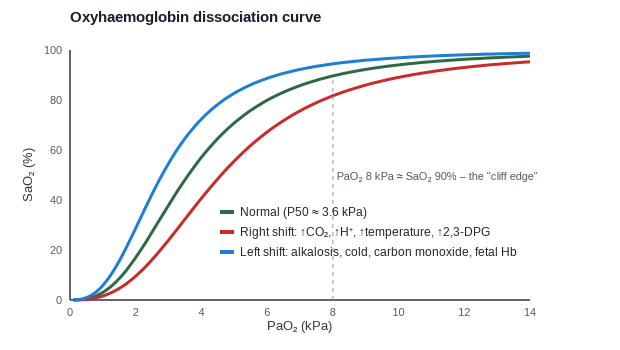
Pulse oximetry estimates arterial oxygen saturation (SpO2) by comparing how pulsatile blood absorbs red and infrared light. It is fast, cheap and continuous, but it can be wrong: poor perfusion, motion, carbon monoxide, methaemoglobin and darker skin pigmentation can all mislead, and saturation falls only late on the steep part of the dissociation curve. Oxygen is a drug that should be prescribed to a target range: 94–98% for most acutely ill adults and 88–92% for those at risk of hypercapnic respiratory failure, such as many people with COPD. Liberal oxygen that pushes saturations above about 96% increases mortality in acutely ill patients and gives no benefit in myocardial infarction or stroke without hypoxaemia. Devices range from nasal cannulae and Venturi masks to reservoir masks and high-flow nasal oxygen, with escalation to non-invasive or invasive ventilation when oxygen alone fails. Long-term oxygen therapy improves survival in COPD with severe resting hypoxaemia.
Patient case, mechanism, investigations, management, flashcards and exam-style questions.Open the lesson →
Key facts
- BTS targets: SpO2 94–98% for most acutely ill adults; 88–92% (or a documented individual target) for those at risk of hypercapnic respiratory failure
- Critically ill patients (shock, sepsis, major trauma, cardiac arrest, anaphylaxis, CO poisoning) start on a 15 L/min reservoir mask, then titrate once stable
- Liberal oxygen (SpO2 above about 96%) increases mortality in acutely ill adults; do not give oxygen in MI or stroke if saturations are normal
- An SpO2 of 90% corresponds to a PaO2 of about 8 kPa (60 mmHg); below this saturation falls steeply
- Pulse oximeters overestimate saturation in people with darker skin, so occult hypoxaemia is missed more often; check a blood gas when the picture does not fit
- Carbon monoxide gives falsely normal SpO2; methaemoglobinaemia drives SpO2 towards about 85%; only co-oximetry measures these
- Venturi masks deliver a fixed FiO2 (24%, 28%, 35%, 40%, 60%) and are preferred in hypercapnic risk; high-flow nasal oxygen gives up to 60 L/min and FiO2 up to 1.0
- LTOT in COPD: stable PaO2 7.3 kPa (55 mmHg) or below, or 8.0 kPa or below with polycythaemia, oedema or pulmonary hypertension, used at least 15 hours a day
Differential diagnosis
| Condition | Clues | Key test |
|---|---|---|
| True hypoxaemia from lung disease | Low SpO2 with good waveform, tachypnoea, abnormal chest signs | Arterial blood gas and chest X-ray |
| Poor peripheral perfusion or motion artefact | Erratic waveform, cold peripheries, shock or shivering | Warm the hand, try earlobe or forehead probe, arterial gas |
| Carbon monoxide poisoning | Headache, confusion, several people affected, normal SpO2 | Co-oximetry carboxyhaemoglobin |
| Methaemoglobinaemia | Cyanosis unresponsive to oxygen, chocolate-brown blood, SpO2 about 85% | Co-oximetry methaemoglobin level |
| Occult hypoxaemia in darker skin | SpO2 92–96% but clinical picture of hypoxaemia | Arterial blood gas (SaO2 and PaO2) |
| Hypercapnic respiratory failure masked by oxygen | Normal SpO2 on oxygen but drowsy with flap | Arterial or capillary blood gas for PaCO2 |
| Anaemia | Normal SpO2 but reduced oxygen content and delivery | Full blood count |
Exam pearls
Guideline
BTS guideline for oxygen use in adults in healthcare and emergency settings (2017), BMJ Rapid Recommendation on oxygen therapy (2018), ESICM ARDS and respiratory support guideline (2023), BTS home oxygen guideline (2015) and GOLD 2027
References
- O'Driscoll BR, Howard LS, Earis J, Mak V; British Thoracic Society Emergency Oxygen Guideline Group.. BTS guideline for oxygen use in adults in healthcare and emergency settings. Thorax 2017.
- Siemieniuk RAC, Chu DK, Kim LH, et al.. Oxygen therapy for acutely ill medical patients: a clinical practice guideline. BMJ 2018.
- Chu DK, Kim LH, Young PJ, et al.. Mortality and morbidity in acutely ill adults treated with liberal versus conservative oxygen therapy (IOTA): a systematic review and meta-analysis. Lancet 2018.
- Sjoding MW, Dickson RP, Iwashyna TJ, Gay SE, Valley TS.. Racial Bias in Pulse Oximetry Measurement. N Engl J Med 2020.
- Austin MA, Wills KE, Blizzard L, Walters EH, Wood-Baker R.. Effect of high flow oxygen on mortality in chronic obstructive pulmonary disease patients in prehospital setting: randomised controlled trial. BMJ 2010.
- Hofmann R, James SK, Jernberg T, et al.. Oxygen Therapy in Suspected Acute Myocardial Infarction. N Engl J Med 2017.
Related topics
By Dr Khalid Seidi (B.Sc., M.D.) · MedEd World Clinical Knowledge library. Original teaching content checked against current guidelines (November 2026); confirm the latest local guidance before clinical use. Not a substitute for clinical judgement.