Clinical Knowledge › Dermatology › Benign skin lesions and birthmarks
Pyogenic granuloma
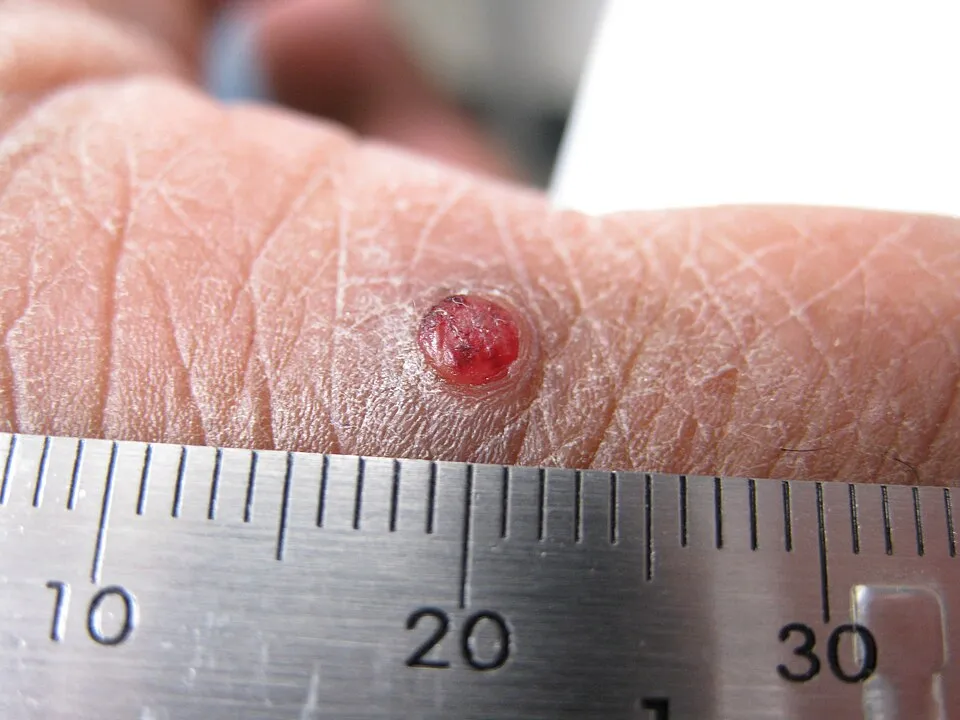
Pyogenic granuloma (lobular capillary haemangioma) is a common benign, acquired vascular tumour of skin and mucosa; the name is a misnomer because it is neither infective nor granulomatous. It typically affects children, young adults and pregnant women, often after minor trauma. Over days to weeks a solitary, bright red, moist, friable papule or polyp up to about 1 cm appears, frequently on a finger, lip, face or gingiva, with a pale collar of epidermis at its base (epidermal collarette). It bleeds profusely with trivial contact and may ulcerate and crust. Triggers include pregnancy (granuloma gravidarum on the gums), retinoids including isotretinoin, EGFR inhibitors, taxanes and some antiretrovirals, and ingrown nails. Histology shows lobules of proliferating capillaries in an oedematous stroma. The key safety point is that amelanotic melanoma, squamous cell carcinoma, Kaposi sarcoma and bacillary angiomatosis can look identical, so every removed lesion must be sent for histology. Treatment is shave or curettage with cautery to the base, or excision, which has the lowest recurrence; small lesions in children may respond to topical timolol. Pregnancy-related lesions may regress after delivery.
Patient case, mechanism, investigations, management, flashcards and exam-style questions.Open the lesson →
Key facts
- Pyogenic granuloma (PG) = lobular capillary haemangioma: a benign acquired vascular tumour, not infective and not granulomatous
- Classic lesion: rapidly growing (days to weeks), bright red, friable, moist papule or polyp with an epidermal collarette
- Bleeds profusely after minor trauma; often on fingers, lips, face and gingiva
- Peaks in children and young adults; granuloma gravidarum occurs on the gingiva in pregnancy
- Drug triggers: systemic retinoids (isotretinoin), EGFR inhibitors, taxanes, some antiretrovirals, capecitabine
- Histology: lobules of capillaries separated by fibrous septa in an oedematous stroma, with surface ulceration and an epidermal collarette
- Always send tissue for histology: amelanotic melanoma is the classic dangerous mimic
- Treatment: shave or curettage with cautery of the base, or full-thickness excision (lowest recurrence); topical timolol for small paediatric lesions
Differential diagnosis
| Condition | Clues | Key test |
|---|---|---|
| Amelanotic melanoma | Older patient, slower or steady growth, irregular, may have residual pigment; no clear trauma | Excision with histology (S100, SOX10, Melan-A) |
| Squamous cell carcinoma or keratoacanthoma | Keratotic, indurated nodule on sun-damaged skin, older adult | Excision biopsy |
| Kaposi sarcoma | Violaceous papules or plaques, often multiple, HIV or immunosuppression | Biopsy: HHV-8 LANA-1 positive |
| Bacillary angiomatosis | Multiple red papules in advanced HIV, fever | Biopsy with Warthin-Starry stain; Bartonella PCR |
| Cherry angioma | Small stable bright red dome-shaped papules on the trunk, older adults; rarely bleed | Clinical; dermoscopy red lagoons |
| Infantile haemangioma | Appears in first weeks of life, proliferates then involutes; GLUT1 positive | Clinical; ultrasound |
| Glomus tumour | Painful, cold-sensitive blue-red subungual lesion | MRI; excision |
| Spitz naevus | Pink dome-shaped papule in a child, not friable | Dermoscopy; excision |
Exam pearls
Guideline
ISSVA classification of vascular anomalies (2018, revised 2025) with NICE NG12 Suspected cancer: recognition and referral (2015, updated) for amelanotic melanoma and SCC mimics
References
- Lee J, Sinno H, Tahiri Y, Gilardino MS. Treatment options for cutaneous pyogenic granulomas: a review. J Plast Reconstr Aesthet Surg 2011.
- Giblin AV, Clover AJ, Athanassopoulos A, Budny PG. Pyogenic granuloma - the quest for optimum treatment: audit of treatment of 408 cases. J Plast Reconstr Aesthet Surg 2007.
- Wine Lee L, Goff KL, Lam JM, et al.. Treatment of pediatric pyogenic granulomas using beta-adrenergic receptor antagonists. Pediatr Dermatol 2014.
- Lomeli Martinez SM, Carrillo Contreras NG, Gomez Sandoval JR, et al.. Oral pyogenic granuloma: a narrative review. Int J Mol Sci 2023.
- Wassef M, Blei F, Adams D, et al.. Vascular anomalies classification: recommendations from the International Society for the Study of Vascular Anomalies (classification updated 2018 and 2025 at issva.org). Pediatrics 2015.
- National Institute for Health and Care Excellence. Suspected cancer: recognition and referral (NG12), 2015, with later updates. NICE 2015.
Related topics
By Dr Khalid Seidi (B.Sc., M.D.) · MedEd World Clinical Knowledge library. Original teaching content checked against current guidelines (November 2026); confirm the latest local guidance before clinical use. Not a substitute for clinical judgement.