Clinical Knowledge › Dermatology › Benign skin lesions and birthmarks
Skin tags
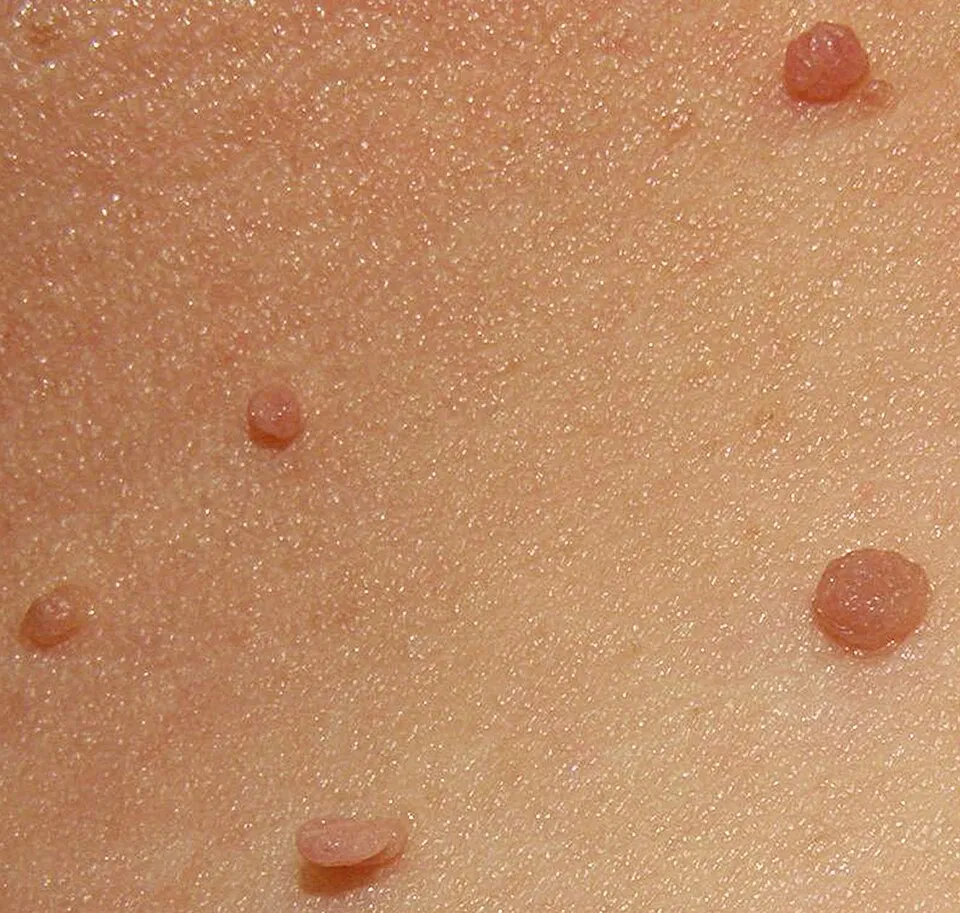
Skin tags (acrochordons, soft fibromas or fibroepithelial polyps) are small, soft, benign, skin-coloured or brown pedunculated papules found in about a quarter to a half of adults. They favour friction-prone flexures: the neck, axillae, groins, eyelids and under the breasts. Numbers increase with age, obesity, pregnancy and insulin resistance, and multiple tags, especially with acanthosis nigricans, are a recognised cutaneous marker of metabolic syndrome and type 2 diabetes; they also accompany acromegaly. Rarely, many small facial and neck papules signal Birt-Hogg-Dubé syndrome (FLCN), with lung cysts, pneumothorax and renal tumours. Histologically they are polyps of loose fibrovascular stroma covered by epidermis, without adnexal structures. Tags may twist, infarct, turn purple and become painful, or bleed after catching on jewellery or clothing. The diagnosis is clinical; atypical, enlarging or pigmented lesions need histology to exclude naevi, neurofibromas, seborrhoeic keratoses or malignancy. Removal by snip excision, cryotherapy or cautery is quick but usually considered cosmetic and not funded unless symptomatic. Always consider screening for diabetes with HbA1c.
Patient case, mechanism, investigations, management, flashcards and exam-style questions.Open the lesson →
Key facts
- Skin tags (acrochordons) are benign fibroepithelial polyps; prevalence roughly 25-50% of adults, rising with age
- Typical sites: neck, axillae, groins, eyelids, inframammary folds - areas of friction
- Morphology: soft, skin-coloured to brown, pedunculated or filiform papules 1-5 mm (occasionally larger 'bag-like' soft fibromas)
- Associations: obesity, insulin resistance, type 2 diabetes, metabolic syndrome, dyslipidaemia, pregnancy, acromegaly
- Multiple skin tags with acanthosis nigricans: check HbA1c or fasting glucose and lipids
- Birt-Hogg-Dubé syndrome (FLCN): fibrofolliculomas and tags on face and neck, lung cysts, spontaneous pneumothorax, renal tumours
- Torsion causes infarction: sudden pain and dark purple or black discolouration; the tag may fall off
- Removal: snip excision, cryotherapy or electrocautery; generally not NHS-funded for cosmetic reasons
Differential diagnosis
| Condition | Clues | Key test |
|---|---|---|
| Intradermal melanocytic naevus | Dome-shaped, sessile, may be hairy; face | Dermoscopy: comma vessels, globules |
| Pedunculated seborrhoeic keratosis | Warty, greasy, keratotic surface | Dermoscopy: milia-like cysts, comedo-like openings |
| Neurofibroma | Soft, skin-coloured, invaginates with pressure (buttonhole sign); NF1 features | Clinical; café-au-lait macules, axillary freckling |
| Viral wart (filiform) | Thread-like keratotic projections, often on face or near lips | Clinical; capillary dots |
| Molluscum contagiosum | Firm umbilicated pearly papules, children or immunosuppressed | Clinical; central core |
| Fibrofolliculoma (Birt-Hogg-Dubé) | Multiple small white-yellow dome-shaped papules on face and neck, family history of pneumothorax or renal cancer | Biopsy; FLCN genetic testing |
| Perianal skin tag of Crohn disease | Large oedematous perianal tags with fissures or fistulae | Colonoscopy and faecal calprotectin |
| Basal cell carcinoma or melanoma (polypoid) | Firm, pearly or pigmented, growing or bleeding | Excision with histology |
Exam pearls
Guideline
NHS Evidence-Based Interventions: removal of benign skin lesions (2019) with NICE PH38 type 2 diabetes prevention (2012, updated 2017) and ADA Standards of Care in Diabetes 2026
References
- Barbato MT, Criado PR, Silva AK, et al.. Association of acanthosis nigricans and skin tags with insulin resistance. An Bras Dermatol 2012.
- Shah R, Jindal A, Patel N. Acrochordons as a cutaneous sign of metabolic syndrome: a case-control study. Ann Med Health Sci Res 2014.
- Menko FH, van Steensel MA, Giraud S, et al.. Birt-Hogg-Dube syndrome: diagnosis and management. Lancet Oncol 2009.
- NHS England / Academy of Medical Royal Colleges. Evidence-Based Interventions programme: removal of benign skin lesions (clinical criteria for funded removal). NHS England 2019.
- National Institute for Health and Care Excellence. Type 2 diabetes: prevention in people at high risk (PH38), 2012, updated 2017. NICE 2012.
- American Diabetes Association. Standards of Care in Diabetes - 2026. Diabetes Care 2026.
Related topics
By Dr Khalid Seidi (B.Sc., M.D.) · MedEd World Clinical Knowledge library. Original teaching content checked against current guidelines (November 2026); confirm the latest local guidance before clinical use. Not a substitute for clinical judgement.