Clinical Knowledge › Internal medicine › Nephrology › Relevant pharmacology
Sodium bicarbonate therapy
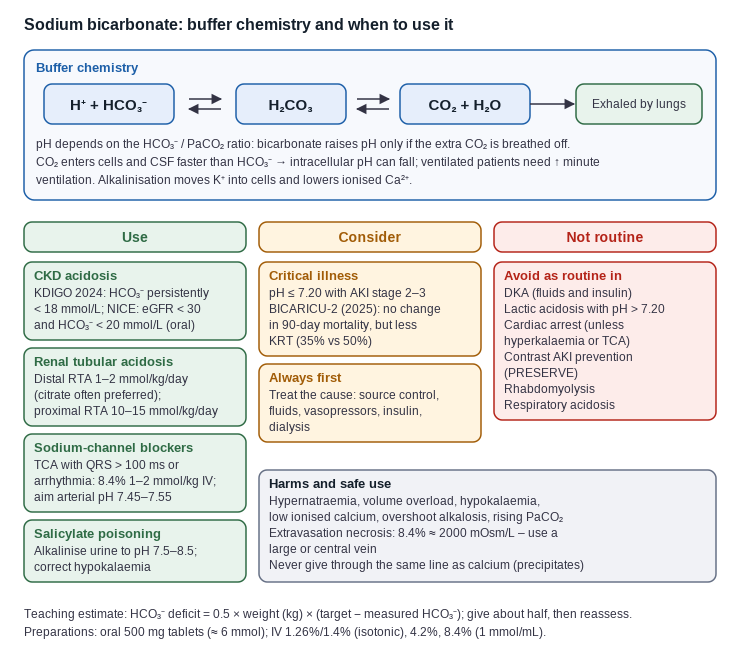
Sodium bicarbonate is an alkalinising salt given orally or intravenously to replace lost bicarbonate, buffer acid, alkalinise urine or counter sodium-channel blockade. It works best where the problem is bicarbonate loss or reduced kidney acid excretion: chronic kidney disease, renal tubular acidosis and diarrhoea. KDIGO 2024 advises considering oral bicarbonate in CKD when serum bicarbonate stays below 18 mmol/L, while avoiding values above the normal range. In acidosis from acid gain, such as lactic acidosis or ketoacidosis, treating the cause matters more; bicarbonate generates CO2, which must be breathed off, and can lower ionised calcium and potassium and overload sodium and fluid. In critically ill adults with pH 7.20 or lower and moderate to severe acute kidney injury, BICAR-ICU and BICARICU-2 (2025) found no effect on mortality but fewer patients needing kidney replacement therapy. Bicarbonate is lifesaving in tricyclic and other sodium-channel blocker poisoning with broad QRS, and is used to alkalinise urine in salicylate poisoning. Hypertonic 8.4% solution needs a large or central vein.
Patient case, mechanism, investigations, management, flashcards and exam-style questions.Open the lesson →
Key facts
- Preparations: oral 500 mg tablets (about 6 mmol each); IV 1.26% or 1.4% (isotonic), 4.2% and 8.4% (1 mmol/mL, about 2000 mOsm/L, central line preferred)
- Bicarbonate deficit (teaching estimate) = 0.5 × weight (kg) × (target − measured HCO3−); give about half, then reassess
- KDIGO 2024: consider treating CKD metabolic acidosis when bicarbonate is persistently below 18 mmol/L; NICE suggests oral bicarbonate if eGFR below 30 and bicarbonate below 20 mmol/L
- BICARICU-2 (2025): in pH 7.20 or lower with moderate–severe AKI, bicarbonate did not change 90-day mortality but reduced kidney replacement therapy (35% vs 50%)
- Not routine in DKA, lactic acidosis with pH above 7.20, cardiac arrest, contrast prevention (PRESERVE) or rhabdomyolysis
- Tricyclic overdose with QRS above 100 ms or arrhythmia: 1–2 mmol/kg of 8.4% IV bolus, aiming for arterial pH about 7.45–7.55
- Salicylate poisoning: IV bicarbonate to urine pH 7.5–8.5, correcting hypokalaemia; haemodialysis if severe
- Harms: hypernatraemia, volume overload, hypokalaemia, low ionised calcium, overshoot alkalosis, rising PaCO2 and extravasation necrosis
Differential diagnosis
| Condition | Clues | Key test |
|---|---|---|
| CKD-related metabolic acidosis | Low bicarbonate, normal or mildly raised anion gap, eGFR below about 30 | eGFR, venous bicarbonate trend |
| Diarrhoea (bicarbonate loss) | Normal anion gap, negative urine anion gap | Urine anion gap, stool history |
| Distal (type 1) RTA | Normal anion gap, urine pH above 5.5, hypokalaemia, stones | Urine pH, urine anion gap |
| Lactic acidosis | High anion gap, shock or hypoperfusion | Lactate; treat cause |
| Diabetic or alcoholic ketoacidosis | High anion gap with ketones | Blood ketones, glucose |
| Toxic alcohol ingestion | High anion gap and high osmolar gap | Osmolar gap, specific levels |
| Sodium-channel blocker poisoning | Broad QRS, terminal R wave in aVR, seizures, hypotension | ECG, history (tricyclics, flecainide, cocaine) |
Exam pearls
Guideline
KDIGO 2024 CKD guideline and NICE NG203 (2021) for chronic acidosis; Surviving Sepsis Campaign 2021 for critical illness, informed by BICAR-ICU (2018) and BICARICU-2 (2025)
References
- Kidney Disease: Improving Global Outcomes (KDIGO) CKD Work Group. KDIGO 2024 Clinical Practice Guideline for the Evaluation and Management of Chronic Kidney Disease. Kidney Int 2024.
- National Institute for Health and Care Excellence. Chronic kidney disease: assessment and management (NG203). NICE 2021.
- Jaber S, Paugam C, Futier E, et al.. Sodium bicarbonate therapy for patients with severe metabolic acidaemia in the intensive care unit (BICAR-ICU): a multicentre, open-label, randomised controlled, phase 3 trial. Lancet 2018.
- BICARICU-2 trial investigators. Sodium bicarbonate for severe metabolic acidemia and acute kidney injury: the BICARICU-2 randomized clinical trial. JAMA 2025.
- BiCARB study group. Clinical and cost-effectiveness of oral sodium bicarbonate therapy for older patients with chronic kidney disease and low-grade acidosis (BiCARB): a pragmatic randomised, double-blind, placebo-controlled trial. BMC Med 2020.
- Evans L, Rhodes A, Alhazzani W, et al.. Surviving Sepsis Campaign: international guidelines for management of sepsis and septic shock 2021. Crit Care Med 2021.
Related topics
By Dr Khalid Seidi (B.Sc., M.D.) · MedEd World Clinical Knowledge library. Original teaching content checked against current guidelines (November 2026); confirm the latest local guidance before clinical use. Not a substitute for clinical judgement.