Clinical Knowledge › Internal medicine › Nephrology › Glomerular diseases
Thin basement membrane disease
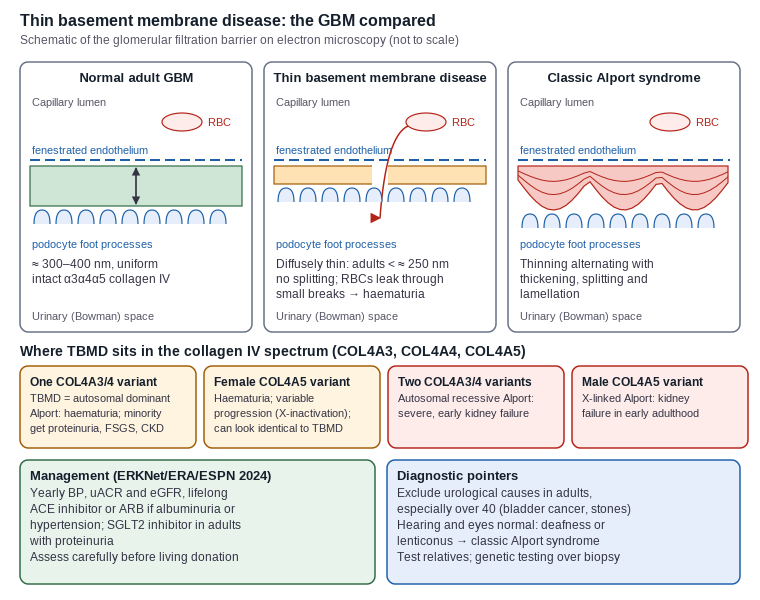
Thin basement membrane disease (TBMD, thin basement membrane nephropathy) describes persistent glomerular microscopic haematuria with uniform thinning of the glomerular basement membrane on electron microscopy, normal kidney function and often a family history of haematuria. It is one of the commonest causes of isolated glomerular haematuria, affecting perhaps 1% of people. Many cases are caused by a single (heterozygous) pathogenic variant in COL4A3 or COL4A4; the 2018 unified classification and the 2024 ERKNet/ERA/ESPN guideline call this autosomal dominant Alport syndrome, while women heterozygous for COL4A5 can look identical. The label 'benign familial haematuria' is no longer used because a minority develop proteinuria, hypertension, secondary FSGS and late CKD. Diagnosis rests on excluding other causes, testing relatives and genetic testing; biopsy is for atypical cases. There is no specific therapy: lifelong yearly checks of BP, albuminuria and eGFR, ACE inhibition once albuminuria or hypertension appears, and careful assessment before living kidney donation.
Patient case, mechanism, investigations, management, flashcards and exam-style questions.Open the lesson →
Key facts
- Persistent isolated microscopic glomerular haematuria (dysmorphic red cells) with normal eGFR and little or no proteinuria
- Electron microscopy: diffuse GBM thinning (adults typically below about 250 nm versus a normal of about 300–400 nm) without splitting or lamellation
- Many cases have a heterozygous COL4A3 or COL4A4 variant (autosomal dominant Alport syndrome); some are female COL4A5 heterozygotes
- Affects roughly 1% of the population; family members often have haematuria on dipstick
- Not always benign: a minority develop proteinuria, hypertension, secondary FSGS and CKD, usually after middle age
- Hearing and eyes are normal; deafness or lenticonus suggests classic Alport syndrome
- In adults with haematuria, urological causes (bladder cancer, stones) must still be excluded, especially over 40
- Management: yearly BP, uACR and eGFR; ACE inhibitor if albuminuria or hypertension develops; caution with living donation
Differential diagnosis
| Condition | Clues | Key test |
|---|---|---|
| IgA nephropathy | Visible haematuria with infections, proteinuria, no family history | Biopsy: mesangial IgA |
| Classic (X-linked or recessive) Alport syndrome | Males with progressive CKD, deafness, lenticonus | Genetic testing, audiometry, eye examination |
| Urological haematuria | Older age, smoking, isomorphic red cells, clots | CT urogram or ultrasound and cystoscopy |
| Hypercalciuria (especially children) | Haematuria with stones or family history of stones | Urine calcium:creatinine ratio |
| Nutcracker syndrome | Left loin pain and haematuria in thin young adults | Doppler ultrasound or CT of left renal vein |
| Sickle cell trait | Painless haematuria, often left-sided, in people of African ancestry | Haemoglobin electrophoresis |
Exam pearls
Guideline
ERKNet/ERA/ESPN 2024 guideline on Alport syndrome (heterozygous COL4A3/COL4A4: autosomal dominant Alport syndrome), building on the 2013 expert guidelines for thin basement membrane nephropathy
References
- Torra R, Lipska-Ziętkiewicz B, Acke F, et al.. Diagnosis, management and treatment of the Alport syndrome – 2024 guideline on behalf of ERKNet, ERA and ESPN. Nephrol Dial Transplant 2025.
- Savige J, Gregory M, Gross O, et al.. Expert guidelines for the management of Alport syndrome and thin basement membrane nephropathy. J Am Soc Nephrol 2013.
- Kashtan CE, Ding J, Garosi G, et al.. Alport syndrome: a unified classification of genetic disorders of collagen IV α345: a position paper of the Alport Syndrome Classification Working Group. Kidney Int 2018.
- Matthaiou A, Poulli T, Deltas C. Prevalence of clinical, pathological and molecular features of glomerular basement membrane nephropathy caused by COL4A3 or COL4A4 mutations: a systematic review. Clin Kidney J 2020.
- Vivante A, Afek A, Frenkel-Nir Y, et al.. Persistent asymptomatic isolated microscopic hematuria in Israeli adolescents and young adults and risk for end-stage renal disease. JAMA 2011.
- Savige J, Lipska-Zietkiewicz BS, Watson E, et al.. Guidelines for genetic testing and management of Alport syndrome. Clin J Am Soc Nephrol 2022.
Related topics
By Dr Khalid Seidi (B.Sc., M.D.) · MedEd World Clinical Knowledge library. Original teaching content checked against current guidelines (November 2026); confirm the latest local guidance before clinical use. Not a substitute for clinical judgement.