Clinical Knowledge › Dermatology › Skin in systemic disease
Xanthomas
Xanthomas are yellow-orange deposits of lipid-laden foam cells in skin or tendons. Their morphology points to the lipid disorder: tendon xanthomas in the Achilles and finger extensor tendons indicate familial hypercholesterolaemia; tuberous xanthomas over elbows and knees and palmar crease xanthomas suggest familial dysbetalipoproteinaemia (APOE2/E2 with a second metabolic hit); crops of eruptive xanthomas with red halos on the buttocks reflect severe hypertriglyceridaemia with risk of acute pancreatitis; intertriginous plane xanthomas in a child suggest homozygous FH; plane xanthomas also occur with cholestasis and, with normal lipids, with monoclonal gammopathy. Xanthelasma of the eyelids is the commonest type and about half of affected people have dyslipidaemia. Assessment includes a full lipid profile with apoB and Lp(a), secondary causes (diabetes, hypothyroidism, nephrotic syndrome, cholestasis, drugs), FH scoring and genetic testing with cascade screening. Treatment targets the lipids under ESC/EAS 2019 with the 2025 update and the 2026 ACC/AHA guideline: statins, ezetimibe, PCSK9-directed therapy, fibrates and, for familial chylomicronaemia syndrome, APOC3-targeted drugs where available; local removal is cosmetic.
Patient case, mechanism, investigations, management, flashcards and exam-style questions.Open the lesson →
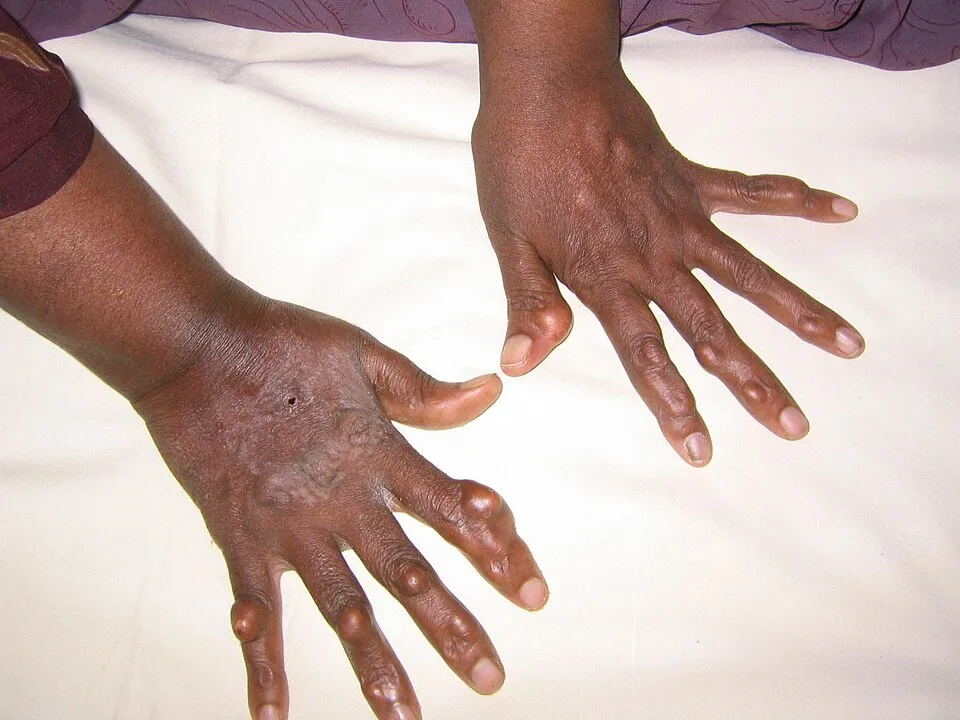
Key facts
- Xanthomas are dermal or tendon collections of foam cells (lipid-laden macrophages)
- Tendon xanthomas (Achilles, finger extensors) are characteristic of familial hypercholesterolaemia
- Palmar crease and tuberous xanthomas suggest familial dysbetalipoproteinaemia (APOE2/E2)
- Eruptive xanthomas: triglycerides usually above 10 mmol/L; risk of acute pancreatitis
- Xanthelasma: only about half have dyslipidaemia, but always check lipids
- Normolipaemic plane xanthoma: screen for monoclonal gammopathy and myeloma
- Screen for secondary causes: diabetes, hypothyroidism, nephrotic syndrome, cholestasis, alcohol, drugs
- FH: high-intensity statin, ezetimibe, PCSK9-directed therapy; cascade-test relatives
Differential diagnosis
| Condition | Clues | Key test |
|---|---|---|
| Gouty tophi | Chalky deposits on ears, fingers, elbows with gout | Urate crystals on aspiration |
| Rheumatoid nodules | Extensor forearm nodules with RA | Rheumatoid factor, anti-CCP |
| Juvenile xanthogranuloma | Solitary orange papule in infancy, normal lipids | Biopsy |
| Sebaceous hyperplasia | Umbilicated yellow papules on forehead | Dermoscopy, clinical |
| Molluscum contagiosum | Umbilicated pearly papules without red halo | Clinical |
| Necrobiosis lipoidica | Yellow atrophic shin plaques in diabetes | Biopsy |
| Epidermoid cyst | Mobile cyst with punctum | Clinical |
Exam pearls
Guideline
2019 ESC/EAS dyslipidaemia guidelines with the 2025 focused update, 2026 ACC/AHA multisociety dyslipidaemia guideline, NICE CG71 familial hypercholesterolaemia and EAS 2023 homozygous FH consensus
References
- Mach F, Baigent C, Catapano AL, et al.. 2019 ESC/EAS Guidelines for the management of dyslipidaemias: lipid modification to reduce cardiovascular risk. Eur Heart J 2020.
- Mach F, Koskinas KC, Roeters van Lennep JE, et al.. 2025 Focused Update of the 2019 ESC/EAS Guidelines for the management of dyslipidaemias. Eur Heart J 2025.
- Blumenthal RS, Morris PB, Gaudino M, et al.. 2026 ACC/AHA/AACVPR/ABC/ACPM/ADA/AGS/APhA/ASPC/NLA/PCNA Guideline on the Management of Dyslipidemia. J Am Coll Cardiol 2026.
- National Institute for Health and Care Excellence. Familial hypercholesterolaemia: identification and management (CG71). NICE 2019.
- Berglund L, Brunzell JD, Goldberg AC, et al.. Evaluation and treatment of hypertriglyceridemia: an Endocrine Society clinical practice guideline. J Clin Endocrinol Metab 2012.
- Cuchel M, Raal FJ, Hegele RA, et al.. 2023 Update on European Atherosclerosis Society Consensus Statement on Homozygous Familial Hypercholesterolaemia: new treatments and clinical guidance. Eur Heart J 2023.
Related topics
By Dr Khalid Seidi (B.Sc., M.D.) · MedEd World Clinical Knowledge library. Original teaching content checked against current guidelines (November 2026); confirm the latest local guidance before clinical use. Not a substitute for clinical judgement.