Clinical Knowledge › Urology › Relevant pharmacology
5-alpha-reductase inhibitors
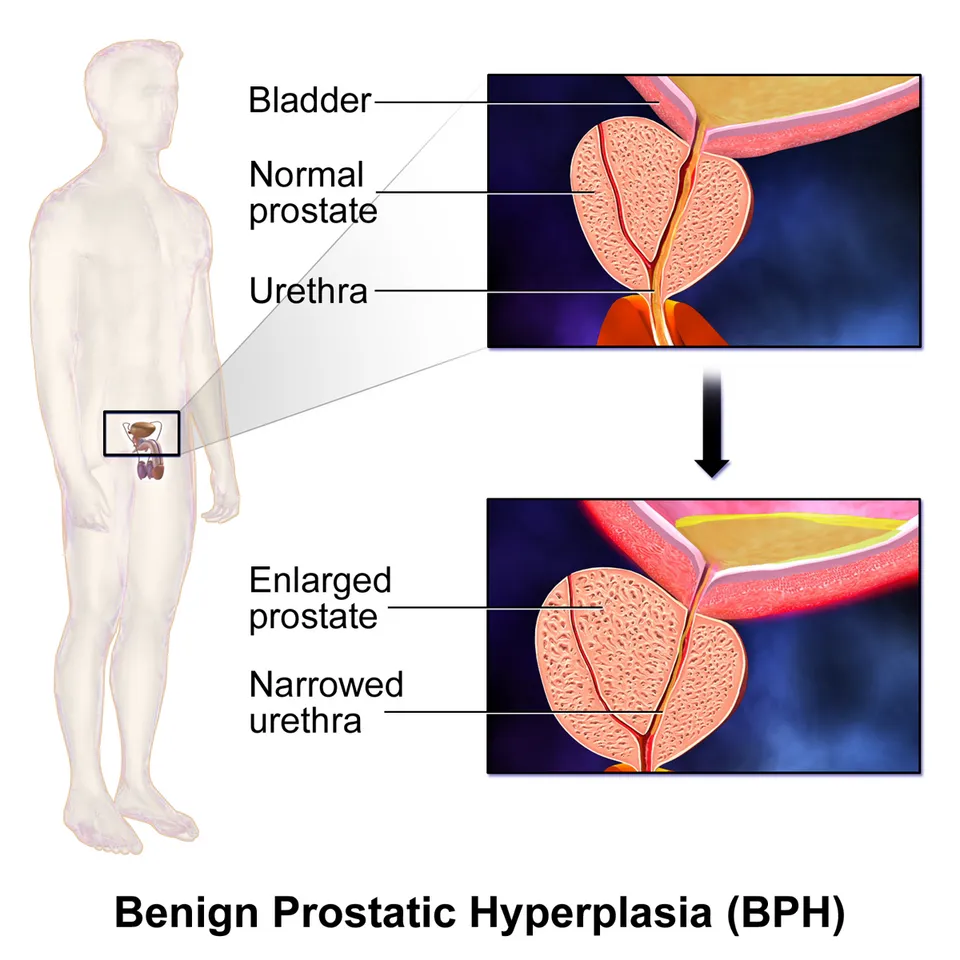
5-alpha-reductase inhibitors (5-ARIs) block conversion of testosterone to the more potent androgen dihydrotestosterone (DHT), the main driver of prostatic growth. Finasteride inhibits the type 2 isoenzyme and lowers serum DHT by about 70%; dutasteride inhibits types 1 and 2 and lowers it by over 90%. Over 6–12 months the prostate shrinks by roughly 20–30%, symptoms and flow improve modestly, and the long-term risks of acute urinary retention and BPH surgery fall by about half. They work only when the prostate is enlarged (about 30–40 mL or more) and are often combined with an alpha-blocker. PSA falls by about 50% within 6–12 months, so a measured PSA must be doubled for interpretation and any confirmed rise on treatment needs assessment. Low-dose finasteride treats male pattern hair loss. Adverse effects are mainly sexual (reduced libido, erectile and ejaculatory dysfunction) and breast tenderness or gynaecomastia; mood change and suicidal thoughts have prompted regulatory warnings. They are teratogenic to a male fetus, and they are not licensed to prevent prostate cancer.
Patient case, mechanism, investigations, management, flashcards and exam-style questions.Open the lesson →
Key facts
- Teaching doses (check local formulary): finasteride 5 mg once daily for BPH, 1 mg daily for hair loss; dutasteride 500 micrograms once daily
- Finasteride blocks type 2 5-alpha-reductase; dutasteride blocks types 1 and 2 and has a half-life of about 5 weeks
- Benefit needs months: assess at 6–12 months, and use only for an enlarged prostate (about 30–40 mL or more, or PSA above about 1.5 ng/mL)
- PLESS: finasteride halved acute urinary retention and BPH surgery over 4 years
- PSA falls by about 50% by 6–12 months: double the value, set a new baseline, and investigate any confirmed rise
- PCPT and REDUCE showed about 23–25% fewer prostate cancers detected, but more high-grade tumours; long-term survival unchanged
- Sexual adverse effects and gynaecomastia are the main harms; regulators warn about depression and suicidal thoughts
- Women who are or may become pregnant must not handle crushed finasteride tablets or leaking dutasteride capsules
Differential diagnosis
| Condition | Clues | Key test |
|---|---|---|
| Expected PSA fall on 5-ARI | PSA about half of baseline after 6–12 months | Double PSA; compare with new baseline |
| Prostate cancer on 5-ARI | Confirmed PSA rise from nadir or abnormal DRE | Repeat PSA; MRI-first pathway |
| Drug-related erectile dysfunction | New ED after starting, sometimes reduced libido | History; testosterone and cardiovascular risk review |
| Gynaecomastia from 5-ARI | Tender breast enlargement | Examination; exclude male breast cancer if asymmetric hard mass |
| Depression or suicidal thoughts | Low mood after starting finasteride | Mood assessment; stop drug and seek help |
| Small prostate with poor response | Prostate under 30 mL, no improvement at 6–12 months | Ultrasound volume; consider alpha-blocker instead |
Exam pearls
Guideline
AUA Guideline on LUTS attributed to BPH (2026, Part II); EAU Guidelines on non-neurogenic male LUTS (2025); NICE CG97 (2010, updated 2015); EMA Article 31 referral on finasteride and dutasteride (2025)
References
- Goueli R, Badlani GH, Welliver C, et al.. Management of lower urinary tract symptoms attributed to benign prostatic hyperplasia: AUA Guideline (2026) Part II: medical management. J Urol 2026.
- European Association of Urology. EAU Guidelines on the management of non-neurogenic male lower urinary tract symptoms (LUTS). EAU Guidelines Office, Arnhem 2025.
- National Institute for Health and Care Excellence. Lower urinary tract symptoms in men: management (CG97). NICE 2010.
- McConnell JD, Bruskewitz R, Walsh P, et al.. The effect of finasteride on the risk of acute urinary retention and the need for surgical treatment among men with benign prostatic hyperplasia. N Engl J Med 1998.
- McConnell JD, Roehrborn CG, Bautista OM, et al.. The long-term effect of doxazosin, finasteride, and combination therapy on the clinical progression of benign prostatic hyperplasia. N Engl J Med 2003.
- Roehrborn CG, Siami P, Barkin J, et al.. The effects of combination therapy with dutasteride and tamsulosin on clinical outcomes in men with symptomatic benign prostatic hyperplasia: 4-year results from the CombAT study. Eur Urol 2010.
Related topics
By Dr Khalid Seidi (B.Sc., M.D.) · MedEd World Clinical Knowledge library. Original teaching content checked against current guidelines (November 2026); confirm the latest local guidance before clinical use. Not a substitute for clinical judgement.