Clinical Knowledge › Urology › Relevant pharmacology
Alpha-blockers
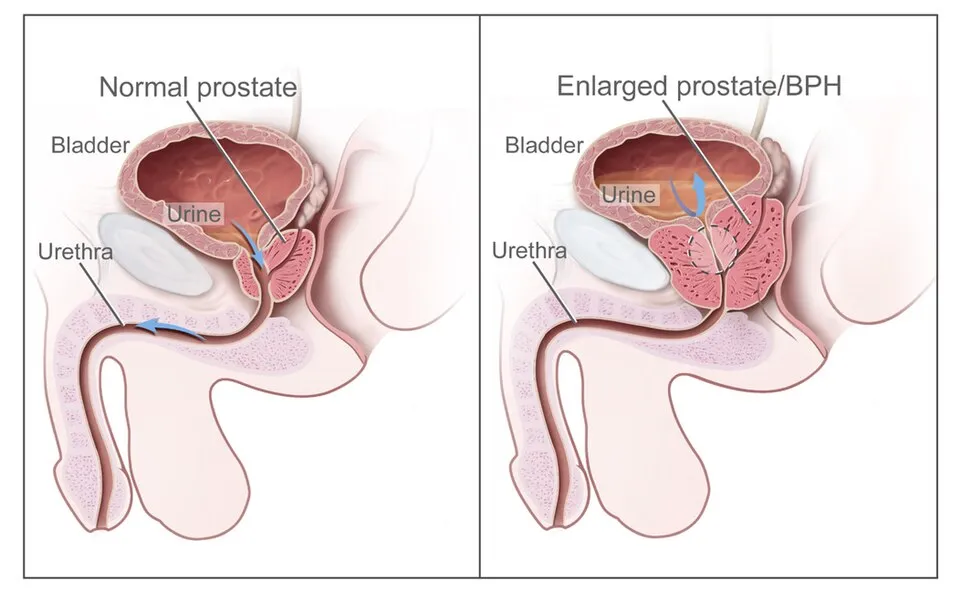
Alpha-1 adrenoceptor antagonists (alpha-blockers) are the usual first drug for bothersome lower urinary tract symptoms (LUTS) in men. Noradrenaline acting on alpha-1A receptors contracts smooth muscle in the prostatic stroma, capsule and bladder neck, the dynamic part of obstruction. Blocking these receptors relaxes the outlet within days, lowering the International Prostate Symptom Score (IPSS) by about 30–40% and raising peak flow modestly, whatever the prostate size. Tamsulosin and silodosin are alpha-1A-selective; alfuzosin, doxazosin and terazosin are less selective and cause more postural hypotension. They do not shrink the prostate or prevent retention and surgery in the long term, which is why a 5-alpha-reductase inhibitor is added for large glands. Other uses include trial without catheter after acute retention, medical expulsive therapy for distal ureteric stones over 5 mm, and doxazosin as a late add-on antihypertensive. Key harms are dizziness and first-dose syncope, ejaculatory dysfunction and intraoperative floppy iris syndrome during cataract surgery.
Patient case, mechanism, investigations, management, flashcards and exam-style questions.Open the lesson →
Key facts
- About 70% of prostatic alpha-1 receptors are the alpha-1A subtype; alpha-1B mainly controls vascular tone, so selective agents cause less hypotension
- Teaching doses (check local formulary): tamsulosin 400 micrograms once daily, alfuzosin 10 mg modified-release once daily, doxazosin 1 mg titrated to 2–8 mg, silodosin 8 mg once daily
- Onset within days; review at 4–6 weeks (NICE) and stop if there is no benefit
- Improve symptoms and flow but do not reduce prostate volume, PSA or long-term retention and surgery risk (MTOPS)
- Ejaculatory dysfunction (reduced or absent ejaculate) is commonest with silodosin and tamsulosin
- Intraoperative floppy iris syndrome is most strongly linked to tamsulosin and can persist after stopping; tell the eye surgeon
- An alpha-blocker before trial without catheter improves the chance of voiding after acute urinary retention
- ALLHAT stopped the doxazosin arm early because of more heart failure than chlorthalidone, so alpha-blockers are not first-line for hypertension
Differential diagnosis
| Condition | Clues | Key test |
|---|---|---|
| Expected postural dizziness | First doses, older man, non-selective agent | Lying and standing BP |
| Volume depletion or other antihypertensive excess | Dizziness after new diuretic or ACE inhibitor | Medication review, U&E |
| Retrograde ejaculation or anejaculation from drug | Dry orgasm after starting tamsulosin or silodosin | Post-orgasm urinalysis for sperm |
| Failure of alpha-blocker due to large prostate | Persistent LUTS, prostate over about 40 mL, PSA above 1.5 | Prostate volume on ultrasound; consider 5-ARI |
| Persistent storage symptoms (OAB) | Urgency and frequency despite good flow | Bladder diary, post-void residual |
| Chronic retention | Large painless bladder, overflow, raised creatinine | Bladder scan, U&E; catheter not tablets |
| Urethral stricture | Young man, poor flow, history of instrumentation or STI | Flow curve plateau, urethrogram or cystoscopy |
Exam pearls
Guideline
AUA Guideline on LUTS attributed to BPH (2026, Part II medical management); EAU Guidelines on non-neurogenic male LUTS (2025); NICE CG97 (2010, updated 2015); EAU Urolithiasis (2025)
References
- Goueli R, Badlani GH, Welliver C, et al.. Management of lower urinary tract symptoms attributed to benign prostatic hyperplasia: AUA Guideline (2026) Part II: medical management. J Urol 2026.
- European Association of Urology. EAU Guidelines on the management of non-neurogenic male lower urinary tract symptoms (LUTS). EAU Guidelines Office, Arnhem 2025.
- National Institute for Health and Care Excellence. Lower urinary tract symptoms in men: management (CG97). NICE 2010.
- McConnell JD, Roehrborn CG, Bautista OM, et al.. The long-term effect of doxazosin, finasteride, and combination therapy on the clinical progression of benign prostatic hyperplasia. N Engl J Med 2003.
- Roehrborn CG, Siami P, Barkin J, et al.. The effects of combination therapy with dutasteride and tamsulosin on clinical outcomes in men with symptomatic benign prostatic hyperplasia: 4-year results from the CombAT study. Eur Urol 2010.
- Pickard R, Starr K, MacLennan G, et al.. Medical expulsive therapy in adults with ureteric colic: a multicentre, randomised, placebo-controlled trial. Lancet 2015.
Related topics
By Dr Khalid Seidi (B.Sc., M.D.) · MedEd World Clinical Knowledge library. Original teaching content checked against current guidelines (November 2026); confirm the latest local guidance before clinical use. Not a substitute for clinical judgement.