Clinical Knowledge › Ear, nose and throat › Basics of ear, nose and throat
Anatomy of the nose and paranasal sinuses
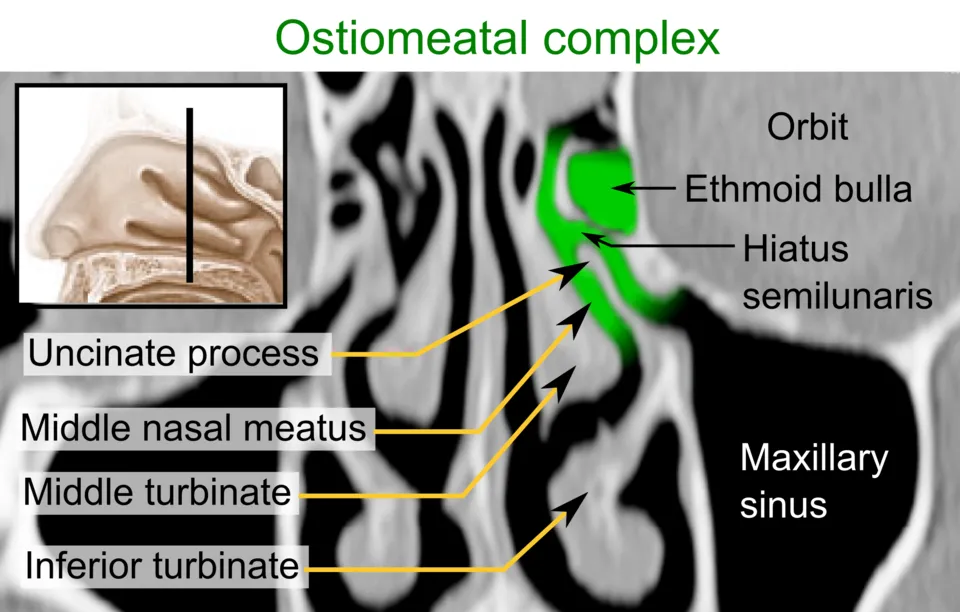
The nose warms, humidifies and filters air, carries the sense of smell and drains the paranasal sinuses. The septum (quadrilateral cartilage, perpendicular plate of the ethmoid and vomer) divides the cavity; the lateral wall carries three turbinates whose meatuses receive the sinus and nasolacrimal openings. The middle meatus is the key area: the ostiomeatal complex drains the frontal, maxillary and anterior ethmoid sinuses, so mucosal swelling here causes most rhinosinusitis and is the target of functional endoscopic sinus surgery. The posterior ethmoid cells drain to the superior meatus, the sphenoid to the sphenoethmoidal recess and the tears to the inferior meatus. Blood arrives from both carotid systems and converges on Little's area, the source of most nosebleeds. The sinuses border the orbit, the anterior cranial fossa, the optic nerve and the internal carotid artery, which explains orbital cellulitis, CSF leak and the risks of sinus surgery. Maxillary and ethmoid sinuses exist at birth, while the frontal sinus develops in later childhood.
Patient case, mechanism, investigations, management, flashcards and exam-style questions.Open the lesson →
Key facts
- Septum: quadrilateral (septal) cartilage anteriorly, perpendicular plate of ethmoid above and behind, vomer below and behind; its cartilage depends on mucoperichondrium for nutrition
- Ostiomeatal complex in the middle meatus drains the frontal, maxillary and anterior ethmoid sinuses; posterior ethmoid drains to the superior meatus, sphenoid to the sphenoethmoidal recess
- Nasolacrimal duct opens into the inferior meatus under the inferior turbinate
- Little's area (Kiesselbach plexus) on the anterior septum is the source of about 90% of nosebleeds: anterior ethmoidal, sphenopalatine, greater palatine and superior labial arteries meet there
- Maxillary and ethmoid sinuses are present at birth, the sphenoid pneumatises in early childhood and the frontal sinus develops from about age 6–8, completing in adolescence
- Lamina papyracea (thin lateral ethmoid wall) explains why ethmoiditis causes orbital cellulitis in children
- Sphenoid sinus relations: optic nerve and internal carotid artery laterally, pituitary above, cavernous sinus lateral to it
- Olfactory epithelium lies high in the olfactory cleft; olfactory nerve fibres cross the cribriform plate, which is vulnerable in trauma and surgery (CSF rhinorrhoea, anosmia)
Differential diagnosis
| Condition | Clues | Key test |
|---|---|---|
| Septal deviation | Fixed unilateral obstruction, often after trauma; seen on rhinoscopy | Anterior rhinoscopy, nasendoscopy |
| Inferior turbinate hypertrophy | Bilateral or alternating obstruction; shrinks with decongestant | Rhinoscopy before and after topical decongestant |
| Nasal polyps | Pale, insensate, mobile grapes from the middle meatus; loss of smell | Nasendoscopy; CT sinuses |
| Internal nasal valve collapse | Inspiratory collapse of the side wall; positive Cottle manoeuvre | Inspection during deep inspiration |
| Septal haematoma | Bilateral boggy septal swelling after trauma | Anterior rhinoscopy; same-day drainage |
| Sinonasal malignancy | Unilateral obstruction, bloody discharge, facial numbness, epiphora, proptosis | Endoscopy with biopsy; CT and MRI |
| Adenoid hypertrophy (children) | Mouth breathing, snoring, hyponasal speech | Flexible nasendoscopy or lateral neck X-ray |
Exam pearls
Guideline
EPOS 2020 with AAO-HNSF Adult Sinusitis (2025 update), Surgical Management of CRS (2025) and Nosebleed (2020) guidelines
References
- Standring S, ed.. Gray's Anatomy: The Anatomical Basis of Clinical Practice. Elsevier 2020.
- Watkinson JC, Clarke RW, eds.. Scott-Brown's Otorhinolaryngology and Head and Neck Surgery. CRC Press 2018.
- Flint PW, Francis HW, Haughey BH, et al., eds.. Cummings Otolaryngology: Head and Neck Surgery. Elsevier 2021.
- Fokkens WJ, Lund VJ, Hopkins C, et al.. European Position Paper on Rhinosinusitis and Nasal Polyps 2020. Rhinology 2020.
- Payne SC, McKenna M, Buckley J, et al.. Clinical Practice Guideline: Adult Sinusitis Update. Otolaryngol Head Neck Surg 2025.
- Shin JJ, Wilson M, McKenna M, et al.. Clinical Practice Guideline: Surgical Management of Chronic Rhinosinusitis. Otolaryngol Head Neck Surg 2025.
Related topics
By Dr Khalid Seidi (B.Sc., M.D.) · MedEd World Clinical Knowledge library. Original teaching content checked against current guidelines (November 2026); confirm the latest local guidance before clinical use. Not a substitute for clinical judgement.